
Introduction
After a prolonged period of relative underperformance, Indian equity markets appear to be regaining momentum, renewing optimism among investors. A combination of improving investor sentiment, foreign portfolio investment (FPI) inflows, positive assessments by global brokerage houses, and encouraging domestic economic fundamentals are contributing to a more optimistic outlook for Indian equities.
The recent upward movement in benchmark indices, particularly the Nifty crossing the 25,800 mark on 20 November 2026 for the first time since February, reflects a noticeable improvement in market sentiment. This development is significant against the backdrop of earlier market volatility, global economic uncertainties, and fluctuations in foreign investment flows.
However, optimism is not driven by a single factor. It reflects the interaction of global investment expectations, domestic growth prospects, sectoral opportunities and evolving monetary and currency conditions. While the near-term outlook appears encouraging, investors must continue to evaluate market valuations, corporate earnings and global risks before making investment decisions.
Global Brokerages Turn Bullish on Indian Equities
One of the most encouraging developments is the increasingly positive outlook expressed by leading international brokerage houses. After an extended period of relative weakness in Indian equities, several global institutions anticipate a potential recovery, supported by the possibility of mean reversion.
Their latest projections indicate that Indian equities could offer meaningful opportunities over the coming years.
Goldman Sachs has projected a Nifty target of 28,500 by 2027, while Citi has set its target at 28,000. Bernstein and Bank of America have projected targets of 26,100 and 26,200, respectively, by December 2026. Morgan Stanley has also expressed optimism, projecting a Sensex target of 95,000 by 2027.
These projections suggest that global investment institutions are increasingly recognizing the long-term potential of the Indian equity market.
Mean reversion is particularly relevant here. Markets that have underperformed their historical trends or global peers may recover when valuations, earnings expectations, and investor sentiment become more favorable.
Nevertheless, brokerage targets should not be interpreted as assured market outcomes. They are based on assumptions regarding economic growth, corporate profitability, interest rates, liquidity and geopolitical developments. Actual market performance may differ considerably.
For investors, the important takeaway is that institutional optimism is returning, but investment decisions should remain grounded in fundamentals rather than short-term market targets.
Strong FPI Inflows into Indian Equities
Another significant development is the substantial return of foreign investment into Indian equities.
According to NSDL data, Foreign Portfolio Investors invested a record net amount of ₹84,291 crore in Indian equities during the first fortnight of November 2026, covering 1 to 15 November. However, this FPI inflow exceeded ₹1 trillion as of 20th Novemebr, 26.
This substantial inflow indicates a renewed interest among international investors in India’s growth prospects.
Foreign portfolio investment plays an important role in determining equity market liquidity, investor sentiment, and price movements. Strong FPI inflows can support market valuations, improve liquidity, and create positive momentum across major indices.
The recent inflows may also indicate that global investors are reassessing their allocation towards emerging markets, with India attracting attention because of its domestic consumption potential, infrastructure development, expanding financial services industry, and long-term economic growth prospects.
However, FPI flows are inherently volatile, as they have been net sellers in Indian equity markets for a sustained period since October 2024, accelerating in subsequent years. International interest rates, US dollar movements, geopolitical developments, and relative valuations between emerging markets can influence the direction of foreign investment.
In addition, news about of the abolition of long-term capital gains tax and proposals to remove the additional disclosure framework for FPIs are also supporting positive investor sentiment and encouraging foreign investment in Indian equities.
Therefore, while the recent inflows are encouraging, their sustainability will depend on India’s economic performance and the relative attractiveness of its equity market.
Sectoral Opportunities: Where Is Foreign Capital Moving?
The sectoral distribution of FPI investments provides further insight into the areas attracting institutional interest.
Between 1 and 15 November 2026, the major sectors receiving foreign investment included financial services, telecommunications, automobiles and auto components, consumer services and information technology.
The preference for financial services reflects the importance of India’s expanding banking, insurance and financial ecosystem. Growing credit demand, financial inclusion, digital banking and increasing participation in capital markets provide long-term opportunities for the sector.
Telecommunications continues to benefit from India’s digital transformation. Growing demand for data services, digital connectivity, enterprise solutions, and technological infrastructure has strengthened the sector’s long-term relevance.
The automobile and auto components industry is also attracting attention. Rising income levels, changing consumer preferences, infrastructure development and the gradual transition towards electric mobility are creating new growth opportunities.
Consumer services represent another important area of interest. India’s expanding middle class, urbanization, rising disposable incomes, and changing consumption patterns are supporting growth in businesses operating in retail, hospitality, travel, and related services.
Meanwhile, the information technology sector remains strategically important because of India’s global position in software services, digital transformation, artificial intelligence and technology consulting.
These sectoral trends suggest that foreign investors are looking beyond short-term market movements and identifying businesses that could benefit from India’s structural economic transformation.
Nevertheless, sectoral investment flows do not automatically translate into attractive returns for every company within those sectors. Company-specific fundamentals, valuations, debt levels, and earnings visibility remain essential considerations.
Nifty Crosses 25,800: A Technical and Psychological Milestone
The Nifty 50 crossing the 25,800 mark on Friday, 20 November 2026, amid strong FPI inflows, rupee appreciation and easing crude oil prices, represents an important development for the domestic equity market.
Beyond its technical significance, this movement also carries psychological importance. A decisive recovery in benchmark indices can strengthen investor confidence, encourage fresh market participation and raise expectations of further gains.
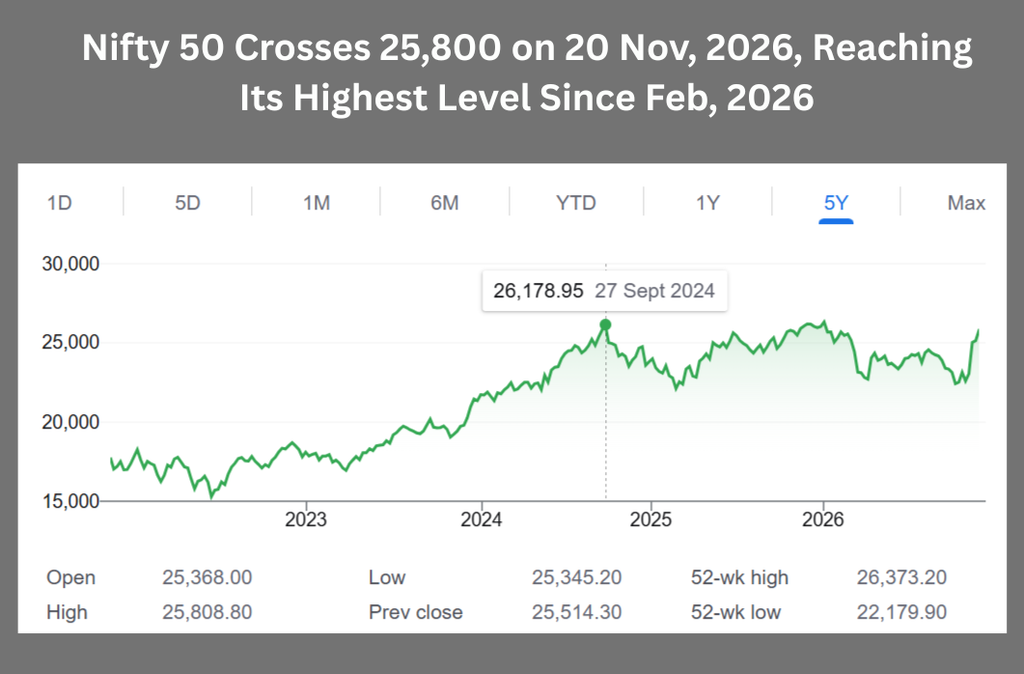
The recovery also indicates an improvement in buying interest following a period of relative weakness.
However, it is important to distinguish between a temporary upward movement and a sustainable market recovery. A durable bullish trend requires support from corporate earnings growth, improving economic indicators, reasonable valuations and consistent domestic and foreign investment flows.
Investors should therefore monitor market breadth, trading volumes, corporate earnings announcements and institutional investment patterns rather than relying exclusively on benchmark index movements.
Indian Rupee Poised for Unprecedented Monthly Gains in Eight Years
The Indian rupee appreciated for the fifth consecutive trading session on Friday, supported partly by strong FPI inflows into domestic equities. It settled at ₹92.68 against the US dollar on Friday, from 94.96 per dollar at the end of October.
Currency movements are an important component of India’s broader financial market dynamics.
A stronger rupee can help moderate the cost of imported commodities, particularly crude oil, thereby potentially reducing imported inflationary pressures. It may also improve sentiment towards Indian financial assets among international investors.
However, the relationship between currency appreciation and foreign investment flows is not always straightforward. Interest rate differentials, international capital movements, trade balances, crude oil prices and global dollar strength also influence the exchange rate.
For an economy that imports a substantial proportion of its crude oil requirements, currency stability is particularly important. A combination of relatively stable crude prices and a stronger rupee can provide some relief to India’s import bill and inflation outlook.
Manufacturing: The Long-Term Growth Imperative
Beyond financial market developments, India’s manufacturing ambitions remain central to its long-term economic transformation.
S. Mahendra Dev, Chairman of the Economic Advisory Council to the Prime Minister (EAC-PM), has emphasized the need to increase manufacturing’s contribution to India’s GDP to 25% by 2047, compared with the present estimated level of around 16–17%.
This objective reflects the importance of strengthening India’s productive capacity as it moves towards its centenary of independence.
A stronger manufacturing sector can generate employment, enhance technological capabilities, improve export competitiveness and reduce dependence on imported goods.
Initiatives relating to infrastructure development, domestic production, industrial corridors, logistics improvement and manufacturing incentives can contribute to this transformation.
However, achieving the 25% target will require sustained improvements in productivity, technological innovation, skill development, access to capital and ease of doing business.
Manufacturing development also has important implications for the equity market. Companies operating in capital goods, engineering, automobiles, industrial technology, electronics and related sectors may benefit from long-term investment in domestic production capacity.
Thus, India’s manufacturing ambitions represent not merely an economic policy objective but also a potential source of structural investment opportunities.
Global Currency and Commodity Markets: Important External Variables
Despite the improving outlook for Indian equities, global financial market developments continue to influence domestic investment sentiment.
As of 20 November 2026, December 2026 US Dollar Index futures (DXZ6) settle at 103.58, down 0.08% from 19 November. Movements in the dollar index are important because a stronger US dollar can influence emerging-market capital flows, commodity prices, and currency stability.
The commodity market also witnessed significant price movements. On the other hand, Brent crude oil price was approximately $91.60 per barrel, while COMEX gold stood at $3,570 per ounce and silver at $42.67 per ounce, as of 20th November.
Gold and silver prices declined following hawkish comments from the US Federal Reserve, alongside a strengthening US dollar.
A hawkish monetary policy stance generally indicates that interest rates may remain elevated for longer than previously anticipated. Higher interest rates can increase the opportunity cost of holding non-interest-bearing assets such as gold and silver.
Consequently, precious metals may come under downward pressure as expectations of higher US interest rates strengthen.
For India, these global developments have multiple implications. Higher crude oil prices can increase the import bill and put pressure on inflation and the current account balance. At the same time, fluctuations in gold and silver prices can influence domestic investment preferences and commodity-linked businesses.
Investors should therefore closely monitor global monetary policy, dollar movements, and commodity-price trends while evaluating the outlook for Indian financial markets.
What Should Investors Focus on Going Forward?
The Nifty 50’s sharp recovery and its recent move to cross the 25,800 mark have created an interesting situation for market participants. The changing market dynamics have also left many investors and traders reassessing their investment strategies. Just two months ago, large-cap stocks were relatively underperforming. However, a sudden surge in Foreign Portfolio Investor (FPI) inflows has renewed interest in large-cap companies, accompanied by sustained buying across sectors such as financial services, telecommunications, automobiles and auto components, consumer services, and information technology.
These developments provide reasons for cautious optimism. However, investors must distinguish between short-term market momentum and sustainable long-term growth.
First, focus on corporate earnings rather than relying solely on optimistic brokerage projections. Sustainable market appreciation ultimately depends on consistent earnings growth, business profitability and healthy cash-flow generation. Brokerage targets may influence market sentiment, but actual corporate performance remains the fundamental driver of long-term returns.
Second, evaluate sectoral opportunities carefully. Financial services, telecommunications, automobiles, consumer services and information technology may offer attractive long-term growth prospects. However, investment decisions should be guided by valuations, company-specific fundamentals, earnings visibility and business sustainability rather than sectoral popularity alone.
Third, maintain an appropriate asset allocation. Equity investments should be aligned with individual financial goals, investment horizons and risk tolerance. Short-term market movements should not dictate long-term financial decisions. A disciplined asset allocation strategy helps investors navigate market fluctuations without compromising their financial objectives.
Fourth, diversification remains essential. Concentrating investments in a limited number of stocks or sectors can expose portfolios to unnecessary risks, particularly during periods of heightened market volatility. Diversification across asset classes, sectors and investment categories can help manage portfolio risk.
Finally, investors approaching retirement or already in retirement should prioritise capital preservation, adequate liquidity and a sustainable retirement income strategy. Rather than attempting to maximise returns through excessive equity exposure, they should focus on protecting their accumulated wealth and ensuring that their investments can support their financial needs over the long term.
Conclusion
The developments observed in November 2026 indicate a potentially significant phase for Indian financial markets. Positive global brokerage projections, substantial FPI inflows, renewed strength in benchmark indices and improving currency sentiment are contributing to a more constructive investment environment.
At the same time, India’s long-term economic prospects remain closely linked to manufacturing expansion, infrastructure development, technological progress, rising domestic consumption and sustained corporate earnings growth.
Nevertheless, financial markets rarely move in a straight line. Global monetary policy, geopolitical uncertainties, crude oil prices, currency fluctuations and corporate earnings performance could influence market direction in the coming months.
The broader message for investors is clear: optimism must be accompanied by discipline, patience and informed decision-making.
For long-term wealth creation, the objective should not be to predict every market movement but to participate in India’s growth story through appropriate asset allocation, diversification and a well-defined investment strategy.
Ultimately, successful investing is not about timing every market movement; it is about staying invested with discipline, managing risk prudently and remaining aligned with long-term financial goals.
Disclaimer: This article is intended solely for educational and informational purposes and does not constitute investment advice or a recommendation to buy or sell any financial instrument. Market data and views are based on publicly available information and have not been independently verified. Readers should consult their financial advisers before making investment decisions. Investments are subject to market risks.
CMA (Dr.) R. K. Mohapatra is a former General Manager (Finance) of IRCON International Ltd., a practising Cost Accountant, author and Founder of NextZen Wealth.