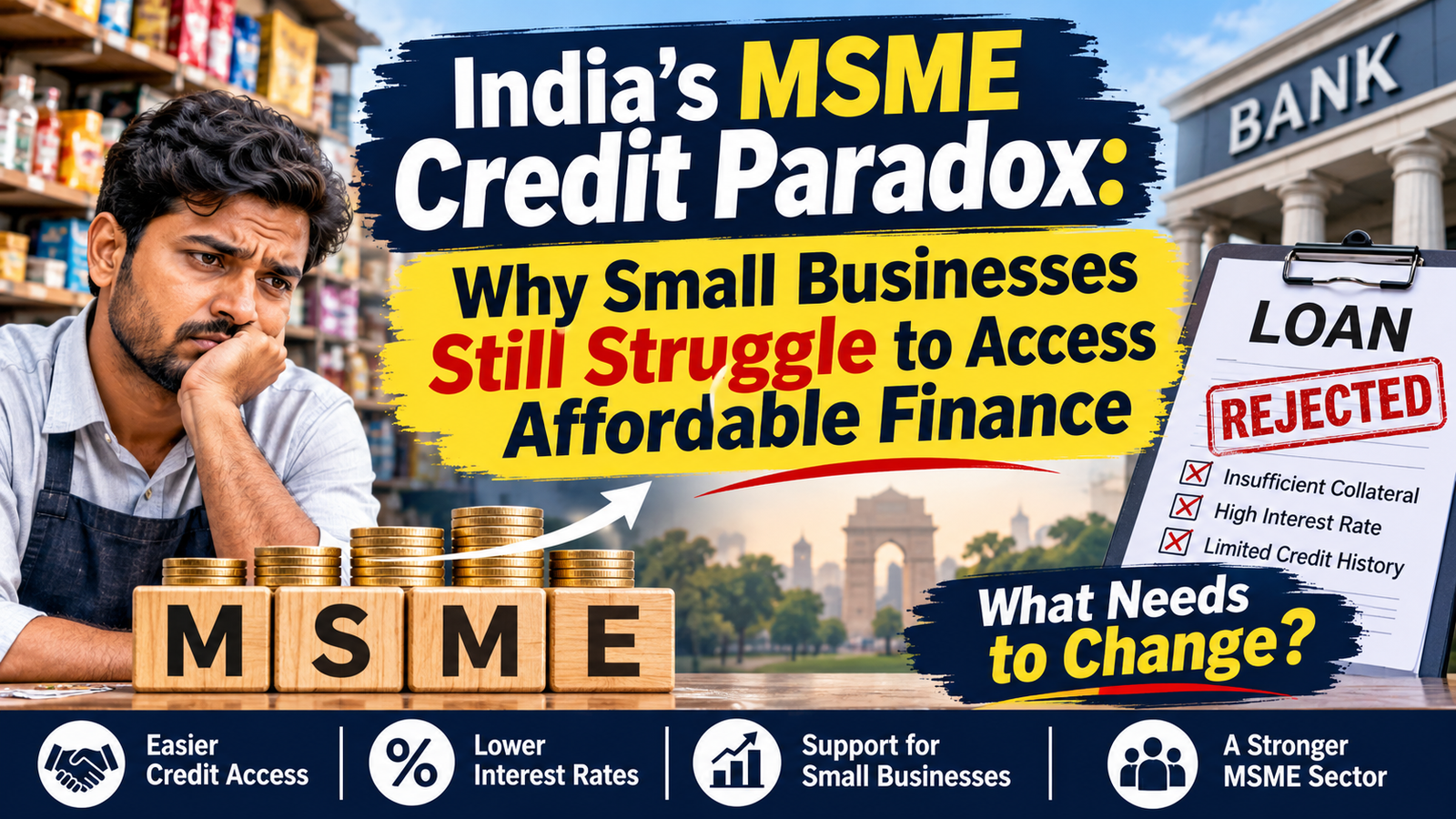
India’s MSME sector is a major contributor to employment, manufacturing and economic development. Yet, despite expanding formal credit channels and government-backed financing initiatives, access to affordable finance remains a persistent challenge.
Introduction: The Backbone of the Economy, but Not Always of the Banking System
Micro, Small and Medium Enterprises (MSMEs) are widely recognised as the backbone of the Indian economy. From neighbourhood retailers and small manufacturers to emerging startups and service providers, these enterprises contribute significantly to production, exports, employment and entrepreneurship.
However, behind their economic contribution lies a persistent financial challenge: businesses that need capital to grow are often the ones that struggle most to obtain it.
A small manufacturer may have confirmed customer orders but insufficient working capital to purchase raw materials. A retailer may want to expand operations but lack acceptable collateral. A service-based enterprise may generate consistent revenue but struggle to demonstrate sufficient financial documentation to secure a formal loan.
This creates an economic paradox. India wants its MSMEs to expand, invest and generate employment, but many continue to face barriers in accessing the finance required to achieve these objectives.
The issue is no longer simply whether credit is available. It is whether the right businesses can access sufficient credit, at an affordable cost, when they actually need it.
1. India’s MSME Credit Gap: Understanding the Numbers
According to SIDBI’s report Understanding Indian MSME Sector: Progress and Challenges, published in May 2025, India’s addressable MSME credit gap was estimated at approximately ₹30 lakh crore, representing around 24% of the sector’s estimated credit demand.
The report, prepared with CRISIL Intelligence and based on a survey of 2,097 MSMEs across 19 sectors, highlights the difference between the financing businesses require and the formal credit available to them.
The findings also reveal that access to credit is uneven. Approximately 17% of surveyed enterprises had not availed any credit, while 8% relied on informal sources.
Micro enterprises faced greater difficulties than larger businesses, with approximately 12% reporting informal borrowing compared with 3% of small enterprises and 2% of medium enterprises.
These findings indicate that expanding bank lending alone may not be sufficient. The challenge is also about reaching enterprises that remain outside the formal financial system.
2. Why Banks Hesitate to Finance Small Businesses
Access to finance is influenced by how lenders evaluate risk. Banks must assess repayment capacity, business stability, credit history and the availability of supporting documentation before approving loans.
For many small businesses, these requirements become significant obstacles.
Limited financial documentation: Many micro enterprises maintain incomplete accounting records, have irregular financial statements or do not consistently separate personal and business transactions. This makes it difficult for lenders to assess their actual financial position.
Insufficient collateral: Small businesses often lack property or other acceptable assets to offer as security. Even viable enterprises may therefore struggle to qualify for traditional secured lending.
Limited credit history: Newly established businesses may have no previous borrowing record. Without an established credit profile, lenders can find it difficult to assess their creditworthiness.
Perceived lending risk: Smaller enterprises may operate in competitive markets, experience seasonal revenue fluctuations and depend on a limited number of customers. These factors can increase perceived lending risk.
Consequently, a business with genuine growth potential may find itself financially constrained because it cannot satisfy conventional lending requirements.
3. The Cost of Credit: When Borrowing Becomes Expensive
Getting a loan is only one part of the problem. The cost of borrowing can be equally challenging.
ICRIER’s Annual Survey of MSMEs in India 2025 found that the average interest rate reported by surveyed MSMEs was approximately 12.27%, while micro enterprises faced an average of around 12.53%.
The survey also found that nearly 70% of respondents identified high interest rates as their primary concern when applying for loans. Payment terms and lengthy approval processes were additional concerns.
For a small enterprise operating on limited margins, even a modest increase in borrowing costs can affect profitability.
Consider a manufacturer borrowing ₹10 lakh to finance inventory and daily operations. At an annual interest rate of 12%, the approximate annual interest cost would be ₹1.2 lakh, assuming the full principal remains outstanding.
For businesses operating with narrow profit margins, this expense can reduce funds available for expansion, employee salaries, technology upgrades and other productive investments.
The problem becomes particularly serious when businesses are forced to depend on expensive informal borrowing because formal finance is unavailable or too slow.
4. The Working Capital Problem: Profitable Businesses Can Still Face Cash Shortages
One of the most overlooked financial challenges for MSMEs is working capital management.
A business may generate revenue and report profits but still experience cash-flow difficulties because payments from customers are delayed.
For example, a small manufacturing unit may supply products to a large corporate buyer on 60-day payment terms. During this period, the manufacturer must continue paying employees, purchasing raw materials, covering electricity expenses and meeting other operating costs.
The result is a mismatch between cash inflows and cash outflows.
This is particularly difficult for businesses that depend on a small number of customers or operate with limited financial reserves.
Delayed payments can create a chain reaction:
- Suppliers demand faster payments.
- Businesses increase short-term borrowing.
- Interest expenses rise.
- Investment and expansion plans are postponed.
- Employment generation becomes difficult.
Therefore, access to working capital is not merely a banking issue. It is closely connected to payment discipline across the business ecosystem.
5. Government Initiatives: Is the Credit Environment Improving?
Recognising the importance of MSME financing, the government and the Reserve Bank of India have introduced several measures to improve formal credit access.
Some important initiatives include:
Collateral-free lending: Under the RBI’s amended MSME lending directions issued on 9 February 2026, banks are mandated not to accept collateral security for loans up to ₹20 lakh extended to Micro and Small Enterprises. The revised directions became effective from 1 April 2026. Banks may also increase this limit to ₹25 lakh for eligible enterprises with a good track record and financial position, according to their internal policies.
Credit Guarantee Scheme: Credit guarantee mechanisms help reduce the lending risk faced by financial institutions by providing eligible guarantees against covered credit facilities.
Prime Minister’s Employment Generation Programme (PMEGP): This programme supports eligible entrepreneurs in establishing new micro-enterprises through a combination of bank finance and government subsidy.
Trade Receivables Discounting System (TReDS): TReDS provides a digital platform through which MSMEs can obtain financing against eligible trade receivables, helping address delayed payment challenges.
Priority Sector Lending: RBI’s priority-sector framework requires banks to direct a prescribed share of their lending towards identified sectors, including eligible MSME activities.
These initiatives represent important steps towards improving financial inclusion. However, the effectiveness of such policies depends on awareness, implementation, timely loan processing and the willingness of financial institutions to reach smaller enterprises.
6. Digital Finance: A New Opportunity for MSME Lending
Digitalisation is gradually changing the way financial institutions evaluate small businesses.
Traditional lending often depends heavily on collateral and historical financial statements. However, digital business transactions can provide additional information about an enterprise’s financial health.
GST returns, bank transaction histories, digital invoices, payment records and account aggregation can help lenders assess cash flows and repayment capacity.
Alternative credit assessment models can potentially make lending more accessible to businesses that lack extensive borrowing histories.
Fintech companies and non-banking financial companies (NBFCs) are also expanding their presence in the MSME financing ecosystem.
However, digital lending must be supported by transparent pricing, responsible credit assessment, data protection and appropriate borrower safeguards. Faster loan approval should not come at the cost of excessive borrowing or unsuitable financial products.
7. What Needs to Change?
Reducing India’s MSME credit gap requires more than increasing the overall volume of bank lending. The financial system must become better equipped to understand the specific requirements of smaller enterprises.
Some important priorities include:
- Cash-flow-based lending: Greater use of verified business cash flows rather than relying exclusively on physical collateral.
- Faster loan processing: Simplifying documentation and reducing unnecessary delays in credit approval.
- Affordable finance: Improving competition and designing suitable loan products for micro and small enterprises.
- Financial literacy: Encouraging proper bookkeeping, timely GST compliance, financial planning and responsible borrowing.
- Stronger payment discipline: Ensuring timely settlement of MSME invoices to reduce working capital pressure.
- Better digital infrastructure: Expanding access to digital financial records and responsible alternative credit assessment.
Banks, NBFCs, fintech platforms and government institutions must work together to create a financing environment that recognises the actual business potential of smaller enterprises.
Conclusion: Credit Must Reach the Businesses That Need It Most
India’s MSME sector has considerable potential to support industrial development, entrepreneurship and employment generation. However, that potential cannot be fully realised if financially viable enterprises remain constrained by inadequate or expensive credit.
The estimated ₹30 lakh crore addressable credit gap highlights the scale of the challenge. Government-backed guarantees, collateral-free lending provisions and digital financing platforms are important developments, but the broader objective must be to make formal finance accessible, affordable and timely.
A small business should not have to struggle to obtain working capital simply because it lacks the financial scale of a large corporation.
Ultimately, the success of India’s MSME financing ecosystem should not be measured only by the growth of bank credit. It should also be measured by how effectively finance reaches first-time borrowers, small entrepreneurs and businesses with genuine potential to grow.
India’s next phase of economic development will depend not only on how much capital its financial system generates, but also on how effectively that capital reaches the enterprises capable of creating jobs, supporting communities and strengthening the economy.