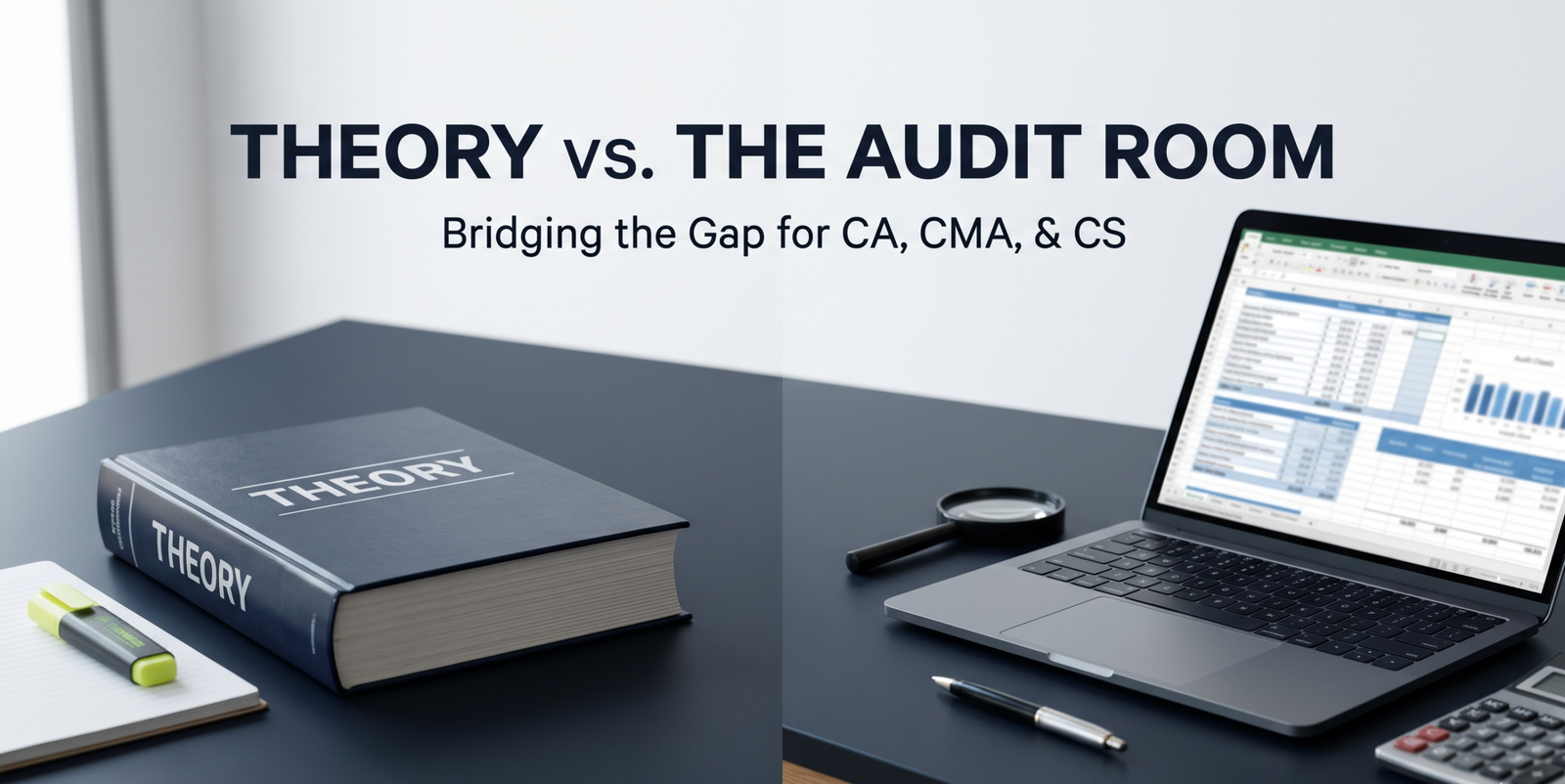
Every year, thousands of bright commerce graduates and professional aspirants—pursuing Chartered Accountancy (CA), Cost and Management Accountancy (CMA), and Company Secretaryship (CS)—clear rigorous exams with flying colors. They can effortlessly pass complex journal entries for share forfeitures, compute marginal cost variances to the second decimal, and recite statutory sections verbatim. Yet, the moment these newly minted professionals step into an actual audit room or sit across from a client’s ERP terminal, a quiet panic sets in.
In the examination hall, problems are neatly packaged. Opening balances match, adjustments are explicitly listed at the bottom of the question paper, and every transaction fits cleanly into a theoretical framework. In the real world of Indian statutory audits, taxation, and corporate compliances, ledgers are messy, invoices go missing, and regulatory notifications change the rules of engagement overnight.
Drawing from years of experience across statutory audits, tax advisory, and mentoring hundreds of CA, CMA, and CS aspirants, one truth stands out: textbook accounting teaches you how transactions should look, while practical auditing trains you to survive how they actually happen.
1. The Illusion of the “Balanced” Trial Balance
In textbooks, a tallied Trial Balance is treated as the finish line. In an audit room, a tallied Trial Balance is merely the starting point of scrutiny.
Consider how accounting software operates today. Under Ministry of Corporate Affairs (MCA) Notification No. G.S.R. 206(E) dated March 24, 2021 (and subsequent amendment G.S.R. 235(E) making it mandatory from April 1, 2023), Rule 11(g) of the Companies (Audit and Auditors) Rules, 2014 requires statutory auditors to report whether a company has used accounting software with an active, tamper-proof Audit Trail (Edit Log) facility throughout the year.
In classroom problems, a backdated entry or a rectified voucher is just a neat red-ink correction. On a live Tally Prime or ERP server, an unlogged edit or a disabled audit trail triggers a direct qualification in the Independent Auditor’s Report. Students who only focus on debit-and-credit rules often miss the IT general controls, user-access logs, and database timestamps that now govern statutory compliance.
2. GST Input Tax Credit: Possession vs. Portal Reality
Ask a student when a business can claim Input Tax Credit (ITC) under the Goods and Services Tax (GST) regime, and they will rightly list the four primary conditions under Section 16(2) of the CGST Act, 2017: possession of a tax invoice, receipt of goods or services, payment of tax to the government, and filing of returns.
However, in live practice, the game-changer has been Section 16(2)(aa), introduced via the Finance Act, 2021 and notified effective January 1, 2022, vide CBIC Notification No. 39/2021–Central Tax (dated December 21, 2021). This clause strictly mandates that ITC cannot be availed unless the supplier furnishes the invoice details in their Form GSTR-1 and it reflects in the recipient’s auto-populated Form GSTR-2B.
In the audit room, a valid tax invoice sitting in a physical file is worthless if the vendor defaulted on filing GSTR-1. Practical taxation is no longer just about computing tax rates; it is about monthly GSTR-2B vs. Purchase Register reconciliations, tracking vendor compliance, reversing ineligible credits under Rule 42/43, and drafting replies to departmental scrutiny notices (ASMT-10) when minor GSTIN typos block legitimate working capital.
3. Income Tax Finalization: When Accrual Accounting Meets Statutory Deadlines
From Class 11 Commerce onward, students are taught the fundamental Accrual Concept—expenses are recorded when incurred, regardless of when cash is paid. Yet, during Tax Audit finalization (Form 3CD), blind adherence to accrual accounting without checking statutory overrides can lead to massive tax disallowances.
A prime example is Section 43B(h) of the Income Tax Act, 1961, inserted by the Finance Act, 2023 (effective from Assessment Year 2024–25 onward). Linking income tax deductions directly to Section 15 of the MSMED Act, 2006, this provision mandates that any sum payable to a registered Micro or Small enterprise beyond 15 days (where no written agreement exists) or 45 days (where a written agreement exists) is disallowed as an expense in that financial year if it remains unpaid as of March 31. Unlike other Section 43B items, paying the vendor before the ITR filing due date does not save the deduction.
When an aspirant audits a client’s sundry creditors list in March, textbook accounting sees a routine trade payable. A seasoned auditor immediately cross-verifies every vendor’s Udyam Registration Certificate, checks whether the vendor is a manufacturer/service provider versus a trader, calculates exact credit days from the date of acceptance, and flags unpaid invoices for disallowance under Clause 22 of Form 3CD.
4. ROC & MCA Compliances: Beyond Balance Sheet Numbers
For CA, CMA, and CS students, Corporate Law and Financial Accounting are often studied in separate silos—one on Monday, the other on Tuesday. In corporate practice, law and accounting are inseparable.
A single board resolution authorizing a related-party transaction, an increase in authorized share capital, or the appointment of a director cascades simultaneously into:
- MCA V3 Portal filings (such as Form AOC-4, MGT-7/7A, DIR-12, or PAS-3) within strict statutory windows to avoid heavy per-day additional fees.
- Companies Act disclosures under Schedule III, requiring granular ageing schedules for trade receivables and payables, analytical ratios with variance explanations exceeding 25%, and CSR expenditure tracking.
- Cost Audit and Cost Record maintenance under Section 148 read with the Companies (Cost Records and Audit) Rules, 2014 (Form CRA-1 to CRA-4) for applicable manufacturing and regulated sectors.
How Aspirants Can Bridge the Gap Today
Passing professional examinations requires conceptual mastery, but thriving in the profession requires practical agility. If you are preparing for your CA, CMA, or CS exams—or stepping into your articleship or practical training—here is how you can bridge the divide early:
- Read Bare Acts Alongside Notifications: Never rely solely on summarized coaching notes. Whenever you study a chapter in Taxation or Corporate Law, look up the latest CBDT, CBIC, or MCA notifications to understand why the government introduced the amendment.
- Master Spreadsheet Reconciliation: In practice, 60% of audit and tax work happens in Excel. Learn
XLOOKUP,SUMIFS, Pivot Tables, and conditional formatting to reconcile 26AS/AIS, GSTR-2B, and ledger dumps efficiently. - Question the Ledger, Not Just the Formula: When practicing case studies, ask yourself: What supporting document proves this entry? Could this expense be disallowed under Section 40(a)(ia) for TDS non-deduction or Section 43B(h) for MSME delay?
- Practice Application-Focused Mock Tests: Shift away from rote-memory questions. Challenge yourself with integrated, multi-step case studies that test how a single business transaction impacts accounting entries, GST liability, TDS compliance, and board reporting all at once.
The transition from an exam hall to an audit room does not have to be overwhelming. Textbooks give you the compass, and statutory notifications draw the map—but it is practical curiosity that teaches you how to navigate the terrain.
Author Bio:
CMA Vivek Kumar is a qualified Cost and Management Accountant (ACMA) and B.Com (Accounting Honours) graduate with extensive experience in statutory and tax audits, direct and indirect taxation, and ROC/MCA corporate compliances. Alongside his practice, he mentors CA, CMA, and CS aspirants and designs exam-oriented test series to bridge practical industry expertise with academic preparation.