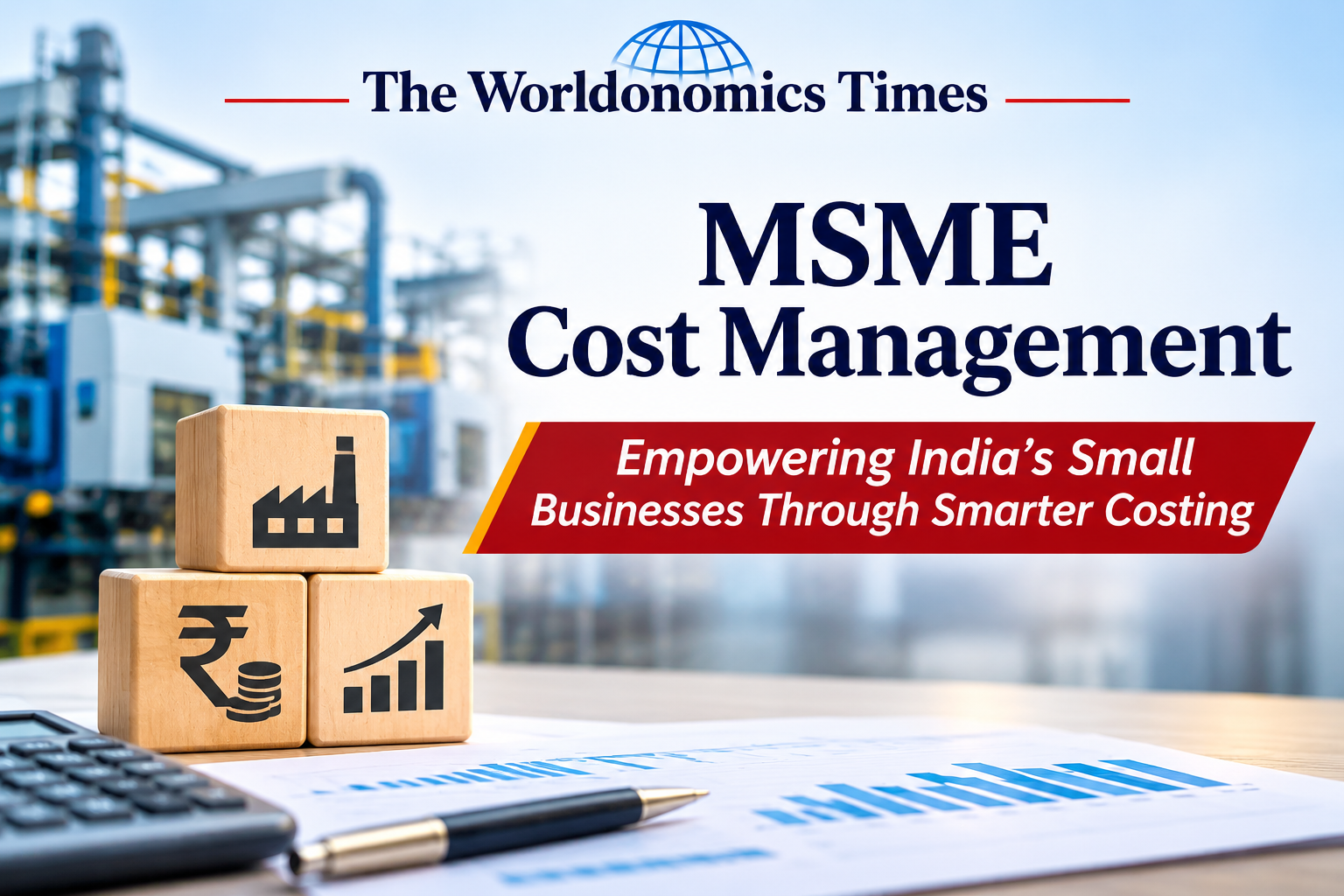
Empowering India’s Small Businesses Through Smarter Costing
How Strategic Cost Management Can Improve MSME Profitability, Productivity and Global Competitiveness
Introduction
Micro, Small and Medium Enterprises (MSMEs) are among the most important pillars of India’s economic development. They contribute significantly to manufacturing, exports, employment generation, entrepreneurship and regional industrial growth. From small manufacturing units and trading businesses to technology startups and service providers, MSMEs play a vital role in strengthening India’s economic foundation.
However, operating a small business in an increasingly competitive environment is not easy. Rising raw material prices, increasing labour costs, transportation expenses, energy charges, financing costs and changing customer expectations continuously affect business profitability.
While entrepreneurs often concentrate on increasing sales and acquiring new customers, one equally important factor deserves greater attention: scientific cost management.
Smarter costing can help MSMEs understand their actual expenses, improve pricing decisions, reduce wastage, increase profitability and build sustainable businesses.
1. Understanding the Importance of Cost Management
Many small businesses operate with limited financial and managerial resources. In several cases, business owners determine product prices by observing competitors or adding an estimated margin to purchase costs.
Such an approach may create problems because the actual cost of a product includes much more than raw materials or direct labour.
Indirect expenses such as electricity, rent, depreciation, administrative salaries, packaging, transportation, financing and maintenance must also be considered.
Without a proper costing system, an entrepreneur may believe that a product is profitable even when its actual contribution to the business is very low.
Scientific cost management provides a clear understanding of the resources consumed in producing goods or delivering services. It enables entrepreneurs to identify profitable products, eliminate unnecessary expenditure and make informed business decisions.
2. Product-Wise Costing: The Foundation of Better Decisions
One of the biggest challenges for MSMEs is understanding the profitability of individual products and services.
Consider a small manufacturing enterprise producing three different products. Although all three products generate sales revenue, their consumption of materials, labour hours, electricity and machine capacity may differ considerably.
A product with higher sales may not necessarily generate the highest profit.
Product-wise costing helps businesses determine:
- Actual manufacturing cost.
- Direct and indirect material consumption.
- Labour and machine-hour costs.
- Factory and administrative overheads.
- Product-wise contribution and profitability.
- Appropriate selling prices.
Techniques such as job costing, process costing, standard costing and activity-based costing can be adopted according to the nature and size of the enterprise.
Even a simple spreadsheet-based costing system can provide valuable information to a small entrepreneur.
3. Cost Reduction vs Cost Control: Finding the Right Balance
Cost reduction and cost control are often used interchangeably, but they represent different management approaches.
Cost control focuses on monitoring expenditure against predetermined budgets, standards and targets. Cost reduction aims to achieve a genuine and sustainable decrease in costs without compromising quality or performance.
For MSMEs, both are essential.
For example, reducing employee training expenditure may provide temporary savings but could affect productivity and quality. In contrast, improving machine utilisation, reducing material wastage and optimising inventory can create sustainable cost advantages.
Entrepreneurs should focus on eliminating non-value-adding activities rather than simply cutting expenditure.
The objective should be to produce better products at competitive costs while maintaining customer satisfaction.
4. Inventory and Working Capital Management
Inventory management is another critical area where MSMEs frequently face challenges.
Excessive inventory blocks working capital, increases storage expenses and creates the risk of deterioration or obsolescence. On the other hand, insufficient inventory may interrupt production and delay customer deliveries.
Scientific inventory management techniques such as Economic Order Quantity (EOQ), ABC Analysis, Reorder Level and Just-in-Time inventory management can improve operational efficiency.
Similarly, monitoring receivables, payables and cash conversion cycles can help entrepreneurs maintain adequate liquidity.
A business may report accounting profits but still experience financial difficulties because its money is blocked in inventory and outstanding customer payments.
Therefore, cost management must be integrated with working capital planning.
5. Digital Transformation and AI in MSME Costing
Technology is creating new opportunities for small businesses to adopt professional management practices at affordable costs.
Cloud-based accounting software, Enterprise Resource Planning (ERP) systems, automated inventory management and data analytics can provide better visibility into business expenditure.
Artificial Intelligence can further support MSMEs by identifying unusual cost variations, analysing purchasing patterns, forecasting material requirements and highlighting operational inefficiencies.
For example, a business can use historical consumption data to estimate future raw material requirements and reduce unnecessary purchases.
Digital dashboards can also help entrepreneurs monitor sales, expenses, gross margins, inventory turnover and product-wise profitability.
The adoption of technology should not be viewed merely as an IT investment. It should be treated as an investment in better business management.
6. The Role of Cost and Management Accountants
Cost and Management Accountants (CMAs) can play a transformative role in strengthening India’s MSME ecosystem.
Their expertise extends beyond cost calculations and compliance. They can assist businesses in developing budgeting systems, conducting profitability analysis, implementing cost control mechanisms, improving operational efficiency and evaluating investment decisions.
A CMA can help an MSME:
- Establish a practical costing system.
- Identify unprofitable products and activities.
- Develop realistic budgets.
- Improve pricing strategies.
- Reduce material and energy wastage.
- Strengthen inventory and working capital management.
- Evaluate business expansion opportunities.
There is significant scope for professional cost management services among small businesses that cannot maintain large finance departments but still require reliable management information.
Professional institutions and industry associations can also encourage greater interaction between CMAs and MSME entrepreneurs through workshops, awareness programmes and industry-specific training.
7. Government Initiatives and the Opportunity for MSMEs
Government initiatives supporting MSME development, digitalisation, market access, financing and technology adoption provide opportunities for small businesses to strengthen their competitiveness.
Programmes associated with the Ministry of MSME, National Small Industries Corporation (NSIC), GeM, ONDC and other institutional platforms can help eligible enterprises improve access to markets and business opportunities.
However, access to schemes and markets alone does not guarantee sustainable growth.
Businesses must also develop internal systems capable of managing larger orders, controlling production expenses, maintaining quality and meeting delivery commitments.
Professional costing and financial management can help MSMEs prepare for this next stage of growth.
8. Building Globally Competitive Indian MSMEs
As India seeks to expand its manufacturing capabilities and strengthen exports, MSMEs must increasingly compete with businesses operating in international markets.
Global competitiveness requires more than low prices. It involves consistent quality, efficient production, reliable delivery, innovation and sustainable operations.
Strategic cost management can help Indian enterprises identify operational advantages, optimise supply chains and improve resource utilisation.
Businesses that understand their costs are better positioned to negotiate with suppliers, respond to market changes and make informed investment decisions.
The objective should be to develop MSMEs that are not merely small businesses but professionally managed, financially sustainable and globally competitive enterprises.
Conclusion: Smarter Costing, Stronger MSMEs, Stronger India
The future of India’s MSME sector will depend not only on access to finance, infrastructure and markets but also on the ability of enterprises to manage their resources efficiently.
Scientific costing must become an integral part of business decision-making rather than an activity undertaken only for accounting or compliance purposes.
Every entrepreneur should understand the actual cost of producing a product, delivering a service and operating a business.
Cost and Management Accountants have an important opportunity to bring professional financial and operational management practices to India’s small business ecosystem.
As India moves towards Viksit Bharat 2047, stronger MSMEs will require smarter management, better technology and greater cost efficiency.
The message for Indian entrepreneurs is simple: Higher sales may grow your business, but smarter costing can make that growth sustainable.
The Worldonomics Times – Connecting Knowledge, Professionals and the Global Economy.