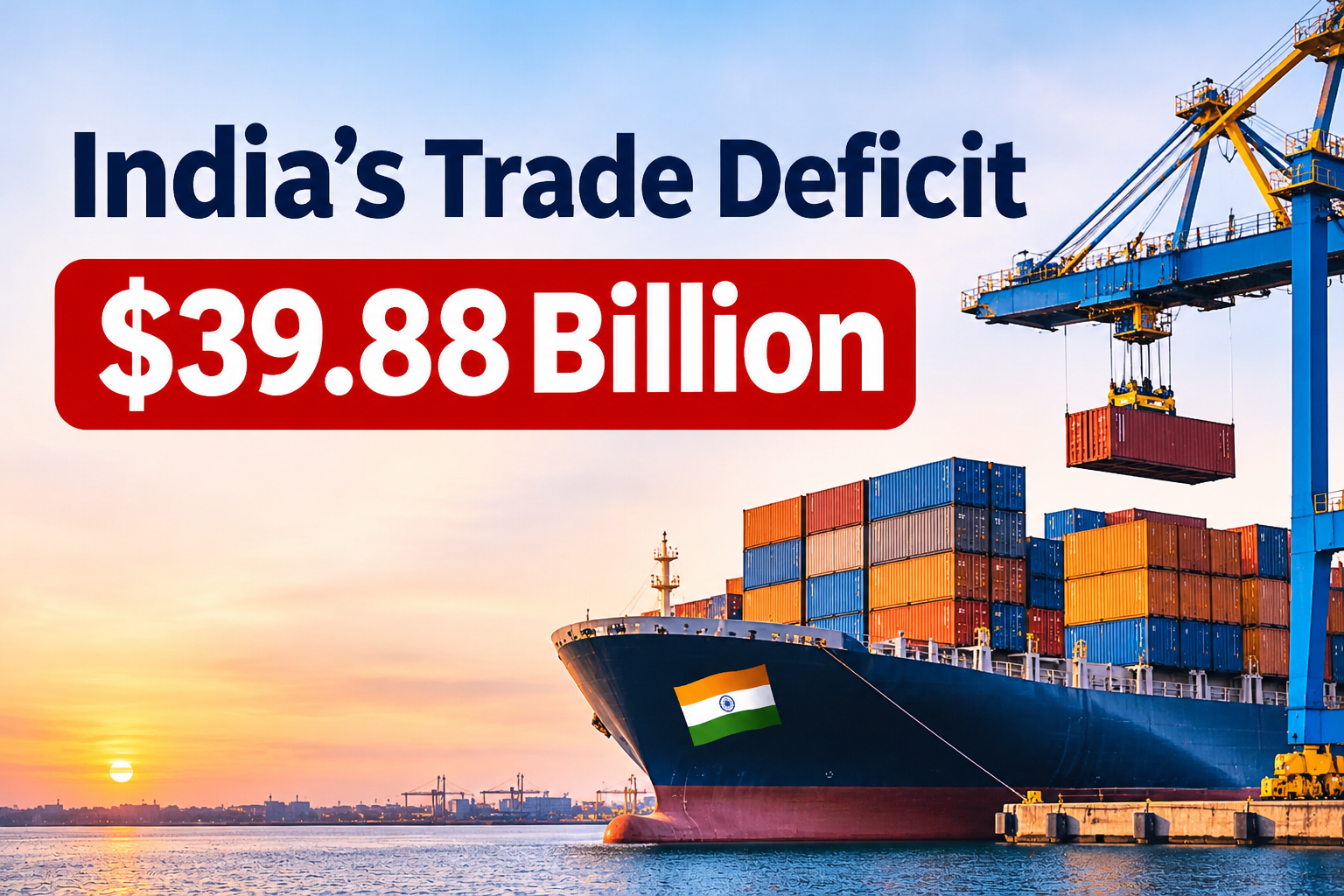
India’s merchandise trade deficit widened to a one-year high of US$39.88 billion in October 2026 as imports surged to US$89.35 billion. Despite record merchandise exports of US$49.47 billion, faster growth in imports increased pressure on India’s external trade balance.
India’s external trade position came under renewed attention after the merchandise trade deficit increased significantly in October 2026. According to data released by the Ministry of Commerce and Industry, the trade deficit widened from US$30.21 billion in September 2026 to US$39.88 billion in October.
The latest figure was also higher than the US$33 billion deficit recorded in October 2025.
The development highlights a key challenge for the Indian economy: maintaining strong export growth while managing the cost of imported energy, commodities and industrial inputs.
Imports Rise Faster Than Exports
India recorded merchandise exports of US$49.47 billion in October 2026, compared with US$44.40 billion in September.
However, merchandise imports increased much faster, reaching US$89.35 billion in October against US$74.61 billion in the previous month.
| Trade indicator | September 2026 | October 2026 |
|---|---|---|
| Merchandise exports | $44.40 bn | $49.47 bn |
| Merchandise imports | $74.61 bn | $89.35 bn |
| Trade deficit | $30.21 bn | $39.88 bn |
Exports increased by approximately 11.4% month-on-month, while imports rose by around 19.7%.
The faster increase in imports explains the widening trade deficit despite record monthly merchandise exports. The Economic Times
Rising Energy Import Costs Add Pressure
India remains heavily dependent on imported crude oil to meet its domestic energy requirements. The country imports nearly 85% of its crude oil consumption, making its external trade position sensitive to international petroleum prices.
Higher crude oil prices, transportation expenses, shipping costs and insurance premiums can increase the country’s overall import bill.
Energy imports also influence the cost structures of several domestic industries, including chemicals, fertilisers, transportation, aviation, manufacturing and logistics.
Any prolonged increase in international energy prices could therefore affect India’s trade balance as well as domestic inflation.
Why the Trade Deficit Matters for the Indian Economy
A widening merchandise trade deficit has several economic implications.
1. Pressure on the Current Account: A higher goods trade deficit can increase pressure on the current account deficit, although services exports and remittance inflows provide important support.
2. Foreign Exchange Demand: Higher imports increase demand for foreign currencies, particularly the US dollar, potentially influencing the rupee’s exchange rate.
3. Inflationary Risks: More expensive imported petroleum, machinery and industrial inputs can increase production and transportation costs.
4. Business Competitiveness: Export-oriented businesses may face pressure if imported raw materials and energy become more expensive.
5. Foreign Exchange Reserves: Persistent external-sector pressure can influence foreign exchange management and capital-flow requirements.
India’s Export Performance Provides Some Relief
Despite the widening trade deficit, India’s export performance remained encouraging.
Merchandise exports reached a record US$49.47 billion in October 2026. Engineering goods, electronics, petroleum products and other manufactured products contributed to the increase.
Services exports also remain an important source of foreign exchange earnings.
India’s expanding services sector, particularly information technology, consulting, financial services and professional services, helps offset part of the merchandise trade deficit.
Government Focus on Trade Diversification
India has been pursuing trade agreements and market-access initiatives to strengthen its international trade position.
Recent trade initiatives involving the United Kingdom, New Zealand, the European Union and the United States are aimed at expanding export opportunities and improving India’s participation in global supply chains.
Diversifying export destinations can help Indian businesses reduce excessive dependence on individual markets.
The government is also focusing on manufacturing expansion, logistics infrastructure, production competitiveness and MSME participation in international trade.
Impact on Indian MSMEs
A widening trade deficit is not necessarily negative for every business sector. Imports of machinery, technology and industrial inputs can support domestic production and future export capacity.
However, MSMEs dependent on imported raw materials, petroleum products and specialised components may face higher operating expenses.
Export-oriented MSMEs need to focus on productivity, product quality, cost management and market diversification to remain competitive.
Improved access to export finance, international buyers and trade facilitation services will also be important.
Outlook: Can India Balance Import Growth and Exports?
The coming months will be important in determining whether India’s merchandise trade deficit remains elevated.
International crude oil prices, domestic demand, industrial production, gold imports, shipping costs and global trade conditions will influence the country’s import bill.
The Reserve Bank of India has also highlighted the importance of monitoring external-sector risks, including energy prices and global trade uncertainty.
The broader trade position should be assessed by considering merchandise trade alongside services exports, remittances and capital flows.
Conclusion
India’s merchandise trade deficit reaching US$39.88 billion in October 2026 highlights the challenge of balancing import requirements with export competitiveness.
Although record merchandise exports provide encouraging momentum, the faster growth in imports underlines the importance of strengthening domestic manufacturing, reducing critical import dependencies and expanding high-value exports.
For India, the long-term objective will be to build a globally competitive economy with stronger manufacturing capabilities, diversified export markets and sustainable external-sector stability.
Source: Ministry of Commerce and Industry, Government of India; The Economic Times.
The Worldonomics Times | Economics & Global Trade