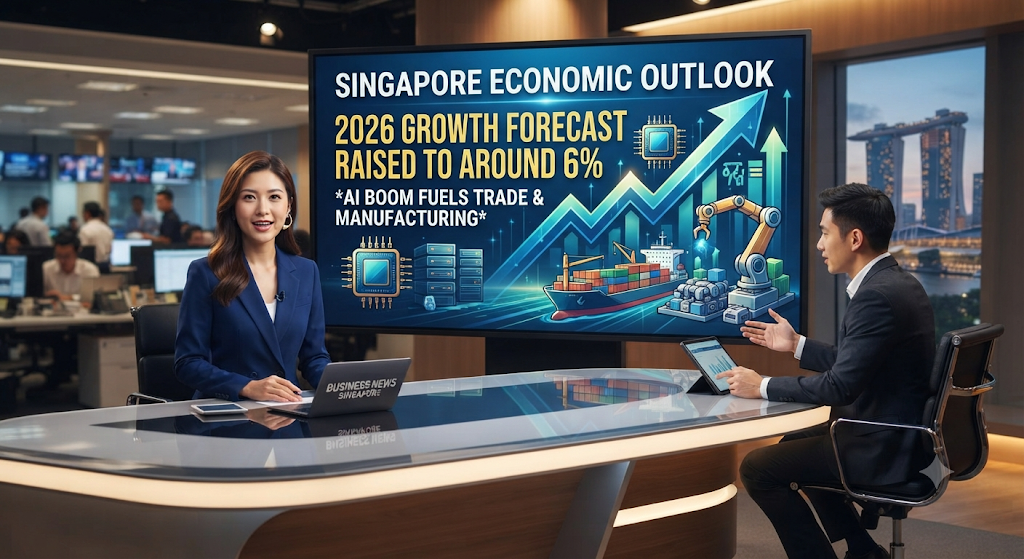
Strong global demand for artificial intelligence-related electronics, specialised machinery and data centre investments drives Singapore’s economic outlook, while challenges remain in consumer-facing sectors.
SINGAPORE | 24 November 2026
Singapore has upgraded its economic growth forecast for 2026 to around 6%, reflecting stronger-than-expected economic performance and increasing global demand for artificial intelligence (AI)-related products and services. The upward revision highlights the country’s growing position as a major international trade, technology and financial hub, supported by robust manufacturing activity, expanding exports and rising investments in digital infrastructure.
According to Singapore’s Ministry of Energy, Trade and Industry (METI), the country’s gross domestic product (GDP) expanded by 6.1% year-on-year in the third quarter of 2026. Although this represented a slight moderation from the 6.4% growth recorded in the second quarter, the performance exceeded earlier expectations and prompted the government to revise its full-year economic outlook.
The revised forecast of approximately 6% is an improvement over the previous projection of 4.5% to 5.5% announced in August. The latest figures demonstrate the resilience of Singapore’s export-oriented economy amid an evolving global economic environment.
AI Demand Emerges as a Major Growth Driver
One of the most significant contributors to Singapore’s economic expansion has been the accelerating global demand for AI-related technologies. The rapid development of artificial intelligence applications worldwide has increased demand for semiconductors, electronic components, specialised machinery and advanced computing infrastructure.
Singapore’s manufacturing and wholesale trade sectors have benefited considerably from this trend. The electronics and precision engineering manufacturing clusters have recorded stronger activity, supported by international demand for technology-related products.
The expansion of data centres has also emerged as an important contributor to economic momentum. As businesses and governments invest in digital transformation, cloud computing and AI infrastructure, the demand for specialised equipment and advanced technological components continues to increase.
Singapore’s strategic location, established infrastructure, skilled workforce and business-friendly environment have helped it attract investments connected to these expanding industries.
The wholesale trade sector has also recorded significant growth, particularly in machinery, equipment, telecommunications products, computers and electronic components. These developments underline the importance of international supply chains in supporting Singapore’s economic performance.
Manufacturing and Trade Strengthen Economic Performance
The manufacturing sector remains a central pillar of Singapore’s economic growth. During the third quarter, manufacturing activity benefited from improved performance across electronics, precision engineering, transport engineering and general manufacturing.
The wholesale trade, manufacturing, and finance and insurance sectors were among the principal contributors to the country’s third-quarter expansion.
Singapore’s ability to participate in high-value global supply chains has strengthened its position in international commerce. Its advanced port infrastructure, financial ecosystem and connectivity with major Asian markets continue to provide advantages for businesses operating across borders.
Enterprise Singapore has also raised its forecast for non-oil domestic exports (NODX) growth in 2026 to between 30% and 32%, reflecting particularly strong demand for electronics and specialised machinery.
This improvement indicates that Singapore’s economic momentum is not limited to domestic activity but is also closely linked to international investment cycles and technology-driven global trade.
Consumer-Facing Industries Continue to Face Challenges
Despite the positive economic outlook, not all sectors are experiencing similar growth.
Retail trade and food and beverage services have faced comparatively weaker conditions. Both sectors contracted during the third quarter, partly reflecting a sustained shift in local spending towards overseas travel and consumption.
This uneven economic performance highlights an important distinction between Singapore’s internationally oriented industries and businesses that depend primarily on domestic consumer demand.
While technology, manufacturing and wholesale trade are benefiting from global investment, smaller retailers, restaurants and consumer-facing businesses continue to face a more challenging operating environment.
Elevated energy prices and global inflationary pressures also remain concerns for businesses. Higher operating costs, changing consumer behaviour and uncertainty in international markets could affect profitability across several industries.
What Lies Ahead for Singapore’s Economy?
Looking towards 2027, the government expects economic growth to moderate to between 2.5% and 4.5%.
The anticipated slowdown reflects expectations that global AI investment will expand at a slower pace after its strong performance in 2026. Growth among several of Singapore’s major trading partners is also expected to soften.
Nevertheless, the outlook for technology-related industries remains relatively encouraging. Electronics manufacturing, precision engineering, specialised machinery and information and communications services are expected to benefit from continuing demand for AI applications and digital transformation.
The aerospace industry may also provide additional growth opportunities through capacity expansion and aircraft maintenance, repair and overhaul activities.
For Singapore, the key challenge will be maintaining economic competitiveness while managing external uncertainties and ensuring that the benefits of technology-driven growth reach a wider range of businesses and workers.
The Worldonomis Times View
Singapore’s upgraded economic growth forecast is an encouraging indication of how countries can benefit from emerging global technology trends when supported by strong infrastructure, effective economic policies and international business connectivity.
The country’s growing involvement in AI-related manufacturing, electronics, specialised machinery and data centre infrastructure demonstrates the importance of adapting to changing global demand. Singapore’s success also reinforces its position as a strategic destination for international investors and companies seeking access to Asian markets.
However, headline GDP growth should not be viewed as the only measure of economic success. The contrasting performance of technology-driven industries and consumer-facing businesses suggests that the benefits of economic expansion are not necessarily distributed evenly.
Going forward, Singapore must continue investing in workforce development, innovation, digital capabilities and support for small and medium-sized enterprises. Strengthening domestic consumption and improving productivity across traditional industries will also be essential.
The expected moderation in 2027 should not be interpreted as a sign of economic weakness but as a reminder that technology-led investment cycles can fluctuate. Sustainable growth will depend on the country’s ability to diversify its economic strengths beyond the current AI boom.
The Worldonomis Times believes that Singapore’s next phase of economic success will depend not only on its ability to lead in technology and international trade, but also on how effectively it translates global opportunities into long-term, inclusive and sustainable prosperity.