Proposed all-share merger aims to strengthen market competitiveness, unlock operational efficiencies and accelerate investment in 5G, artificial intelligence and digital infrastructure.
SINGAPORE | 24 November 2026
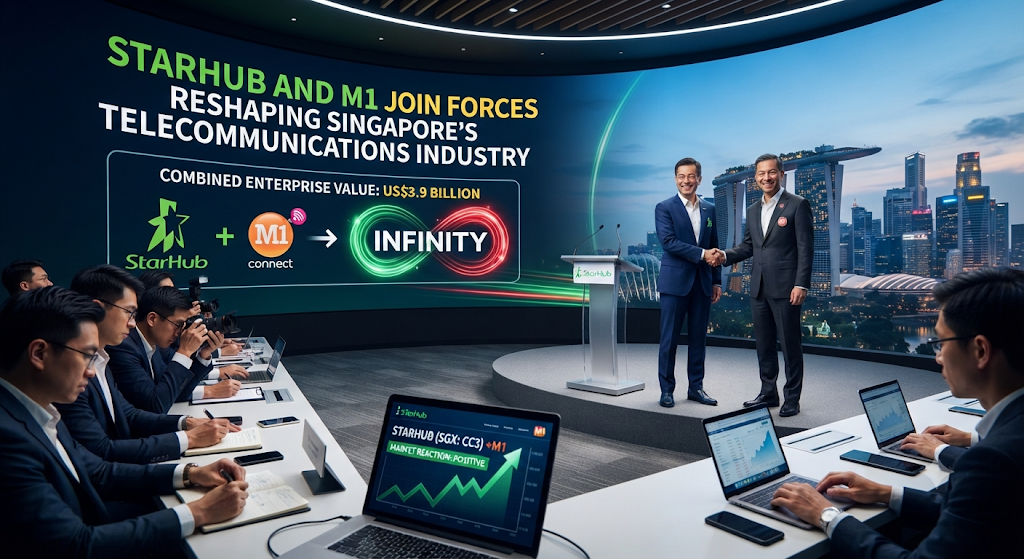
Singapore’s telecommunications industry is set for a major transformation as StarHub has agreed to combine its operations with M1, the mobile telecommunications business majority-owned by Keppel, in a landmark all-share transaction. The proposed combination will create a telecommunications group with an enterprise value of approximately S$5 billion (US$3.87 billion), marking one of the most significant developments in Singapore’s telecom sector.
The transaction reflects growing pressure on telecommunications companies to achieve greater operational efficiency, strengthen network capabilities and invest in next-generation digital infrastructure. With competition intensifying and technology requirements evolving rapidly, the combination of StarHub and M1 is expected to create a stronger business capable of serving consumers, enterprises and government organisations.
Under the proposed agreement, StarHub will issue approximately 651.7 million new shares to M1’s shareholders, representing around 27.4% of its enlarged share capital. Following completion, M1 will become a subsidiary of StarHub, while Keppel is expected to hold an effective 23% stake in the combined company.
The transaction remains subject to regulatory and shareholder approvals, with completion expected in the first half of 2027.
Strategic Consolidation to Strengthen Market Position
The proposed merger comes at a time when Singapore’s telecommunications industry is experiencing significant structural changes. Operators are facing increasing investment requirements, competitive pricing pressures and the need to upgrade infrastructure to support faster connectivity and growing digital consumption.
By bringing together StarHub and M1, the companies aim to create a larger organisation with stronger financial resources, broader customer reach and improved operational capabilities.
The combined business is expected to serve approximately 4.1 million customers across mobile, broadband, enterprise connectivity and digital services. Greater scale could help the organisation improve network management, optimise infrastructure spending and strengthen its ability to compete in Singapore’s rapidly evolving digital economy.
According to the companies, the proposed combination is expected to generate approximately S$110 million in annual operating cost synergies by 2030, with an estimated net present value of S$1.1 billion.
These savings are expected to come from efficiencies across network operations, infrastructure, commercial activities and information technology.
Greater Investment in 5G and Digital Infrastructure
One of the key objectives behind the transaction is to strengthen Singapore’s digital infrastructure.
The increasing adoption of artificial intelligence, cloud computing, digital banking, online commerce and connected devices is creating greater demand for reliable and secure telecommunications networks.
The combined organisation intends to use its expanded capabilities to accelerate investments in 5G technology, fibre connectivity, cybersecurity, cloud platforms and network automation.
These investments could prove particularly important as businesses increasingly depend on digital infrastructure to manage operations, process information and deliver services.
The merger will also bring together complementary enterprise capabilities. By combining connectivity services with cloud, cybersecurity and digital solutions, the enlarged business aims to strengthen its position in the enterprise technology market.
This strategy could help Singapore-based businesses access more integrated digital services while supporting the country’s ambitions to develop a competitive and trusted digital economy.
What the Deal Means for Customers and Employees
For consumers, the proposed merger could create opportunities for improved network quality, broader service offerings and more efficient customer support.
The companies have indicated that existing customers will retain their current plans, services and points of contact during the transition. StarHub and M1 will continue operating independently until the transaction is completed.
Over the longer term, customers could benefit from greater investment in network capacity, infrastructure modernisation and digital innovation.
However, the integration process will require careful management. Combining telecommunications networks, information technology systems, business operations and corporate cultures can present significant operational challenges.
Employees will also be an important part of the transition. Both companies have indicated their commitment to structured employee engagement, consultation and regular communication throughout the integration process.
Regulatory Approval and the Road Ahead
The proposed transaction will require approval from Singapore’s Infocomm Media Development Authority (IMDA), the Ministry of Digital Development and Information, and relevant shareholders.
The combination is expected to reduce the number of major mobile network operators in Singapore from four to three, increasing the importance of regulatory oversight.
Authorities will need to consider the implications for competition, consumer choice, service quality and pricing.
The proposed merger follows an earlier attempt by Australia’s Tuas to acquire Keppel’s interest in M1, which did not proceed after regulatory scrutiny. The latest agreement represents a different strategic approach to consolidation in Singapore’s telecommunications market.
Alongside the M1 transaction, StarHub has also exercised its option to acquire the Singapore mobile business of Circles.Life, further expanding its mobile services portfolio.
If completed successfully, these developments could significantly reshape the competitive landscape and strengthen StarHub’s position in the domestic telecommunications market.
The Worldonomis Times View
The proposed StarHub-M1 combination represents more than a corporate acquisition. It reflects a broader transformation taking place across the global telecommunications industry, where scale, technology investment and operational efficiency are becoming increasingly important for long-term competitiveness.
Telecommunications networks are no longer simply platforms for voice calls and internet access. They have become essential infrastructure supporting artificial intelligence, financial services, smart manufacturing, digital commerce and modern business operations.
From this perspective, the merger could provide StarHub and M1 with the resources needed to compete more effectively in an increasingly technology-driven environment.
However, consolidation must deliver meaningful benefits beyond financial synergies. Reduced competition can create risks if consumers face fewer choices, weaker pricing pressure or limited improvements in service quality.
Regulators therefore have an important responsibility to ensure that the proposed combination supports investment and innovation without compromising a competitive telecommunications market.
The successful integration of both businesses will also depend on transparent leadership, effective workforce management and a clear commitment to customer satisfaction.
The Worldonomis Times believes that the true success of this merger will not be measured solely by its S$5 billion enterprise value or projected cost savings, but by its ability to build stronger digital infrastructure, improve customer experiences and contribute to Singapore’s long-term economic competitiveness.
As Singapore advances towards a more connected and technology-driven future, the StarHub-M1 deal could become an important milestone in the evolution of its telecommunications industry.