No Intent to Evade Tax, No Section 74: Rajasthan High Court Quashes ₹73.43 Crore GST Show Cause Notice Against Jaipur Development Authority
Author: CMA Parul Aggarwal
Introduction
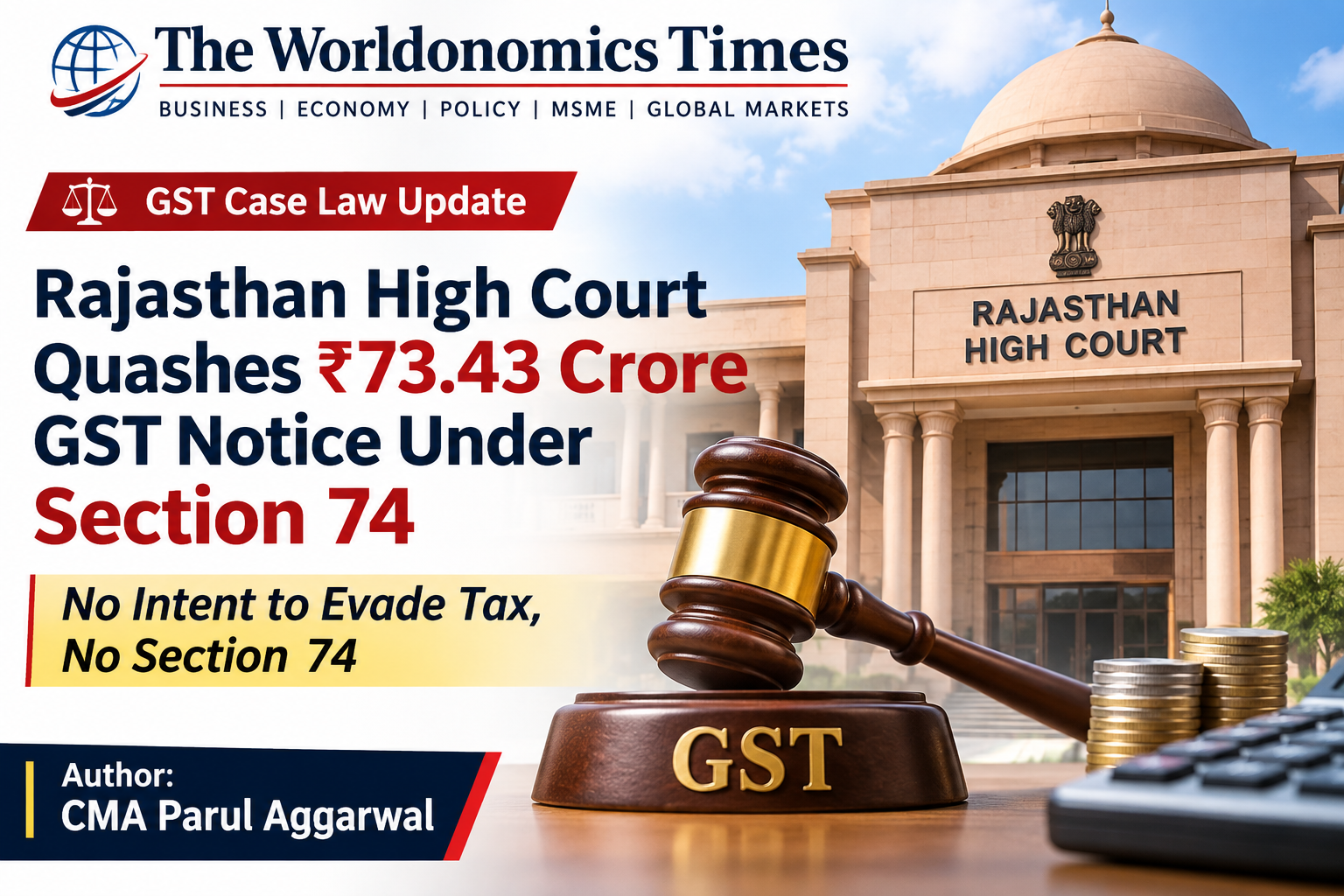
The Rajasthan High Court has delivered an important judgment reinforcing the legal requirements for invoking Section 74 of the Central Goods and Services Tax (CGST) Act, 2017. In Jaipur Development Authority v. Additional Commissioner, CGST Audit, Jaipur & Others, decided on 4 November 2026, the Court quashed a GST show cause notice involving a proposed demand of approximately ₹73.43 crore.
The judgment emphasises that mere non-payment of tax or a disagreement over the taxability of a transaction cannot automatically be treated as fraud, wilful misstatement or suppression of facts with an intention to evade tax.
The ruling is particularly relevant for businesses, government authorities, public sector organisations and tax professionals dealing with GST investigations and extended-period demands.
Background of the Case
Jaipur Development Authority (JDA), a statutory authority constituted under the Jaipur Development Authority Act, 1982, was subjected to a GST audit covering the financial years 2019-20 to 2023-24.
During the audit, the GST authorities raised objections concerning certain receipts of JDA and proposed to levy GST on the following activities:
- Road cutting charges.
- Additional Floor Area Ratio (FAR) charges and betterment levy.
- Sale of Master Plan booklets and related forms.
The department issued a show cause notice dated 30 September 2025 under Section 74 of the CGST Act, proposing a tax demand of approximately ₹73.43 crore.
The department treated the non-disclosure and non-payment of GST on these receipts as wilful misstatement and suppression of facts.
JDA challenged the proceedings before the Rajasthan High Court, contending that the receipts were disclosed in its books of accounts and that the dispute essentially concerned the legal interpretation of whether these statutory receipts constituted taxable supplies under GST.
Key Legal Issue
The principal question before the High Court was:
Can the GST department invoke Section 74 merely because tax has not been paid, without establishing an intention to evade tax through fraud, wilful misstatement or suppression of facts?
The case also raised an important question regarding the jurisdiction of constitutional courts to interfere with GST show cause notices at the initial stage of proceedings.
Relevant Provisions of the CGST Act
Section 74 of the CGST Act, 2017 deals with the determination of tax not paid, short-paid, erroneously refunded or input tax credit wrongly availed or utilised by reason of fraud, wilful misstatement or suppression of facts to evade tax.
The provision carries significant consequences, including an extended limitation period and penalties.
The distinction between Sections 73 and 74 is therefore important:
- Section 73: Covers cases not involving fraud, wilful misstatement or suppression of facts to evade tax.
- Section 74: Applies where non-payment, short payment, erroneous refund or wrongful ITC is attributable to fraud, wilful misstatement or suppression with an intention to evade tax.
Consequently, the department must establish the necessary statutory ingredients before invoking the more stringent provisions of Section 74.
Findings of the Rajasthan High Court
The Division Bench comprising Justice Arun Monga and Justice Ashutosh Kumar examined the circumstances surrounding the issuance of the show cause notice.
The Court made several important observations.
1. Intention to Evade Tax Is Essential
The Court emphasised that the expression “to evade tax” is an important statutory requirement under Section 74.
The mere existence of unpaid tax does not automatically establish fraud or an intention to evade tax. The department must demonstrate circumstances supporting the necessary intention.
2. Disclosure in Books of Accounts Is Relevant
An important aspect of the case was that the receipts under dispute were recorded in JDA’s own books of accounts.
The Court considered this relevant while examining whether the matter involved deliberate suppression or merely a disagreement regarding the legal treatment of particular receipts.
3. Bona Fide Interpretation Cannot Automatically Become Suppression
Where an organisation has openly recorded its transactions and adopted a particular interpretation of the GST law, a subsequent disagreement by the department regarding taxability does not, by itself, establish an intention to evade tax.
4. Section 74 Cannot Be Used as a Default Provision
The Court highlighted the serious consequences associated with Section 74, including the extended limitation period and substantial penalty exposure.
Therefore, the provision cannot be invoked mechanically in every case of alleged non-payment of GST.
5. Writ Jurisdiction Can Be Exercised Against Jurisdictionally Defective Notices
Although courts ordinarily avoid interfering with show cause notices because taxpayers have statutory remedies, this principle is not an absolute restriction.
Where a notice suffers from a fundamental jurisdictional defect, the High Court can exercise its powers under Article 226 of the Constitution of India.
Final Decision
The Rajasthan High Court allowed JDA’s writ petition and quashed the show cause notice dated 30 September 2025 along with the proceedings initiated pursuant to it.
Importantly, the Court did not decide whether the underlying receipts were ultimately taxable under GST. The judgment was confined to the legal sustainability of invoking Section 74 in the circumstances presented.
The Court also clarified that public authorities are not automatically immune from Section 74. The statutory requirements must, however, be satisfied in each case.
Practical Implications for Businesses and Tax Professionals
This judgment carries several important lessons for taxpayers and GST practitioners.
1. Maintain Proper Accounting Records
Businesses should ensure that all receipts, transactions and relevant financial information are properly recorded in their books of accounts.
2. Document the Tax Position
Where an organisation adopts a particular interpretation of GST provisions, it should maintain supporting legal opinions, internal notes, contractual documents and relevant correspondence.
3. Examine the Invocation of Section 74
Tax professionals should carefully examine whether the show cause notice establishes the necessary ingredients of fraud, wilful misstatement or suppression with an intention to evade tax.
4. Distinguish Tax Disputes from Cases of Evasion
Every disagreement concerning taxability should not automatically be classified as tax evasion. The factual circumstances and statutory requirements must be independently examined.
5. Challenge Jurisdictional Defects Appropriately
Where a show cause notice suffers from a fundamental jurisdictional defect, taxpayers may examine the availability of constitutional remedies, subject to established principles governing writ jurisdiction.
Conclusion
The Rajasthan High Court’s decision in Jaipur Development Authority v. Additional Commissioner, CGST Audit, Jaipur & Others reinforces an important principle of GST jurisprudence: the power to invoke extended limitation and stringent penalties must be exercised strictly within the framework of law.
Section 74 is intended to address cases involving fraud, wilful misstatement or suppression with an intention to evade tax. It should not become a routine mechanism for addressing every disagreement over tax liability.
For businesses and tax professionals, the judgment highlights the importance of transparent accounting, proper documentation and a clear understanding of the distinction between genuine tax disputes and deliberate tax evasion.
Ultimately, effective GST administration requires not only revenue protection but also fairness, legal certainty and accountability in tax proceedings.
Case Reference: Jaipur Development Authority v. Additional Commissioner, CGST Audit, Jaipur & Others, D.B. Civil Writ Petition No. 18970/2025, Neutral Citation: 2026:RJ-JP:45758-DB, decided on 4 November 2026 by the Rajasthan High Court.
Disclaimer: This article is intended for academic and informational purposes and should not be treated as legal advice.