New Delhi | November 25, 2026
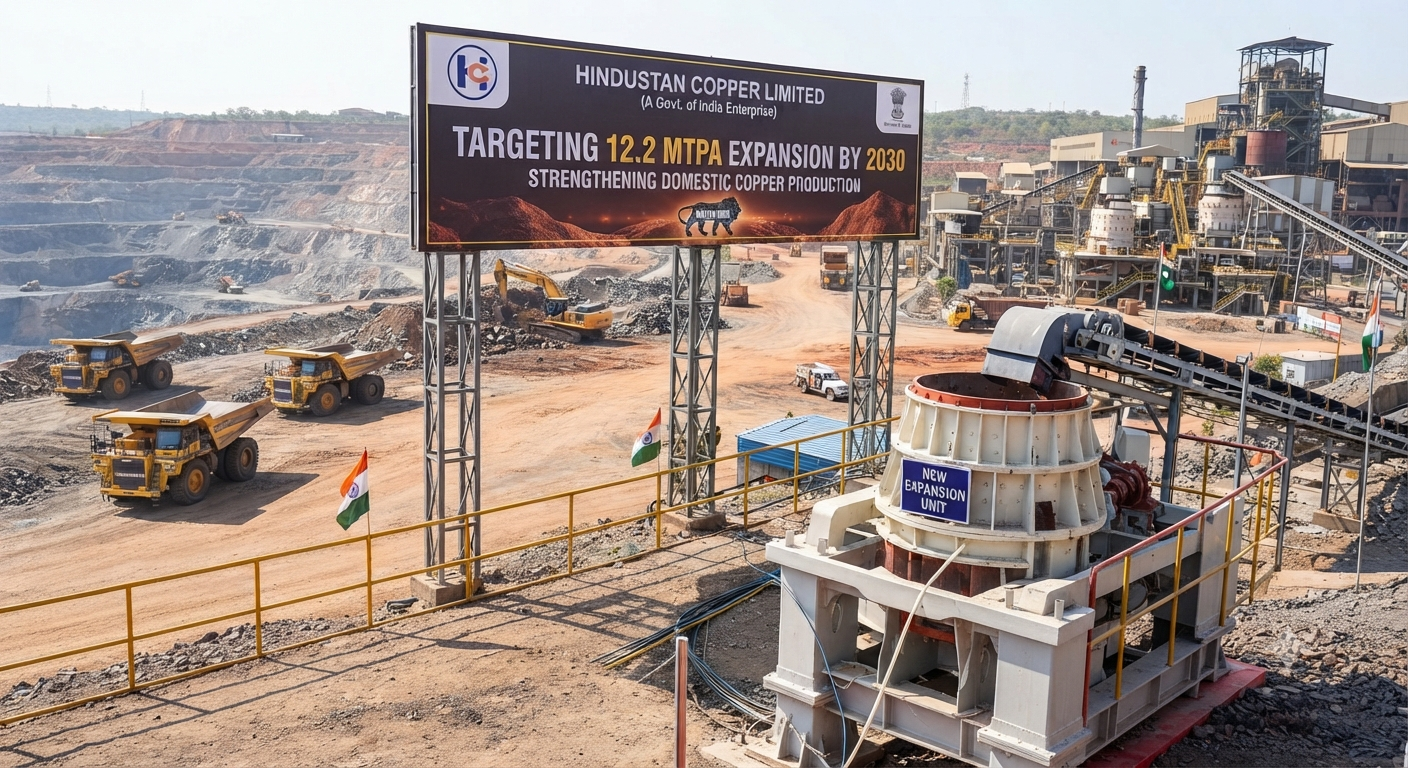
Hindustan Copper Limited (HCL), India’s leading government-owned copper mining company, is pursuing an ambitious expansion strategy to increase its mining capacity to 12.2 million tonnes per annum (MTPA) by 2030. The roadmap is aimed at strengthening domestic copper production, improving mineral resource utilisation and reducing India’s dependence on imported copper resources.
The company’s expansion programme, outlined under its Corporate Plan – Vision 2030, involves a combination of existing mine expansion, reopening of previously closed mines, development of new mining assets and modernisation of mining infrastructure. The plan is supported by a proposed capital expenditure of approximately ₹7,189 crore over five years.
The target represents a major step in HCL’s efforts to increase its contribution to India’s mineral security at a time when copper demand is rising across manufacturing, infrastructure, renewable energy and electric mobility sectors.
Vision 2030: A Major Capacity Expansion Programme
Hindustan Copper’s roadmap aims to increase total ore production capacity from approximately 4.21 MTPA in FY2025–26 to 12.20 MTPA by FY2029–30. The company’s milling capacity is also projected to rise from 3.81 MTPA to 12.20 MTPA over the same period.
The planned investment of around ₹7,189 crore will be directed towards developing mining operations and strengthening the infrastructure required to support higher production.
The proposed capital expenditure is scheduled in phases, with significant spending planned during the middle years of the programme. This investment will support mine development, underground infrastructure, equipment deployment and improvements in ore processing capacity.
HCL Chairman and Managing Director Anupam Misra has reiterated the company’s commitment to the 12.2 MTPA target in a recent interview, highlighting the importance of investment and execution in achieving the expansion roadmap.
It is important to note that the 12.2 MTPA figure represents copper ore mining and milling capacity, rather than refined copper production. Actual copper output will depend on ore grades, recovery rates, processing capacity and the development of downstream facilities.
Expansion Across Existing and New Mining Assets
A key element of HCL’s strategy is to maximise production from its existing mining portfolio while bringing additional resources into operation.
At the Malanjkhand Copper Project in Madhya Pradesh, the company is pursuing an expansion that is expected to increase ore production capacity from approximately 2.5 MTPA to 5 MTPA. The project is one of the important contributors to the company’s long-term production ambitions.
HCL is also planning expansion at the Khetri Copper Complex in Rajasthan. The proposed development aims to increase production capacity from around 1 MTPA to 2.9 MTPA.
In Jharkhand, the Indian Copper Complex is another important part of the expansion strategy. Development plans for the Surda Mine include shaft sinking and underground infrastructure improvements to increase production capacity from approximately 0.4 MTPA to 0.9 MTPA.
The company is also working to revive other mining assets. Mining activities have resumed at Kendadih, while pre-mining activities have progressed at Rakha. HCL has also pursued a Mine Developer and Operator arrangement for the Rakha and Chapri copper mines, envisaging additional ore production and a matching beneficiation facility.
These projects are expected to diversify production sources and improve the company’s ability to meet its long-term capacity target.
Reducing India’s Dependence on Copper Imports
Copper is a strategically important industrial metal because of its excellent electrical conductivity, durability and resistance to corrosion. It is widely used in power transmission, electrical equipment, construction, telecommunications, automobiles and industrial machinery.
Demand for copper is also expected to increase as countries invest in renewable energy systems, electric vehicles, battery infrastructure and modern electricity networks.
India’s growing infrastructure requirements and manufacturing ambitions are likely to increase domestic consumption of copper and copper-based products. However, the country continues to depend significantly on imported copper resources and raw materials.
Expanding domestic mining capacity could help strengthen the availability of locally sourced copper ore and improve resource security. Higher production from HCL’s mines may also support the domestic copper value chain, including mineral processing and metal manufacturing.
The company’s expansion is therefore relevant not only to its own growth but also to India’s wider objective of strengthening domestic mineral production.
Investment, Technology and Operational Efficiency
Achieving the 12.2 MTPA target will require substantial investment in mining technology, underground development, transportation systems and mineral processing facilities.
Modern mining equipment and improved operational planning can help increase productivity, improve ore recovery and strengthen workplace safety. HCL has also outlined digital transformation initiatives under its IT Vision 2026–2030.
These initiatives include improved communication networks, integrated monitoring systems, digital management platforms and the use of advanced analytics. Technology-led improvements could help the company monitor mining operations more effectively and support better decision-making across its units.
Operational efficiency will be particularly important as HCL expands production across multiple locations with different geological and infrastructure conditions.
Stronger Financial and Strategic Position
The expansion programme is also intended to strengthen HCL’s long-term financial performance. Higher production capacity, if supported by favourable market conditions and efficient operations, could improve revenue potential and operating performance.
The company has indicated that internal accruals and available financial resources will play an important role in funding its expansion programme. Its planned capital expenditure reflects a long-term commitment to building productive mining assets rather than relying solely on short-term production improvements.
However, the scale of the programme means that project execution, cost management, environmental clearances, land availability and timely infrastructure development will remain important considerations.
The Worldonomics Times View
Hindustan Copper’s 12.2 MTPA expansion target is strategically important for India’s industrial and mineral security. Copper is essential to the country’s energy transition, infrastructure development and manufacturing ambitions. Increasing domestic ore production capacity can help strengthen the supply chain and reduce exposure to international resource constraints.
The proposed ₹7,189 crore investment demonstrates the scale of the company’s commitment to its Vision 2030 programme. Expansion at Malanjkhand and Khetri, revival of older mines and development of assets in Jharkhand could collectively transform HCL’s production capabilities.
Nevertheless, capacity targets must translate into actual production. Geological challenges, project delays, capital expenditure discipline and environmental responsibilities will determine how successfully the roadmap is implemented. The distinction between ore capacity and refined copper output must also remain clear when assessing the programme’s contribution to domestic supply.
HCL’s success will ultimately depend on consistent execution, modern technology, responsible mining practices and efficient utilisation of its mineral resources.
Conclusion: Hindustan Copper’s plan to reach 12.2 MTPA of ore production capacity by 2030 represents a major investment in India’s domestic mining capabilities. If delivered effectively, the expansion could strengthen the country’s copper supply chain and support the growing requirements of its industrial and energy sectors.