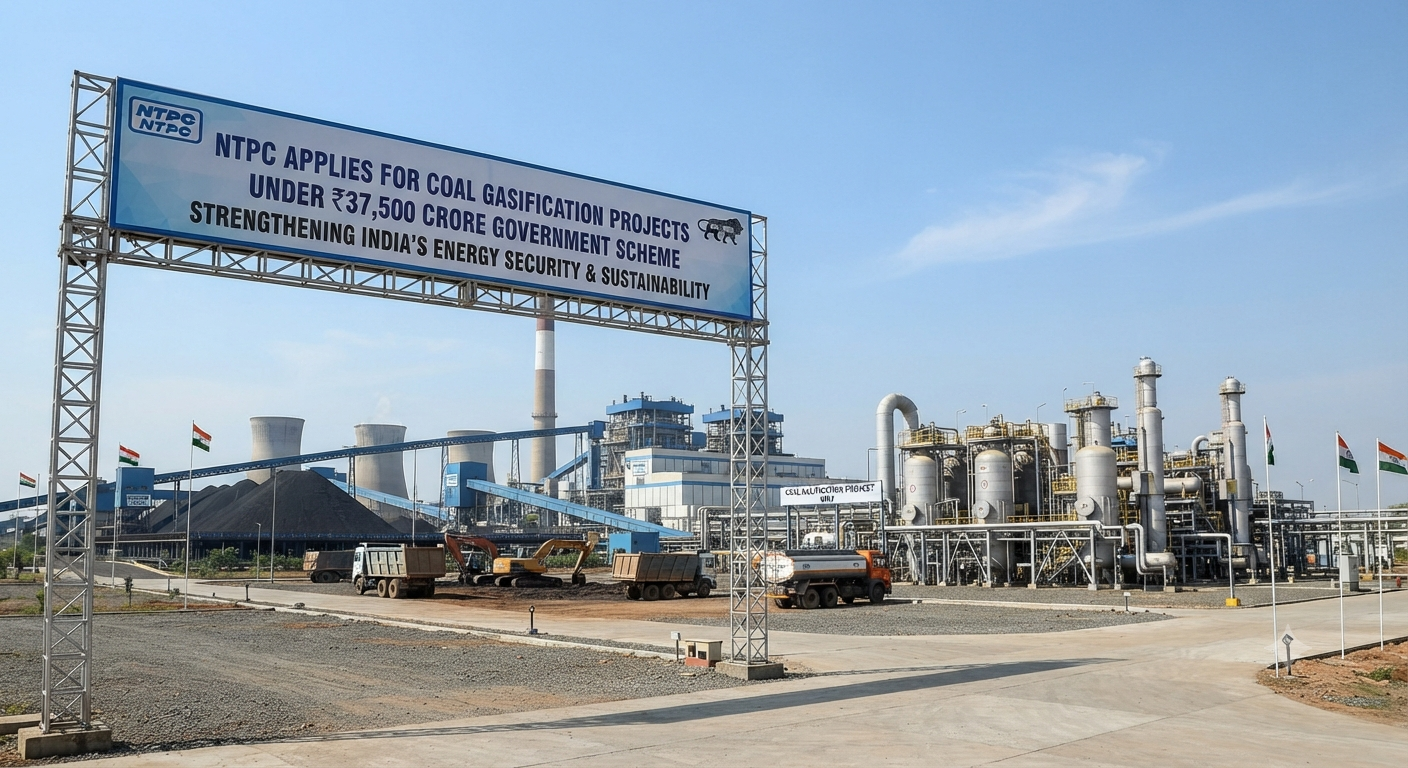
NTPC Applies for Coal Gasification Projects Under ₹37,500 Crore Government Scheme
New Delhi | November 25, 2026
NTPC Limited has taken another step towards diversifying India’s energy and industrial production landscape by submitting two applications under the Central Government’s ₹37,500 crore Scheme for Promotion of Surface Coal/Lignite Gasification Projects. The proposals cover the production of urea, methanol and dimethyl ether (DME), three important industrial products with applications across agriculture, chemicals, manufacturing and energy.
The Ministry of Coal announced on November 10, 2026, that the second round of the scheme had concluded with two applications, both submitted by NTPC. One proposal focuses on urea production, while the other covers methanol and DME manufacturing. The applications highlight the potential of coal gasification to convert India’s domestic coal resources into higher-value industrial products.
The development is significant for NTPC as it explores opportunities beyond conventional electricity generation and supports the government’s broader strategy of strengthening domestic manufacturing, reducing import dependence and expanding the industrial applications of indigenous coal.
₹37,500 Crore Scheme to Promote Coal Gasification
The Union Cabinet approved the Scheme for Promotion of Surface Coal/Lignite Gasification Projects on May 13, 2026, with a total financial outlay of ₹37,500 crore. The initiative aims to accelerate the development of coal and lignite gasification facilities by providing financial support to eligible projects.
Coal gasification is a process through which coal is converted into synthesis gas, commonly known as syngas. This gas primarily contains carbon monoxide and hydrogen and can be processed further to manufacture chemicals, fertilisers, fuels and other industrial products.
Unlike the conventional use of coal primarily for combustion and electricity generation, gasification enables domestic coal resources to serve as feedstock for a broader range of industrial applications.
The government intends to use the scheme to encourage investment, promote technological development and support the national objective of achieving 100 million tonnes of coal gasification capacity by 2030.
NTPC’s Two Applications: Urea, Methanol and DME
The two applications submitted by NTPC cover different downstream manufacturing opportunities.
1. Urea production
The first proposal focuses on producing urea through coal gasification. Urea is one of the most widely used nitrogen-based fertilisers in Indian agriculture and plays an important role in supporting crop productivity.
India has substantial fertiliser requirements, and domestic production is important for maintaining supply stability. Coal gasification offers an alternative pathway for producing the synthesis gas and hydrogen required in the manufacturing process.
If developed successfully, the proposed project could contribute to the diversification of domestic fertiliser feedstock sources and support the country’s efforts to strengthen agricultural input security.
2. Methanol and Dimethyl Ether production
The second application proposes the production of methanol and dimethyl ether.
Methanol is an important industrial chemical used in the manufacture of formaldehyde, acetic acid, plastics, resins and several other chemical products. It also has potential applications as a fuel and as a feedstock for emerging energy technologies.
Dimethyl ether, commonly known as DME, is used in industrial applications and has potential as an alternative fuel and liquefied petroleum gas (LPG) blending component.
The proposed project could therefore create opportunities to expand domestic production of chemicals and alternative fuel-related products. However, the Ministry of Coal’s announcement did not specify the proposed locations, production capacities, project costs or commissioning schedules for either application.
Round Three Opens for Wider Industry Participation
Alongside announcing the conclusion of the second round, the Ministry of Coal launched the third round of applications on November 10, 2026. Eligible companies have been invited to submit proposals for establishing surface coal and lignite gasification projects, with January 11, 2027, set as the application deadline.
The first round had received seven applications from companies including NTPC, Adani Enterprises, Gallantt Ispat and Shyam Sel & Power. The second round, by comparison, received only two applications, both from NTPC.
The next round is expected to provide another opportunity for public and private sector companies to participate in the country’s coal gasification programme.
Broader participation will be important because large-scale gasification projects require substantial capital investment, specialised technology, reliable feedstock arrangements and long-term demand for the products manufactured.
Strengthening India’s Industrial and Energy Security
India’s demand for fertilisers, chemicals and industrial fuels is closely linked to its expanding economy. Domestic production of these products can help improve supply-chain resilience and reduce exposure to international price fluctuations and supply disruptions.
NTPC’s proposals reflect an effort to use the country’s coal resources for applications beyond conventional power generation. By developing gasification-based manufacturing, the company could potentially participate in a wider industrial value chain involving energy, chemicals and fertilisers.
The initiative also supports the government’s broader objective of improving the value obtained from domestic natural resources. Successful implementation could encourage investment in associated infrastructure, technology development, engineering services and industrial facilities.
However, coal gasification projects must demonstrate commercial viability. Capital costs, coal quality, water availability, technology selection, product pricing and logistics will influence their long-term competitiveness.
Environmental and Technological Considerations
While coal gasification offers opportunities for industrial diversification, its environmental performance will remain an important consideration.
The process requires energy and water and can generate carbon emissions. Its overall environmental impact depends on the technology used, plant efficiency, pollution-control systems and the management of carbon dioxide and other by-products.
Future projects will need to incorporate appropriate environmental safeguards, efficient water management and modern emission-control technologies. Carbon capture, utilisation and storage may also have a role in improving the emissions profile where technically and economically feasible.
Balancing industrial development with environmental responsibility will be essential if coal gasification is to become a sustainable part of India’s long-term industrial strategy.
The Worldonomics Times View
NTPC’s two applications under the ₹37,500 crore coal gasification scheme represent an important development in India’s effort to expand the industrial use of domestic coal. The proposed production of urea, methanol and DME connects the energy sector with agriculture, chemicals and emerging fuel applications.
For NTPC, the initiative offers an opportunity to explore new business areas and diversify its role beyond conventional electricity generation. For India, it could support domestic manufacturing, improve supply-chain resilience and encourage greater value addition from indigenous resources.
Nevertheless, applications alone do not guarantee successful projects. The government and participating companies must ensure that financial incentives are matched by commercially viable business models, reliable technology, adequate infrastructure and long-term demand.
Environmental performance must also remain central to project planning. Strong pollution controls, efficient water use and credible carbon-management strategies will be necessary to ensure that industrial gains do not come at an unacceptable environmental cost.
The opening of the third application round is an opportunity to attract wider participation and build a stronger project pipeline. If implemented responsibly and supported by competitive economics, coal gasification could become an additional instrument in India’s industrial development strategy.
Conclusion: NTPC’s proposals mark a significant step in exploring coal-based production of fertilisers and industrial chemicals. Their eventual impact will depend on project approvals, investment decisions and execution, but the initiative highlights India’s growing interest in converting domestic coal resources into higher-value products.New Delhi | November 25, 2026
NTPC Limited has taken another step towards diversifying India’s energy and industrial production landscape by submitting two applications under the Central Government’s ₹37,500 crore Scheme for Promotion of Surface Coal/Lignite Gasification Projects. The proposals cover the production of urea, methanol and dimethyl ether (DME), three important industrial products with applications across agriculture, chemicals, manufacturing and energy.
The Ministry of Coal announced on November 10, 2026, that the second round of the scheme had concluded with two applications, both submitted by NTPC. One proposal focuses on urea production, while the other covers methanol and DME manufacturing. The applications highlight the potential of coal gasification to convert India’s domestic coal resources into higher-value industrial products.
The development is significant for NTPC as it explores opportunities beyond conventional electricity generation and supports the government’s broader strategy of strengthening domestic manufacturing, reducing import dependence and expanding the industrial applications of indigenous coal.
₹37,500 Crore Scheme to Promote Coal Gasification
The Union Cabinet approved the Scheme for Promotion of Surface Coal/Lignite Gasification Projects on May 13, 2026, with a total financial outlay of ₹37,500 crore. The initiative aims to accelerate the development of coal and lignite gasification facilities by providing financial support to eligible projects.
Coal gasification is a process through which coal is converted into synthesis gas, commonly known as syngas. This gas primarily contains carbon monoxide and hydrogen and can be processed further to manufacture chemicals, fertilisers, fuels and other industrial products.
Unlike the conventional use of coal primarily for combustion and electricity generation, gasification enables domestic coal resources to serve as feedstock for a broader range of industrial applications.
The government intends to use the scheme to encourage investment, promote technological development and support the national objective of achieving 100 million tonnes of coal gasification capacity by 2030.
NTPC’s Two Applications: Urea, Methanol and DME
The two applications submitted by NTPC cover different downstream manufacturing opportunities.
1. Urea production
The first proposal focuses on producing urea through coal gasification. Urea is one of the most widely used nitrogen-based fertilisers in Indian agriculture and plays an important role in supporting crop productivity.
India has substantial fertiliser requirements, and domestic production is important for maintaining supply stability. Coal gasification offers an alternative pathway for producing the synthesis gas and hydrogen required in the manufacturing process.
If developed successfully, the proposed project could contribute to the diversification of domestic fertiliser feedstock sources and support the country’s efforts to strengthen agricultural input security.
2. Methanol and Dimethyl Ether production
The second application proposes the production of methanol and dimethyl ether.
Methanol is an important industrial chemical used in the manufacture of formaldehyde, acetic acid, plastics, resins and several other chemical products. It also has potential applications as a fuel and as a feedstock for emerging energy technologies.
Dimethyl ether, commonly known as DME, is used in industrial applications and has potential as an alternative fuel and liquefied petroleum gas (LPG) blending component.
The proposed project could therefore create opportunities to expand domestic production of chemicals and alternative fuel-related products. However, the Ministry of Coal’s announcement did not specify the proposed locations, production capacities, project costs or commissioning schedules for either application.
Round Three Opens for Wider Industry Participation
Alongside announcing the conclusion of the second round, the Ministry of Coal launched the third round of applications on November 10, 2026. Eligible companies have been invited to submit proposals for establishing surface coal and lignite gasification projects, with January 11, 2027, set as the application deadline.
The first round had received seven applications from companies including NTPC, Adani Enterprises, Gallantt Ispat and Shyam Sel & Power. The second round, by comparison, received only two applications, both from NTPC.
The next round is expected to provide another opportunity for public and private sector companies to participate in the country’s coal gasification programme.
Broader participation will be important because large-scale gasification projects require substantial capital investment, specialised technology, reliable feedstock arrangements and long-term demand for the products manufactured.
Strengthening India’s Industrial and Energy Security
India’s demand for fertilisers, chemicals and industrial fuels is closely linked to its expanding economy. Domestic production of these products can help improve supply-chain resilience and reduce exposure to international price fluctuations and supply disruptions.
NTPC’s proposals reflect an effort to use the country’s coal resources for applications beyond conventional power generation. By developing gasification-based manufacturing, the company could potentially participate in a wider industrial value chain involving energy, chemicals and fertilisers.
The initiative also supports the government’s broader objective of improving the value obtained from domestic natural resources. Successful implementation could encourage investment in associated infrastructure, technology development, engineering services and industrial facilities.
However, coal gasification projects must demonstrate commercial viability. Capital costs, coal quality, water availability, technology selection, product pricing and logistics will influence their long-term competitiveness.
Environmental and Technological Considerations
While coal gasification offers opportunities for industrial diversification, its environmental performance will remain an important consideration.
The process requires energy and water and can generate carbon emissions. Its overall environmental impact depends on the technology used, plant efficiency, pollution-control systems and the management of carbon dioxide and other by-products.
Future projects will need to incorporate appropriate environmental safeguards, efficient water management and modern emission-control technologies. Carbon capture, utilisation and storage may also have a role in improving the emissions profile where technically and economically feasible.
Balancing industrial development with environmental responsibility will be essential if coal gasification is to become a sustainable part of India’s long-term industrial strategy.
The Worldonomics Times View
NTPC’s two applications under the ₹37,500 crore coal gasification scheme represent an important development in India’s effort to expand the industrial use of domestic coal. The proposed production of urea, methanol and DME connects the energy sector with agriculture, chemicals and emerging fuel applications.
For NTPC, the initiative offers an opportunity to explore new business areas and diversify its role beyond conventional electricity generation. For India, it could support domestic manufacturing, improve supply-chain resilience and encourage greater value addition from indigenous resources.
Nevertheless, applications alone do not guarantee successful projects. The government and participating companies must ensure that financial incentives are matched by commercially viable business models, reliable technology, adequate infrastructure and long-term demand.
Environmental performance must also remain central to project planning. Strong pollution controls, efficient water use and credible carbon-management strategies will be necessary to ensure that industrial gains do not come at an unacceptable environmental cost.
The opening of the third application round is an opportunity to attract wider participation and build a stronger project pipeline. If implemented responsibly and supported by competitive economics, coal gasification could become an additional instrument in India’s industrial development strategy.
Conclusion: NTPC’s proposals mark a significant step in exploring coal-based production of fertilisers and industrial chemicals. Their eventual impact will depend on project approvals, investment decisions and execution, but the initiative highlights India’s growing interest in converting domestic coal resources into higher-value products.