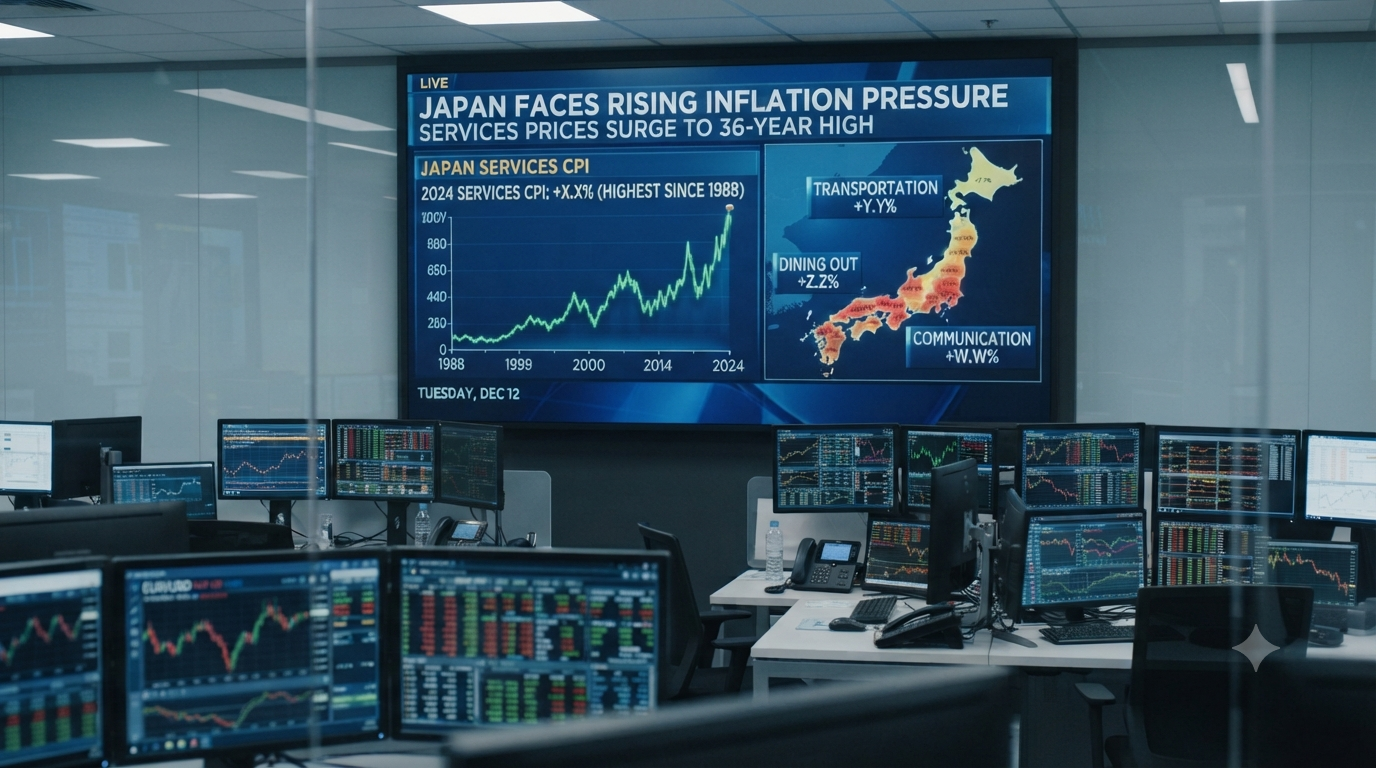
Japan is facing renewed inflationary pressure after prices charged by businesses for services recorded their fastest annual increase in more than three decades. The Bank of Japan’s (BOJ) Services Producer Price Index (SPPI) rose 4.2% year-on-year in October, marking its strongest growth since 1990 and strengthening expectations that the central bank may raise interest rates again in the coming months.
The latest figure accelerated from a revised increase of 3.8% in September, highlighting the growing influence of higher operating expenses, transportation costs and labour-related pressures across Japan’s services sector.
The development is significant for the Japanese economy because services inflation provides an important indication of whether companies are passing higher wages and business costs on to customers. It also gives policymakers additional evidence when assessing whether inflation is becoming sufficiently broad and persistent to justify further monetary tightening.
Services Prices Record Their Fastest Rise Since 1990
Data released by the Bank of Japan on November 25 showed that the overall services producer price index increased by 4.2% compared with October 2025. The index measures prices that businesses charge other businesses for services, rather than the prices consumers directly pay for household services.
The acceleration from September’s revised 3.8% increase indicates that cost pressures remain strong across several service-related industries.
Higher ocean freight transportation charges, leasing expenses and hotel prices were among the major contributors to the October increase. These developments reflect a combination of domestic cost pressures and international economic conditions.
The BOJ also reported that the index excluding international transportation recorded a 3.2% annual increase. This measure is particularly useful for assessing domestic services inflation because it reduces the influence of fluctuations in international freight prices.
The figures suggest that inflationary pressure is not limited to imported goods or energy-related costs. Domestic services businesses are also experiencing increases in expenses that may gradually influence the wider price environment.
Rising Labour Costs Remain a Key Concern
One of the most important considerations for the BOJ is the relationship between wage growth and service-sector prices.
Japan has experienced changes in its labour market as businesses compete to attract and retain employees. Higher wages can improve household purchasing power and support domestic consumption, but they can also increase operating costs for companies, particularly in labour-intensive industries.
When businesses pass these additional expenses on through higher service prices, wage increases can contribute to more persistent inflation.
The BOJ is therefore monitoring whether companies are increasingly transferring labour costs to customers. Prices in labour-intensive service categories rose 2.7% year-on-year in October, compared with 2.6% in September.
Although the increase was relatively modest, it provides another indication that domestic cost pressures remain present.
For policymakers, the challenge is to distinguish between temporary cost increases and a sustained inflation cycle supported by stronger wages, consumption and pricing power.
Bank of Japan Faces Growing Pressure to Raise Interest Rates
The October services inflation data has strengthened expectations of another interest-rate increase by the Bank of Japan.
The central bank has gradually moved away from its prolonged ultra-low interest-rate policy as inflation conditions have changed. It raised its policy rate in June and increased it again to 1.25% in September, reflecting its assessment of economic and price developments.
Governor Kazuo Ueda has indicated that the BOJ remains prepared to increase borrowing costs further if economic activity and inflation evolve in line with its outlook.
Japan’s central bank aims to maintain inflation around its 2% target in a sustainable manner, supported by a healthy relationship between wages and prices.
According to a Reuters survey of economists, a majority expect another rate increase in December, followed by the possibility of an additional move by the end of March 2027. Several analysts see the eventual policy rate potentially reaching approximately 1.75% to 2.0%.
These expectations are not confirmed policy decisions. The BOJ will continue to assess incoming inflation figures, wage negotiations, economic growth and financial market conditions before determining its next move.
Wholesale Inflation Adds to the Pressure
Services inflation is not the only area attracting attention. Japan’s wholesale prices have also recorded substantial increases, adding to concerns about broader inflationary pressures.
Annual wholesale inflation reached 7.1% in October, reflecting higher prices for several industrial and commodity-related products.
International developments, including tensions in the Middle East, have contributed to higher energy-related costs. Strong demand associated with artificial intelligence investment has also supported prices for certain materials and semiconductor-related products.
A weaker yen can further increase the domestic cost of imported energy, raw materials and other essential inputs. These pressures may eventually affect businesses and households through higher production, transportation and retail prices.
The combination of rising wholesale prices and accelerating services inflation creates a more complicated environment for the BOJ, which must balance price stability against the risk of slowing economic activity.
Implications for the Yen and Financial Markets
Expectations of higher Japanese interest rates can influence the yen, government bond yields and international investment flows.
Higher domestic borrowing costs may make yen-denominated assets more attractive to investors, potentially supporting the Japanese currency. However, the exchange rate will also depend on interest-rate differences between Japan and other major economies, particularly the United States.
For international investors, a change in the BOJ’s policy direction could influence decisions involving Japanese government bonds, equities and currency positions.
Businesses may also face adjustments as financing costs rise. Companies with substantial borrowing requirements could experience higher interest expenses, while savers may gradually benefit from improved returns on deposits and other interest-bearing assets.
For households, the broader impact will depend on whether wage growth keeps pace with living costs and whether higher borrowing expenses offset improvements in purchasing power.
The Worldonomics Times View
Japan’s services inflation reaching a 36-year high is an important signal that domestic price pressures remain stronger than policymakers would ideally prefer. The 4.2% annual increase demonstrates that inflation is extending beyond goods and imported commodities into business services, where wage and operating costs play a significant role.
For the Bank of Japan, the central issue is whether this trend reflects a sustainable cycle of wage growth and price adjustments or whether it is primarily driven by temporary increases in transportation, leasing and other business expenses.
Further interest-rate increases could help normalise monetary policy and prevent inflation from becoming entrenched. However, policymakers must avoid tightening too aggressively in an economy where households and businesses are still adjusting to higher prices and changing financial conditions.
The December policy meeting will therefore be particularly important for investors seeking clarity on Japan’s monetary direction. The central bank’s assessment of wage developments, domestic demand and underlying inflation will matter as much as the latest price index.
Conclusion: Japan’s services producer prices rising 4.2% in October have intensified expectations of further monetary tightening. With wholesale prices also elevated and wage-related cost pressures continuing, the Bank of Japan faces growing pressure to reassess borrowing costs. Whether it proceeds with another increase in December will depend on the durability of inflation and the broader condition of the Japanese economy.