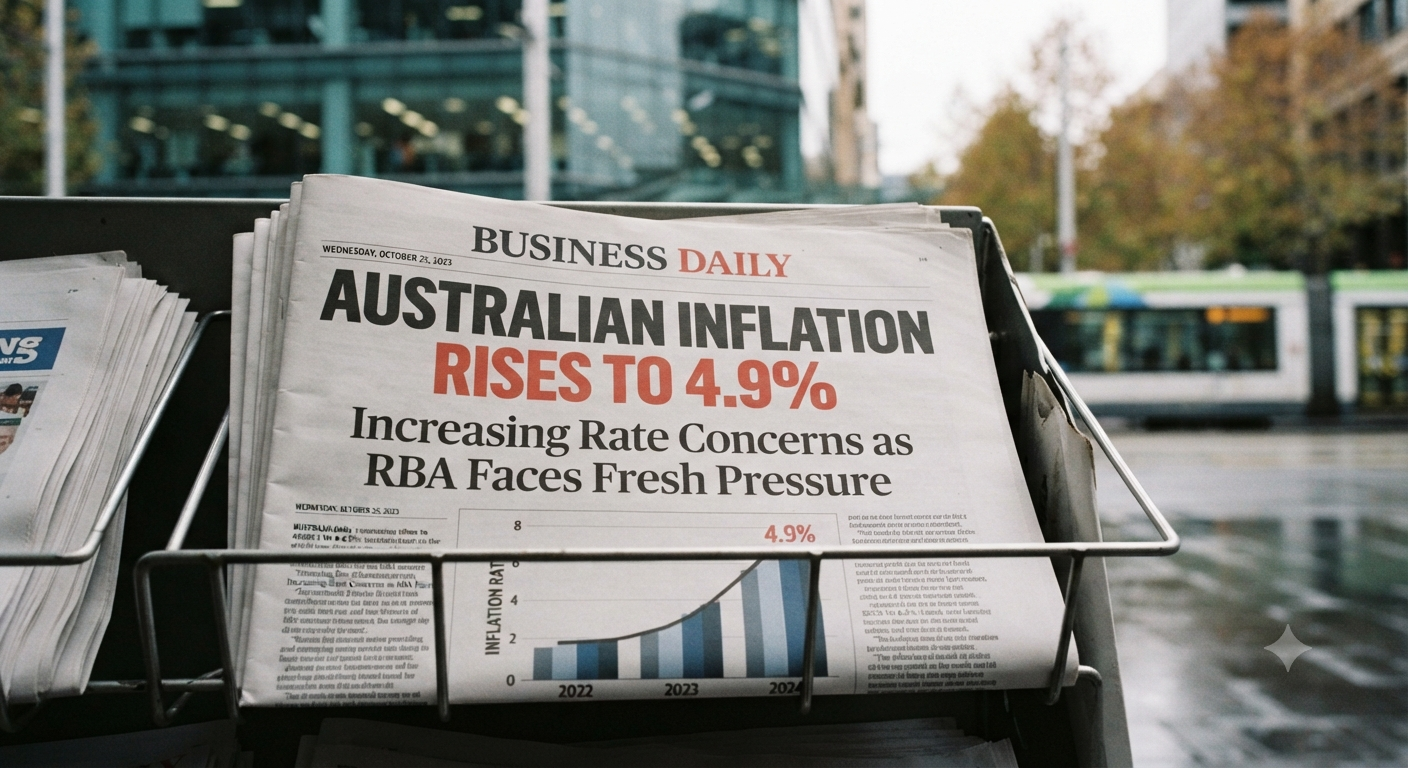
Australia’s inflation rate accelerated more sharply than expected in October, intensifying concerns that the Reserve Bank of Australia (RBA) may need to maintain restrictive monetary policy or consider further interest-rate increases. Annual consumer price inflation reached 4.9% in the 12 months to October, rising from 4.3% in September and exceeding market expectations.
The latest figures, released by the Australian Bureau of Statistics (ABS), highlight the growing pressure on household budgets from higher fuel, electricity and housing costs. The increase also raises questions about whether inflation can return to the RBA’s target range without additional monetary tightening.
The October reading represents a significant development for financial markets, businesses and households, as investors reassess the outlook for borrowing costs and the possibility of further interest-rate increases.
Inflation Accelerates Beyond Market Expectations
The ABS reported that Australia’s Consumer Price Index (CPI) increased by 4.9% year-on-year in October, compared with 4.3% in September. On a monthly basis, the CPI rose 0.5% in original terms and 0.7% on a seasonally adjusted basis.
The October annual inflation figure was above the RBA’s official target range of 2% to 3%, indicating that price pressures remain considerably elevated.
The increase was broad enough to attract attention across several expenditure categories, although housing and transport were the largest contributors to the annual rise.
The acceleration in inflation is particularly important because the RBA has already increased borrowing costs during 2026 in response to persistent price pressures. The latest data could complicate its efforts to balance inflation control with economic growth and employment.
Fuel and Housing Costs Drive Price Pressures
Housing was the largest contributor to annual inflation in October, with prices increasing 6.4% compared with the same month last year. This represented a faster increase than the 5.2% annual rise recorded in September.
Electricity prices increased 25.2% over the year, compared with 12.8% in September. The ABS attributed much of this acceleration to the expiry of government electricity rebates, which had reduced household bills during the previous year.
New dwelling prices also increased 5.1% annually as builders passed on higher material and labour costs.
Transport was the second-largest contributor to annual inflation, recording an increase of 10.6%. Higher automotive fuel prices played a major role in this movement.
Fuel prices rose 6.3% during October, following a 9.4% increase in September. Higher international oil prices contributed to the rise, adding further pressure to household transportation expenses and business operating costs.
These developments demonstrate how energy and housing-related expenses continue to influence Australia’s overall inflation environment.
Underlying Inflation Also Moves Higher
While headline inflation attracts immediate attention, the RBA also closely monitors underlying price measures to understand whether inflation is becoming persistent.
Australia’s trimmed mean inflation, which removes unusually large price movements to provide a clearer indication of underlying trends, increased to 3.8% annually in October from 3.6% in September.
The figure was above market expectations of approximately 3.6%, suggesting that inflationary pressure extends beyond temporary movements in fuel prices.
Monthly trimmed mean inflation increased by 0.5% in October. The annual rate is particularly important for monetary policymakers because it provides a better indication of underlying inflation momentum than the headline CPI alone.
The increase in both headline and underlying inflation reduces the likelihood of an immediate shift towards monetary easing and reinforces the importance of upcoming price and economic data.
Reserve Bank of Australia Faces a Difficult Policy Decision
The latest inflation figures arrive after the RBA raised its cash rate target by 25 basis points to 4.85% on November 3, 2026.
The central bank has highlighted persistent inflation and broader cost pressures as important reasons for maintaining a restrictive policy stance. Its assessment has also been influenced by higher fuel and commodity prices, domestic capacity pressures and rising costs across several goods and services industries.
The October inflation report may strengthen the argument for keeping borrowing costs elevated for longer. Further increases could also remain under consideration if underlying inflation continues to exceed expectations.
However, the RBA faces a difficult balancing act. Higher interest rates can reduce demand and help moderate inflation, but they also increase mortgage repayments, business financing costs and household debt-servicing pressures.
The central bank must therefore consider whether additional tightening would be necessary and proportionate to the inflation outlook.
Impact on Households, Businesses and Financial Markets
Higher inflation is likely to affect Australian households through increased expenses for electricity, transport, housing and other essential services.
Households with mortgages could face additional financial pressure if the RBA raises rates again. Renters may also experience indirect effects as property owners and housing providers respond to higher financing and operating costs.
Businesses face a similarly challenging environment. Higher energy, transportation, labour and construction expenses can reduce profit margins, particularly for companies that cannot easily pass additional costs on to customers.
Financial markets are also responding to the changing inflation outlook. Expectations of further monetary tightening can influence Australian government bond yields, currency movements and equity valuations.
The Australian dollar may receive support from expectations of higher domestic interest rates, although its direction will also depend on global currency movements, commodity prices and the monetary policies of other major central banks.
For international investors, Australia’s inflation trajectory will remain an important factor in assessing the country’s interest-rate outlook and broader economic performance.
Economic Growth and Employment Remain Important Considerations
Although inflation is the immediate policy concern, the RBA cannot ignore signs of pressure on economic activity.
Higher borrowing costs may gradually weaken household consumption, residential investment and business expansion. If inflation remains elevated while economic activity slows, policymakers could face a difficult combination of persistent price pressures and weaker growth.
Employment conditions will also be important. Australia’s unemployment rate reached 4.9% in September, according to the latest figures cited in market reporting. This highlights the need for the central bank to consider the potential consequences of further tightening for the labour market.
The coming months will therefore be important in determining whether inflation begins to moderate or remains strong enough to require additional policy action.
The Worldonomics Times View
Australia’s inflation acceleration to 4.9% is a significant warning for policymakers and financial markets. The increase in housing and transport costs, combined with higher underlying inflation, suggests that price pressures remain a major challenge for the economy.
The RBA’s decision to raise its cash rate to 4.85% in November demonstrates its concern about the inflation outlook. The latest figures strengthen the case for caution before considering any reduction in borrowing costs.
However, further rate increases are not without consequences. Australian households are already dealing with higher living expenses, while businesses face rising operating costs and tighter financing conditions. Monetary policy must therefore balance the need to control inflation against the risks of weakening economic growth and employment.
The next phase will depend on whether inflationary pressures begin to ease, particularly in housing, energy and services. Investors and businesses should pay close attention to underlying inflation measures and future RBA communications rather than treating another rate increase as certain.
Conclusion: Australia’s annual inflation reaching 4.9% in October has increased pressure on the Reserve Bank of Australia and complicated the outlook for interest rates. With housing and fuel costs rising and underlying inflation also accelerating, the central bank faces a challenging decision over how to restore price stability without placing excessive pressure on households and economic activity.