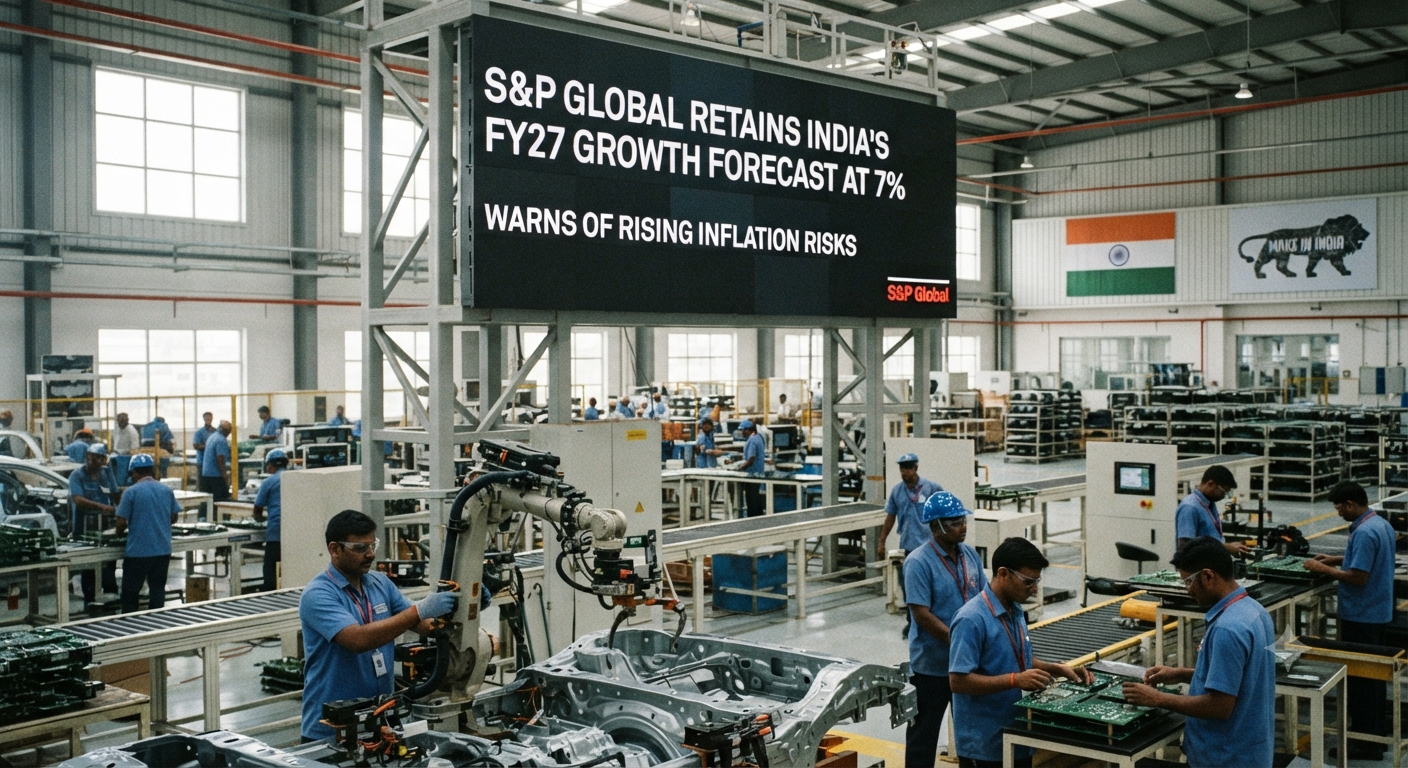
S&P Global Ratings has retained its forecast for India’s economic growth at 7% for the financial year 2026–27, while lowering its projection for FY2027–28 to 7% from an earlier estimate of 7.2%. The ratings agency has also warned that rising input costs, uneven monsoon conditions and higher food prices could intensify inflationary pressures and complicate the country’s economic outlook.
In its latest Asia-Pacific Economic Outlook, released on November 23, S&P Global Ratings indicated that India’s economy continues to demonstrate resilience, supported by strong merchandise exports, public-sector investment and household consumption. However, the agency expects the balance between economic growth and inflation to become less favourable during the second half of FY27.
The report also anticipates that the Reserve Bank of India (RBI) could increase its policy interest rate by 25 basis points in December 2026, followed by another possible increase in early 2027.
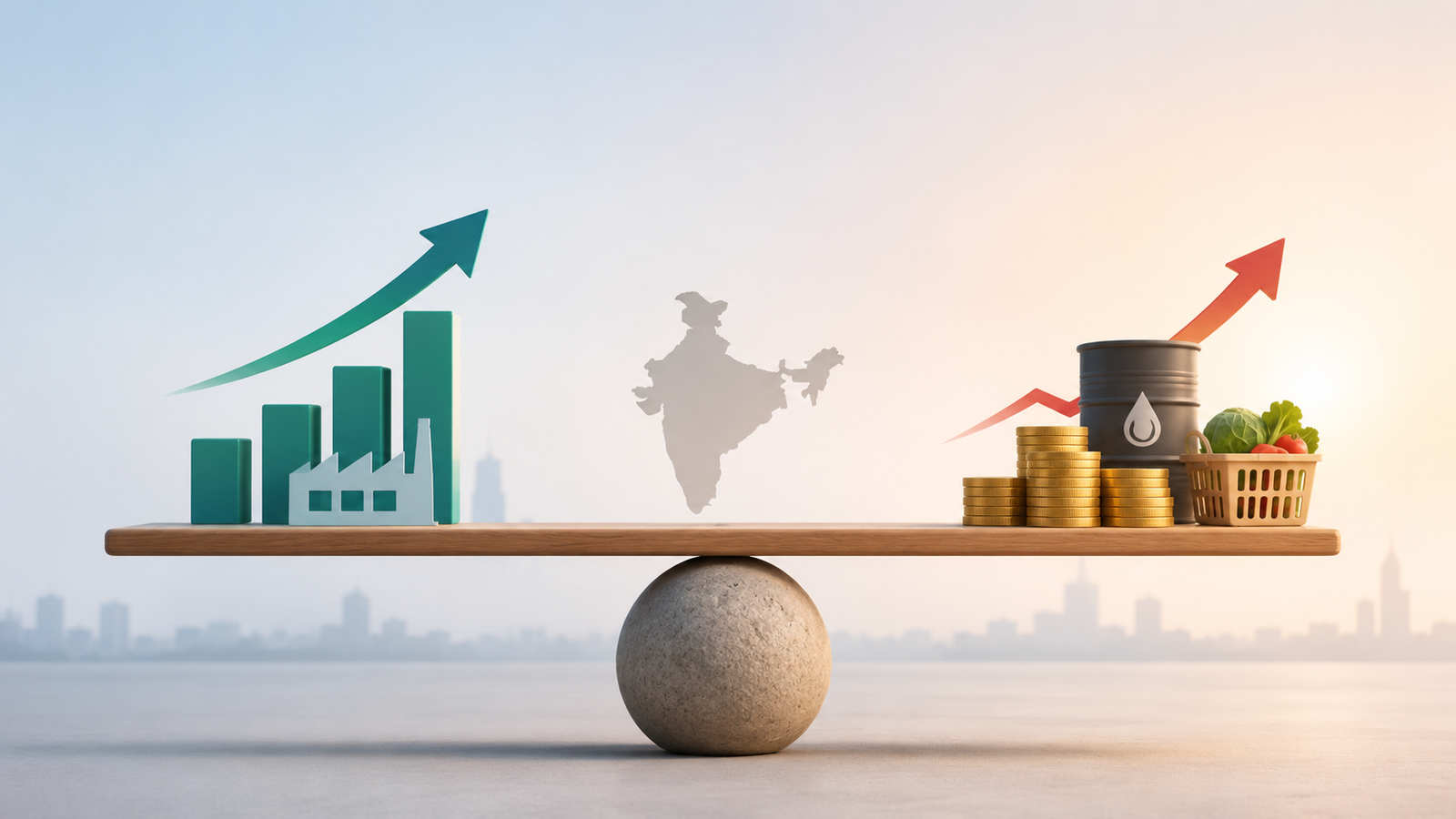
The assessment highlights the challenge facing Indian policymakers: sustaining economic expansion while containing price pressures that could affect households, businesses and financial markets.
India’s Growth Forecast Remains Strong Despite Emerging Risks
S&P Global Ratings’ decision to retain India’s FY27 growth forecast at 7% reflects confidence in the country’s underlying economic momentum.
Economic activity during the June and September quarters was supported by strong goods exports, public-sector investment and household consumption. The agency also highlighted buoyant bank credit growth as an important factor supporting consumer demand.
India’s expanding role in global supply chains has contributed to merchandise export performance. Higher commodity prices, trade diversification and increasing integration with international markets have supported export activity, particularly in electronics, engineering goods and chemicals.
Government investment has also remained an important source of economic support. Infrastructure development and public-sector capital expenditure have helped sustain demand across construction, manufacturing, transportation and related industries.
Nevertheless, the reduction in the FY28 growth projection indicates that S&P expects some moderation in the medium-term growth outlook.
The agency has also raised its FY29 growth projection to 7.2%, suggesting that it continues to expect India to maintain relatively strong economic expansion beyond the immediate inflationary pressures.
Rising Input Costs Could Increase Inflation
One of the central concerns in S&P Global Ratings’ assessment is the possibility that higher production and operating costs will increasingly be passed on to consumers.
Businesses across several sectors are facing pressure from elevated energy prices, transportation expenses and other input costs. When companies transfer these additional expenses into product and service prices, consumer inflation can rise.
The agency expects India’s consumer inflation to average 5.3% during FY27, with risks tilted towards a higher reading. It forecasts inflation to moderate to 4.7% in FY28.
October’s retail inflation reading of approximately 6.1% has added to these concerns. This was above the RBI’s upper tolerance limit of 6% under its inflation-targeting framework, which allows inflation to remain between 2% and 6%.
Persistent inflation could reduce household purchasing power, particularly among lower-income consumers who spend a larger proportion of their earnings on essential goods.
For businesses, higher input costs may affect profit margins, pricing strategies and investment decisions. Companies that cannot pass on increased expenses may experience pressure on profitability.
Uneven Monsoon and El Niño Raise Agricultural Concerns
Weather conditions represent another important risk to India’s inflation outlook.
S&P Global Ratings has highlighted deficient summer rainfall, lower reservoir levels and persistent El Niño conditions as factors that could affect agricultural production.
Uneven rainfall can influence crop yields, agricultural incomes and the availability of essential food commodities. Lower reservoir levels may also affect irrigation and water availability, increasing uncertainty for farmers.
The agency warned that these conditions could affect both the current agricultural harvest and the upcoming winter crop.
Any reduction in agricultural output could increase food prices, adding to inflationary pressure across the economy. Food inflation is particularly significant in India because it directly affects household budgets and can influence overall consumer price movements.
The impact may also extend beyond rural areas. Higher agricultural prices can increase the operating costs of food-processing companies, restaurants, retailers and other businesses dependent on agricultural inputs.
A sustained improvement in agricultural production and food supply will therefore be important for moderating inflation during the coming months.
RBI May Consider a 25-Basis-Point Rate Increase
Against the backdrop of rising inflation risks, S&P Global Ratings expects the Reserve Bank of India to increase its policy rate by 25 basis points in December 2026.
A basis point represents one-hundredth of a percentage point, meaning a 25-basis-point increase would raise the policy rate by 0.25 percentage points.
The agency also considers another increase in early 2027 increasingly likely. Its projections indicate that the RBI policy rate could reach 6% by March 2027 and remain at that level through March 2028, before easing to 5.5% by March 2029.
These are S&P’s forecasts rather than confirmed RBI decisions.
The central bank’s challenge will be to assess whether inflationary pressures are temporary or becoming sufficiently persistent to require a tighter monetary policy.
Higher interest rates can help moderate demand and contain inflation, but they also increase borrowing costs for households and businesses.
For homebuyers, companies seeking expansion finance and businesses dependent on working capital loans, additional monetary tightening could increase financial expenses.
The RBI will therefore need to balance inflation control with the objective of maintaining sustainable economic growth.
Implications for Businesses, Consumers and Investors
The combination of strong growth and rising inflation creates a mixed operating environment for Indian businesses.
Manufacturing companies may benefit from continued domestic demand and export opportunities, but higher energy, transportation and raw material costs could affect production expenses.
Agriculture-dependent industries may face additional uncertainty if uneven rainfall affects crop availability and input prices.
For consumers, higher food and essential commodity prices could reduce disposable income and influence spending decisions. If borrowing costs increase, households with loans may also face higher interest expenses.
Financial markets will closely monitor the RBI’s policy decisions, inflation data and developments in agricultural production. Expectations of higher interest rates can influence bond yields, banking sector funding costs, equity valuations and the movement of the Indian rupee.
International investors will also assess how effectively India manages inflation while maintaining its position as one of the faster-growing major economies.
India’s Position in the Asia-Pacific Economic Outlook
Despite the risks, S&P Global Ratings expects India to remain among the fastest-growing economies in the Asia-Pacific region in 2027, alongside Vietnam.
The agency identified elevated energy prices as a major economic headwind for the region, while investment in artificial intelligence infrastructure and related technologies represents an important potential growth driver.
For India, the combination of domestic consumption, public investment, export diversification and expanding manufacturing capabilities provides support for medium-term growth.
However, the ability to manage inflation, maintain agricultural stability and sustain private-sector investment will be important in determining whether the country can maintain its growth momentum.
The Worldonomics Times View
S&P Global Ratings’ latest assessment presents a balanced picture of India’s economic outlook. Retaining the FY27 growth forecast at 7% reflects confidence in domestic demand, exports and government investment. However, reducing the FY28 projection from 7.2% to 7% signals that the agency sees some moderation in the medium-term outlook.
Inflation is the most immediate policy concern. Higher input costs, uneven rainfall and potential food supply disruptions could place additional pressure on household budgets and business operations.
The RBI may consequently face a difficult monetary policy decision in December. A 25-basis-point increase could help address inflation risks, but higher borrowing costs may also affect consumption and investment.
India’s economic resilience will depend on maintaining a balance between growth and price stability. Strengthening agricultural supply chains, improving infrastructure and encouraging private investment can help reduce some of the pressures affecting the economy.
Conclusion: S&P Global Ratings has maintained India’s FY27 GDP growth forecast at 7% while reducing its FY28 projection to the same level. Although exports, consumption and public investment continue to support economic activity, rising input costs and weather-related agricultural risks could increase inflation. The RBI’s expected December rate decision will be an important development for businesses, consumers and investors as India works to sustain growth while protecting price stability.