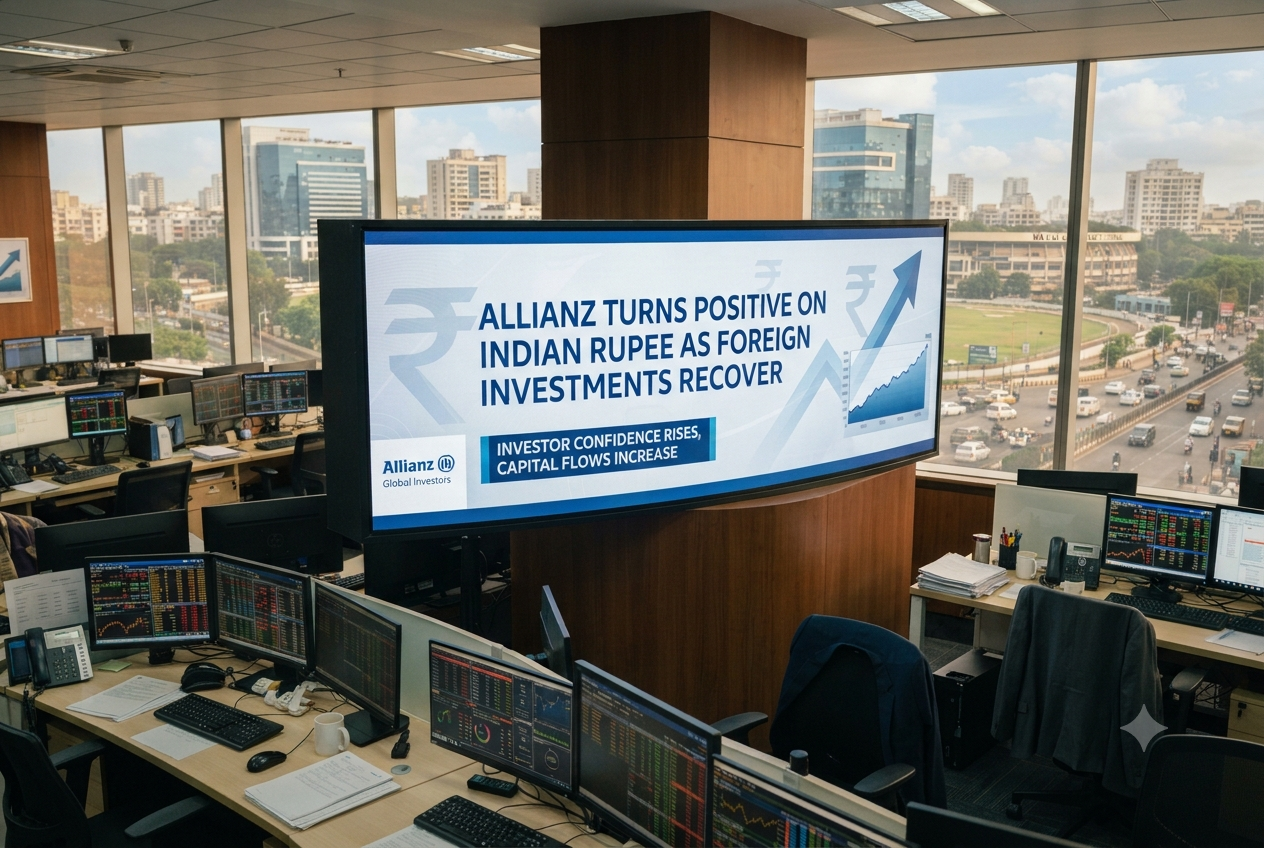
Allianz Global Investors has turned tactically positive on the Indian rupee, signalling improving confidence in the country’s currency following a strong return of foreign investment, softer crude oil prices and supportive measures by the Reserve Bank of India (RBI).
The rupee has recovered to a seven-month high of approximately ₹92.42 against the US dollar, marking a 4.5% appreciation from its record low of ₹96.96 recorded in May 2026. The recovery reflects a combination of improved external conditions, renewed foreign portfolio investment and reduced pressure on the domestic foreign exchange market.
According to a Reuters report published on November 25, foreign investors purchased more than $14 billion worth of Indian equities during November after withdrawing over $31 billion during the first ten months of the year.
The improvement in capital flows has encouraged Allianz Global Investors to adopt a more favourable short-term outlook for the rupee. However, the investment manager has emphasised that the recovery remains tactical, with its long-term sustainability dependent on oil prices, foreign investment and greater clarity over India’s trade relationship with the United States.
Foreign Investment Returns to Indian Financial Markets
The return of foreign portfolio investors has emerged as one of the strongest factors supporting the rupee’s recent appreciation.
Foreign investors had withdrawn substantial capital from Indian equities during the first ten months of 2026, creating pressure on domestic financial markets and increasing demand for US dollars.
November has brought a significant reversal in this trend. Overseas investors have purchased more than $14 billion in Indian equities, indicating renewed interest in domestic companies and investment opportunities.
The improvement has also extended to the debt market. Foreign investors purchased approximately $1.1 billion worth of Indian bonds during November after recording three consecutive months of outflows.
Ze Yi Ang, senior portfolio manager at Allianz Global Investors, described the recovery in foreign portfolio flows as significant, particularly in equities, while also acknowledging the supportive contribution from bond investments.
The renewed interest reflects changing global investment preferences. Concerns surrounding valuations in artificial intelligence-related markets and the sustainability of the technology-led rally have encouraged some investors to reconsider their international allocations.
India has consequently benefited from a shift in global capital towards other markets, supported by its domestic consumption potential, corporate growth opportunities and relatively favourable economic outlook.
Lower Crude Oil Prices Provide Additional Support
Falling crude oil prices have provided another important source of support for the Indian rupee.
India depends heavily on imported crude oil to meet its domestic energy requirements. Consequently, changes in international oil prices have a direct influence on the country’s import expenditure and demand for foreign currency.
When crude prices rise, oil-importing companies require additional dollars to purchase energy supplies. This can increase demand for the US currency and place depreciation pressure on the rupee.
Conversely, lower crude prices reduce the overall import bill, helping improve India’s external balance and easing demand for dollars.
The recent moderation in oil prices has therefore strengthened the environment for the rupee’s recovery.
Lower energy costs can also benefit the broader economy by reducing transportation expenses, industrial input costs and inflationary pressure. This may support corporate profitability and improve the financial position of oil-dependent industries.
However, the currency’s sensitivity to global energy markets remains an important consideration. A sudden increase in crude prices, particularly because of geopolitical disruptions, could reverse some of the recent gains.
RBI Measures Help Stabilise the Currency
The Reserve Bank of India has also played an important role in supporting the rupee during its period of weakness.
The central bank introduced several measures in recent months to address currency volatility, manage dollar demand and discourage excessive speculative activity in the foreign exchange market.
These steps have helped reduce pressure on the domestic currency and improve market stability.
According to Allianz Global Investors, RBI intervention, combined with lower oil prices and renewed foreign investment, contributed to the decision to adopt a tactically positive position on the rupee.
The recovery has also reduced immediate pressure on the central bank to use higher interest rates specifically to defend the currency.
During the period of significant rupee weakness, financial markets had considered the possibility of a 50-basis-point interest rate increase at the RBI’s December policy meeting.
However, expectations have since shifted towards a more moderate 25-basis-point increase. Current market expectations increasingly reflect domestic inflation concerns rather than the need to support the rupee through monetary tightening.
This distinction is important because monetary policy decisions influence borrowing costs, investment activity, consumer spending and overall economic growth.
Potential Bond Index Inclusion Could Attract More Capital
Another potential source of support for the rupee could emerge from India’s possible inclusion in the Bloomberg Global Aggregate Index in 2027.
According to Allianz Global Investors, successful inclusion could attract an estimated $20 billion in additional bond investment.
Global bond indices are followed by international investment funds and institutional investors. Inclusion can encourage funds tracking these benchmarks to allocate capital to the newly included market.
For India, such an inflow could provide a more stable source of foreign investment and strengthen demand for domestic government securities.
However, the potential benefit will depend on the timing of inclusion and the availability of predictable currency-hedging conditions.
Foreign investors often use currency derivatives to manage exchange-rate risks associated with investments in overseas bonds. Uncertainty or high costs in currency hedging can reduce the attractiveness of otherwise promising investment opportunities.
If India secures greater participation in international bond indices, the resulting investment could complement equity inflows and support the rupee over the medium term.
Nevertheless, the estimated $20 billion represents a potential opportunity rather than confirmed investment.
What Could Limit the Rupee’s Recovery?
Despite the improvement in market sentiment, Allianz Global Investors has cautioned that the rupee has not yet established a sustained recovery supported by all underlying economic fundamentals.
The investment manager believes that a more durable improvement would require three important conditions: stable crude oil prices, clarity on US trade terms and a continued return of foreign capital.
Any significant increase in oil prices could raise India’s import bill and increase demand for dollars.
Uncertainty surrounding trade agreements and tariff arrangements with the United States could also influence investor confidence, export prospects and capital allocation decisions.
Foreign investment flows remain another important variable. While November’s purchases have been substantial, investors could reverse their positions if global financial conditions deteriorate or opportunities elsewhere become more attractive.
Developments in global technology markets, particularly investor sentiment towards artificial intelligence companies, may also influence the direction of international capital.
Consequently, the rupee’s recent appreciation should be viewed as an improvement in market conditions rather than evidence that all external vulnerabilities have disappeared.
Implications for Businesses, Consumers and Investors
A stronger rupee can have several positive implications for the Indian economy.
Import-dependent businesses, particularly those purchasing crude oil, machinery, electronics, chemicals and industrial raw materials, may benefit from lower import costs when the currency appreciates.
Oil marketing companies and industries with significant foreign currency expenses could experience some relief in their operating costs.
For consumers, a stronger rupee can help moderate the domestic cost of imported products and energy-related goods, although the extent of any benefit depends on international prices, taxes and domestic pricing policies.
Export-oriented businesses may face a different impact. A stronger domestic currency can reduce the rupee value of foreign earnings and make Indian products relatively more expensive for overseas buyers, depending on pricing and currency arrangements.
Investors will also monitor the rupee’s direction because currency movements influence the returns earned by overseas investors on Indian assets.
A stable and predictable currency environment can improve confidence among international investors, particularly those considering long-term investments in Indian equities and government bonds.
The Worldonomics Times View
Allianz Global Investors’ decision to turn tactically positive on the Indian rupee reflects a meaningful improvement in India’s external financial environment.
The return of more than $14 billion in foreign equity investment during November, together with renewed bond purchases, lower crude oil prices and RBI measures, has helped reverse some of the pressure that affected the currency earlier in 2026.
However, the distinction between a tactical recovery and a durable currency trend remains important. Foreign portfolio flows can change quickly in response to global market developments, while India’s dependence on imported energy leaves the rupee exposed to fluctuations in international crude prices.
Potential inclusion in the Bloomberg Global Aggregate Index could provide another source of investment support in 2027, but the expected inflows remain conditional on successful inclusion and favourable currency-hedging arrangements.
Conclusion: The Indian rupee’s recovery to a seven-month high of ₹92.42 against the US dollar has encouraged Allianz Global Investors to adopt a tactically positive outlook. Strong foreign investment, lower oil prices and RBI intervention have improved market sentiment and reduced immediate pressure on the currency. However, sustaining the recovery will require stable external conditions, predictable trade arrangements and consistent foreign capital inflows. The coming months will determine whether the rupee’s recent improvement develops into a more durable trend.