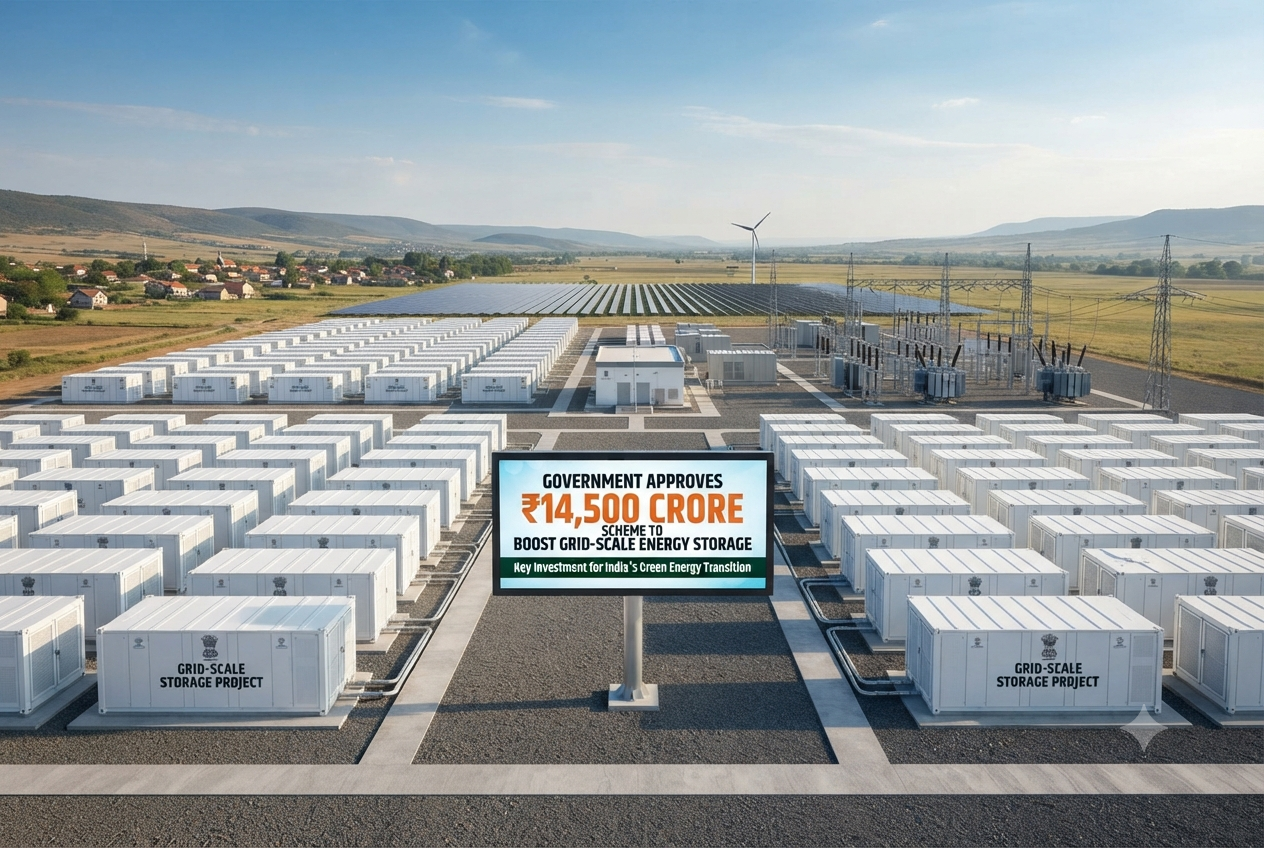
India has taken a significant step towards strengthening its electricity infrastructure with the Union Cabinet’s approval of a ₹14,500 crore Viability Gap Funding (VGF) scheme to support the development of 92 GWh of grid-scale energy storage capacity. Approved on November 4, 2026, the initiative is designed to accelerate renewable energy integration, improve electricity grid stability and support the country’s transition towards cleaner energy.
The scheme will operate from FY 2026–27 to FY 2030–31 and is expected to attract an estimated total investment of ₹97,600 crore. It will support battery energy storage systems, pumped hydro storage projects and emerging storage technologies, creating additional infrastructure to manage fluctuations in electricity generation and demand.
The approval comes as India expands its solar and wind power capacity and faces the growing requirement for reliable electricity storage to ensure uninterrupted power supply.
₹14,500 Crore VGF Scheme Targets 92 GWh Capacity
The government has structured the scheme to support three categories of energy storage technologies.
The planned allocation includes:
- 30 GWh of Battery Energy Storage Systems (BESS): These systems will store electricity in batteries and release it when required, helping manage peak demand and fluctuations in renewable energy generation.
- 60 GWh of Pumped Storage Projects (PSP): These facilities will use surplus electricity to pump water to elevated reservoirs and generate power when electricity demand increases.
- 2 GWh of emerging storage technologies: This allocation will support alternative energy storage solutions and encourage the development of new technologies.
Together, these projects are expected to create 92 GWh of additional grid-scale storage capacity.
The government estimates that the supported capacity will be equivalent to approximately 170% of India’s existing grid-scale energy storage capacity. It will also contribute towards meeting the country’s projected requirement of around 411 GWh of energy storage by FY 2031–32. <Cite refs={[“turn984762search1″,”turn984762search5″,”turn984762search13”]}/>
How Viability Gap Funding Will Support Projects
Viability Gap Funding is a financial support mechanism designed to make infrastructure projects commercially viable when their costs and expected revenues do not sufficiently attract private investment.
Large-scale energy storage projects often involve substantial initial capital expenditure. Battery systems require investment in cells, power conversion equipment, control systems and grid connections. Pumped hydro projects can require significant expenditure on reservoirs, civil construction, turbines and transmission infrastructure.
These costs can make storage projects financially challenging, particularly when electricity price differences between peak and off-peak periods are insufficient to recover the investment.
The ₹14,500 crore government support is intended to bridge part of this financial gap and encourage greater participation from public and private sector developers.
Projects will be allocated through a tariff-based competitive bidding process. Public and private sector electricity distribution companies will be eligible for support for battery and pumped hydro projects, while alternative storage technology projects will also be open to public and private sector entities. <Cite refs={[“turn984762search2″,”turn984762search6”]}/>
Battery Storage to Strengthen Renewable Energy Integration
Battery Energy Storage Systems are expected to play an increasingly important role in India’s electricity network.
Solar power generation is generally strongest during daylight hours, while electricity demand can remain high during the evening. Wind generation also varies depending on weather conditions.
Without sufficient storage infrastructure, electricity generated during periods of high renewable output may not always be available when demand increases.
Grid-scale battery systems can store surplus electricity and release it when required. This helps balance supply and demand, reduce pressure on conventional power generation and improve the utilisation of renewable energy.
BESS installations can also provide grid-support services, including frequency regulation and rapid responses to changes in electricity demand.
The planned 30 GWh battery storage capacity could therefore support a more flexible electricity system as India increases the share of renewable energy in its power mix.
Pumped Hydro Storage to Provide Long-Duration Support
The scheme’s largest allocation, 60 GWh, is dedicated to pumped hydro storage.
Unlike conventional battery installations, pumped storage facilities use water reservoirs at different elevations to store and generate electricity.
When surplus electricity is available, water is pumped from a lower reservoir to an upper reservoir. During periods of higher demand, the stored water is released through turbines to generate electricity.
Pumped hydro projects can provide large-scale storage over extended periods and help balance fluctuations in renewable power generation.
Their inclusion in the scheme reflects the government’s intention to develop a combination of storage technologies rather than depending exclusively on batteries.
However, project development will depend on factors such as suitable geographical locations, land availability, environmental clearances, construction timelines and financing requirements.
40% Domestic Content Requirement to Encourage Indian Manufacturing
A major feature of the scheme is its focus on strengthening domestic manufacturing.
Battery energy storage projects will be subject to a minimum Domestic Content Requirement of 40%. This provision is intended to encourage the use of domestically manufactured components, reduce dependence on imported equipment and create opportunities for Indian manufacturers.
The requirement could support investment across several parts of the energy storage value chain, including battery components, power electronics, control systems and related equipment.
Indian companies involved in battery manufacturing, engineering, electrical equipment, renewable energy infrastructure and industrial automation may find opportunities as project development accelerates.
The policy also complements broader efforts to establish a domestic battery manufacturing ecosystem and improve India’s long-term energy security. <Cite refs={[“turn984762search1″,”turn984762search8”]}/>
Opportunities for India’s Power and Renewable Energy Sector
The new scheme could create business opportunities across the electricity and infrastructure industries.
Battery manufacturers: Increased demand for grid-scale storage could encourage investment in battery production and related components.
Power infrastructure companies: Developers and engineering companies may benefit from opportunities involving storage installations, grid connections, power conversion systems and project construction.
Renewable energy developers: Storage facilities could help solar and wind power companies deliver electricity more consistently and improve the commercial value of renewable generation.
Electricity distribution companies: DISCOMs could benefit from improved management of peak demand and greater flexibility in procuring electricity.
Investors and project developers: The VGF mechanism may improve project economics and encourage participation in large infrastructure projects.
The estimated ₹97,600 crore investment associated with the scheme could also generate demand for construction services, electrical equipment, engineering, logistics and specialised technology solutions.
Challenges in Implementing the Energy Storage Programme
Despite the expected benefits, the successful implementation of the scheme will depend on several factors.
Battery storage projects will need to manage technology costs, battery performance, operating life, safety standards and recycling requirements. Developers will also need reliable access to battery materials and domestic manufacturing capabilities.
Pumped hydro projects generally require longer development periods and involve land, water-resource and environmental considerations. Delays in approvals or construction could affect project commissioning schedules.
Another important factor will be the financial health of electricity distribution companies. Their ability to enter into long-term power procurement and storage agreements will influence the commercial viability of projects.
Effective coordination between central and state governments, regulators, project developers and electricity utilities will therefore be essential.
The Worldonomics Times View
The ₹14,500 crore energy storage scheme represents an important development in India’s efforts to build a more flexible and reliable electricity system. As solar and wind generation expand, the ability to store electricity and release it when demand increases will become increasingly important.
The decision to support 30 GWh of battery storage alongside 60 GWh of pumped hydro and 2 GWh of emerging technologies provides a diversified approach to meeting future storage requirements.
The 40% domestic-content requirement is also significant because it connects energy infrastructure development with the growth of India’s manufacturing capabilities.
However, the success of the initiative will depend on timely project execution, competitive procurement, technological reliability and the financial viability of storage installations. The government will need to ensure that supported projects translate into operational capacity rather than remaining limited to investment announcements.
Conclusion: The Union Cabinet’s approval of ₹14,500 crore in viability gap funding for 92 GWh of grid-scale energy storage marks a major step in India’s clean energy transition. By supporting battery systems, pumped hydro projects and emerging technologies, the scheme aims to improve grid stability, strengthen renewable energy integration and attract an estimated ₹97,600 crore in investment. Its emphasis on domestic manufacturing could also create opportunities for Indian industry. Effective implementation will be crucial to ensuring that the additional storage capacity strengthens India’s electricity network and supports reliable, affordable power supply.