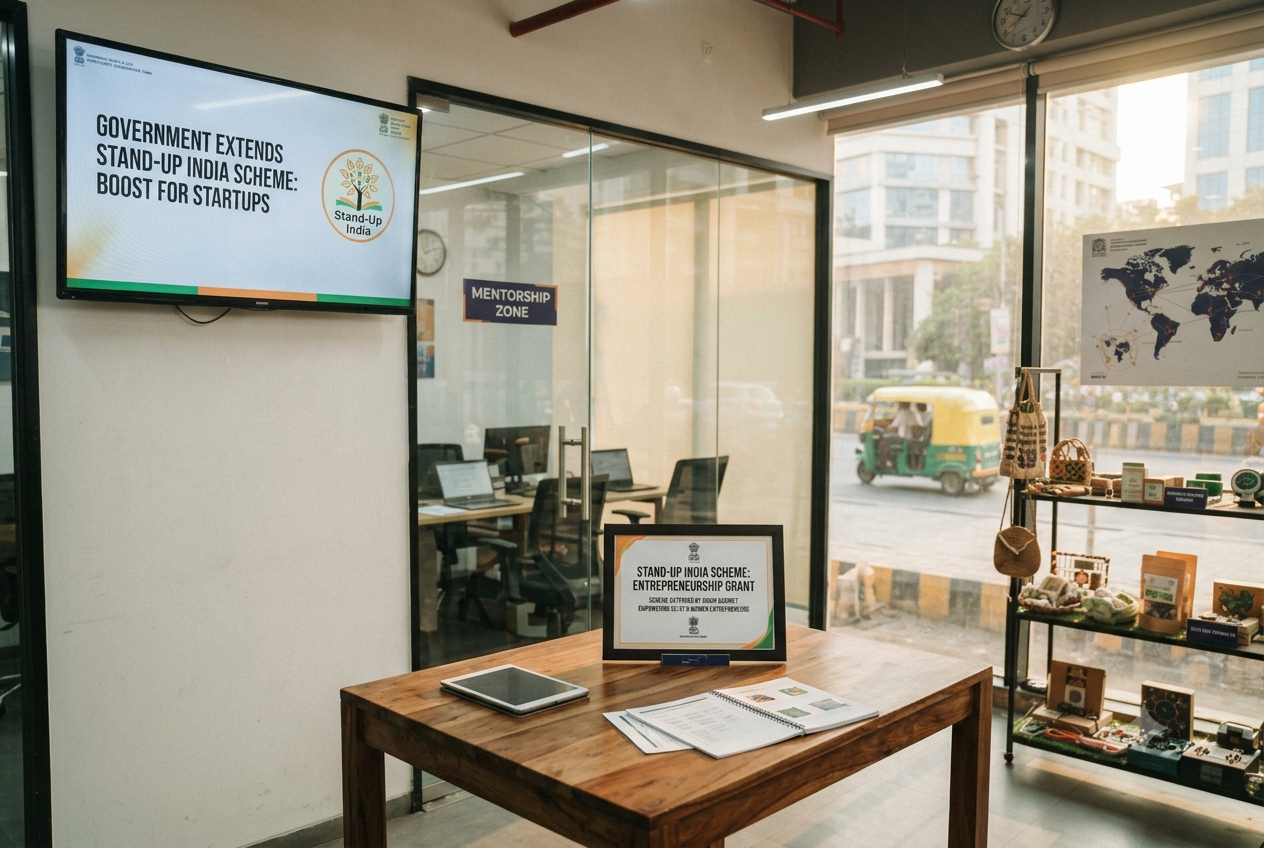
India has renewed its push for inclusive entrepreneurship, with the Union Cabinet approving the continuation of the Stand-Up India Scheme for another five years until March 31, 2031. The initiative aims to improve access to institutional finance for women and entrepreneurs from Scheduled Castes (SCs) and Scheduled Tribes (STs), enabling them to establish new businesses and participate more actively in the country’s economic development.
Approved on November 11, 2026, the extension includes a ₹4,111 crore Credit Guarantee Corpus and sets a target of providing financial assistance to at least 2.5 lakh additional entrepreneurs over the next five years. The decision builds on a programme that has facilitated loans to more than 2.75 lakh women and SC/ST entrepreneurs since its launch in April 2016.
The continuation is intended to strengthen access to formal credit, encourage business ownership among underserved communities and support employment generation across multiple sectors.
Five-Year Extension Targets 2.5 Lakh New Entrepreneurs
The extended scheme will operate until March 31, 2031, with a focus on helping eligible entrepreneurs establish greenfield enterprises, meaning businesses that are newly set up rather than existing operations being expanded.
The government’s target is to support at least 2.5 lakh additional entrepreneurs during the extension period. This reflects an effort to widen the reach of institutional finance and create opportunities for individuals who may face difficulties accessing conventional business loans.
The ₹4,111 crore credit guarantee corpus is an important component of the renewed programme. It is designed to provide greater assurance to lending institutions against potential credit risks and encourage banks to extend loans to eligible borrowers.
By strengthening the credit guarantee framework, the government aims to improve the willingness of financial institutions to finance first-time entrepreneurs and businesses from communities that have historically faced barriers to formal credit.
Loan Support of Up to ₹1 Crore
Under the Stand-Up India Scheme, eligible women and SC/ST entrepreneurs can access bank loans of more than ₹10 lakh and up to ₹1 crore for establishing new enterprises.
The financial assistance can be structured in two ways:
- Composite loan: Combines a term loan and working capital to meet both investment and day-to-day business requirements.
- Term loan: Provides financing for eligible business investment requirements.
The loan can cover up to 85% of the project cost, subject to the scheme’s applicable conditions. This can help entrepreneurs finance essential requirements such as machinery, equipment, infrastructure, business premises and initial operating expenses.
The credit guarantee coverage has been set at 85% of the loan amount, with a standard guarantee fee of 0.50%. The guarantee mechanism is intended to reduce the lending institution’s exposure to credit risk and support the flow of finance to eligible businesses.
However, the scheme provides bank credit rather than an unconditional grant. Applicants must meet the applicable eligibility, project appraisal and lending requirements.
Manufacturing, Services and Trading Among Eligible Sectors
The programme covers a broad range of economic activities, allowing entrepreneurs to establish businesses across several industries.
Eligible sectors include:
- Manufacturing
- Services
- Trading
- Agriculture-allied activities
This wide coverage creates opportunities for businesses ranging from small manufacturing units and service enterprises to trading operations and agriculture-related ventures.
For example, an eligible entrepreneur may seek financing to establish a manufacturing facility, launch a professional service business, set up a trading enterprise or develop an agriculture-linked commercial activity.
The inclusion of multiple sectors is significant because entrepreneurship opportunities and financing requirements vary across regions and communities. A flexible sectoral approach can help the scheme reach a wider range of business models.
Improving Access to Institutional Finance
Access to finance remains one of the important challenges for first-time entrepreneurs. Individuals with limited collateral, business experience or established credit histories may find it difficult to secure loans from formal financial institutions.
These challenges can be particularly significant for women entrepreneurs and members of historically underserved communities.
The Stand-Up India Scheme seeks to address this gap by connecting eligible borrowers with institutional lending channels and supporting the financing of new enterprises.
The credit guarantee component is central to this approach. By covering a substantial portion of the eligible loan amount, it is intended to reduce the risk faced by banks and encourage lending to entrepreneurs who may otherwise struggle to obtain business finance.
Improved access to formal credit can also help businesses build financial records, develop banking relationships and establish a foundation for future growth.
Supporting Women-Led and SC/ST-Owned Businesses
A key objective of the scheme is to broaden participation in India’s entrepreneurial ecosystem.
Women-led businesses can contribute to household incomes, employment generation and local economic development. Similarly, improving access to finance for SC/ST entrepreneurs can create opportunities for business ownership, professional advancement and wealth creation.
The scheme’s continuation is therefore relevant beyond the number of loans disbursed. Its wider objective is to encourage greater participation in enterprise creation and make formal financial support more accessible to communities that have faced structural barriers.
If implemented effectively, the programme could help strengthen small businesses in urban as well as rural markets and encourage entrepreneurship beyond established commercial centres.
Implementation and Monitoring Will Be Important
While the extension provides a stronger framework for credit access, its impact will depend on effective implementation.
Banks and financial institutions will play a central role in identifying eligible applicants, evaluating business proposals and ensuring timely loan disbursement. Awareness of the scheme will also be important, particularly among potential entrepreneurs who may not be familiar with available institutional financing options.
Another important factor will be the quality of business support available to beneficiaries. Access to credit alone does not guarantee the success of a new enterprise. Entrepreneurs also need financial literacy, market knowledge, technical skills, mentoring and guidance on regulatory compliance.
Monitoring loan performance, business survival and employment generation will help assess whether the scheme is delivering sustainable economic benefits.
The Worldonomics Times View
The continuation of the Stand-Up India Scheme is a positive step towards making entrepreneurship more inclusive. The ₹4,111 crore credit guarantee corpus and the target of supporting 2.5 lakh additional entrepreneurs provide a renewed framework for expanding institutional finance among women and SC/ST communities.
The programme’s focus on greenfield enterprises is particularly important because it encourages the creation of new businesses rather than limiting support to established companies.
However, the success of the initiative should not be measured only by the number or value of loans sanctioned. The long-term objective must be to help beneficiaries build viable businesses that generate income, create employment and remain financially sustainable.
Stronger coordination between banks, government agencies and business-support institutions will be essential to achieve these outcomes.
Conclusion: The Union Cabinet’s decision to extend the Stand-Up India Scheme until March 31, 2031, reinforces the government’s commitment to inclusive entrepreneurship and wider access to institutional finance. With a ₹4,111 crore credit guarantee corpus, loans of up to ₹1 crore and a target of assisting at least 2.5 lakh additional entrepreneurs, the programme aims to create new opportunities for women and SC/ST business owners. Its lasting impact will depend on effective implementation, accessible credit and continued support that helps new enterprises grow into sustainable businesses.