Over the past decade, India’s Corporate Social Responsibility (CSR) mandate under Section 135 of the Companies Act, 2013 has evolved from a broad philanthropic nudge into a tightly policed statutory regime. While corporate CSR spending has scaled impressively, boards, CSR committees, and statutory auditors have routinely struggled with ambiguous grey zones—ranging from whether in-kind product donations qualify, to high compliance overheads for impact assessments, to limited regulatory visibility once funds are transferred to implementing agencies.
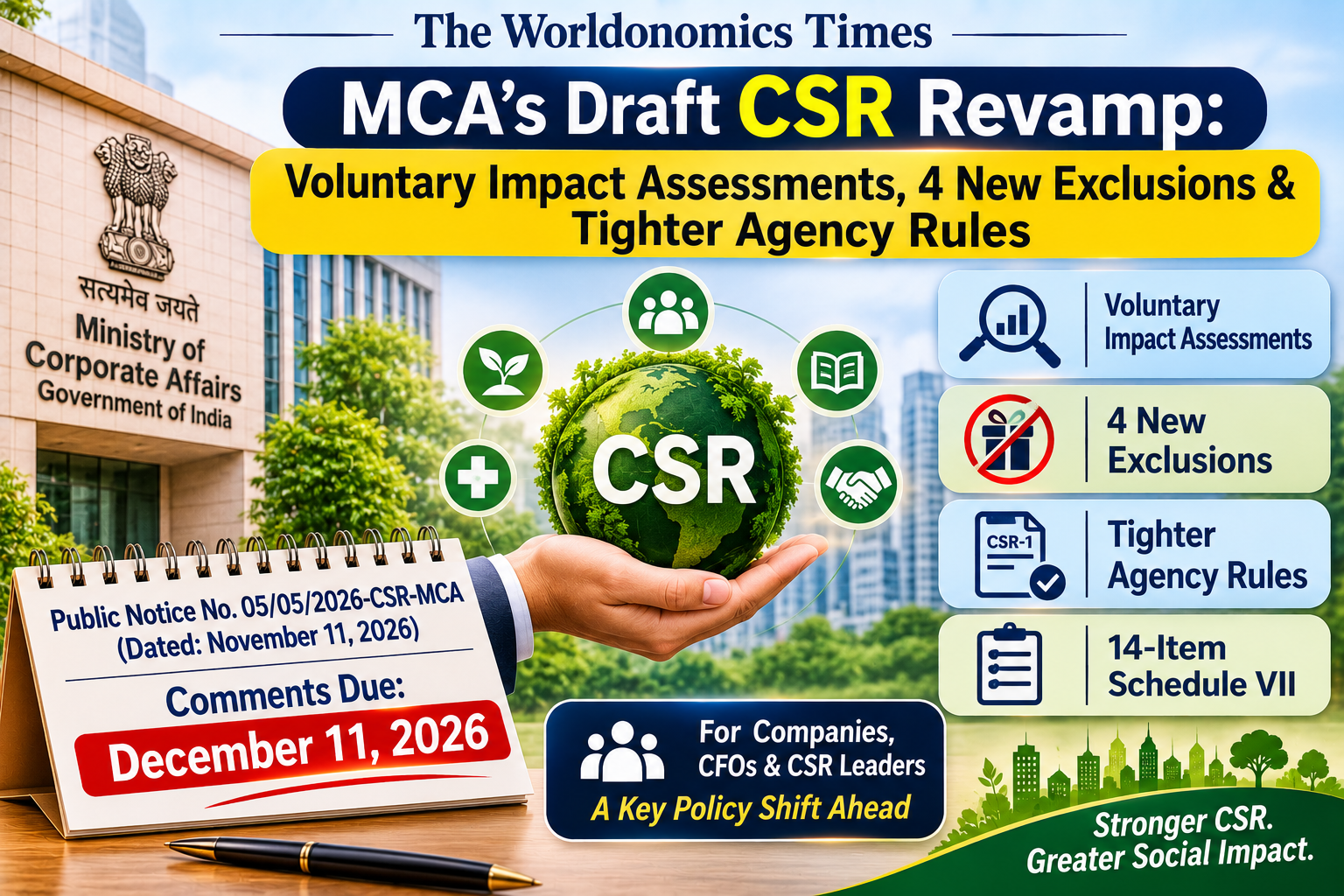
To address these structural gaps, the Ministry of Corporate Affairs (MCA) issued Public Notice No. 05/05/2026-CSR-MCA (dated November 11, 2026), inviting stakeholder comments through the MCA e-consultation module until December 11, 2026. The consultation covers two far-reaching instruments: the draft Companies (Corporate Social Responsibility Policy) Second Amendment Rules, 2026, and a draft notification substituting Schedule VII of the Companies Act, 2013. For CFOs, company secretaries, and CSR leaders, this revamp signals a decisive shift toward cleaner spending definitions and strict agency accountability.
1. Impact Assessment Becomes Voluntary Under Rule 8(3)
Under the existing Rule 8(3) of the CSR Rules, 2014, companies with an average CSR obligation of ₹10 crore or more in the three preceding financial years are mandated to undertake an independent impact assessment for projects having outlays of ₹1 crore or more that have been completed at least one year prior. Many large corporates viewed this blanket mandate as a costly, tick-the-box exercise for routine, well-established social initiatives.
The draft Second Amendment Rules, 2026 replace this mandate with flexibility. Under the proposed Rule 8(3), any CSR-mandated company may voluntarily undertake an impact assessment of its CSR projects through an independent agency, irrespective of its CSR obligation size. However, transparency guardrails remain firmly intact:
- If a company opts for an impact assessment, the report must still be placed before the Board of Directors and annexed to the annual report on CSR.
- The existing expenditure cap is retained—companies may book impact assessment costs as CSR expenditure up to 2% of total CSR expenditure for that financial year or ₹50 lakh, whichever is higher.
2. Four New Express Exclusions Under Rule 2(1)
Historically, several CSR disqualifications existed only inside MCA General Circulars (such as General Circular No. 14/2021), leaving room for aggressive interpretation during statutory audits. The draft rules codify four specific exclusions directly into Rule 2(1), making it unambiguous that the following will not qualify as permissible CSR expenditure:
- One-off events: Short-term marathons, awards, charitable concerts, or standalone promotional events without sustained developmental impact.
- Financing Government schemes: Direct corporate funding of routine government-run welfare schemes.
- Contributions to any corpus fund: Parking CSR money in the permanent corpus or endowment fund of any trust, society, or entity.
- In-kind contributions of a company’s own products or services: Companies can no longer clear unsold inventory or donate routine services and claim CSR credit. The sole exception is immediate relief distribution during disaster management. An added Explanation clarifies that free distribution of goods or services to unrelated parties generally does not constitute a taxable supply in the absence of consideration, and where valuation is required, it must be computed on an arm’s length basis (open market value, net of taxes).
Additionally, the draft formally removes the expired temporary proviso permitting specified COVID-19 research and development expenditure up to FY 2022–23.
3. Full Lifecycle Governance for Implementing Agencies (Rules 4(1) & 4(2A)–4(2C))
The sharpest compliance teeth in the 2026 draft target CSR implementing agencies. Until now, NGOs, trusts, and Section 8 companies simply filed Form CSR-1 once to obtain a CSR Registration Number, with minimal ongoing regulatory oversight. The draft introduces a comprehensive lifecycle regime:
- Updated Eligibility & Tax Alignment (Rule 4(1)): Tax registration references are updated to align with Sections 332 and 354 of the Income Tax Act, 2025. Notably, international organizations having their global headquarters in India (under Rule 2(1)(g)) are now added as eligible implementing agencies.
- Voluntary Surrender (New Rule 4(2A)): Implementing agencies that no longer wish to handle CSR funds can formally apply to surrender their CSR registration number.
- Cancellation & Deactivation (New Rule 4(2B)): If an agency misuses funds or violates eligibility norms, the Central Government may cancel or deactivate its registration. Upon cancellation, the agency must immediately cease handling CSR money, transfer any unspent or unutilized CSR funds in its possession to a Schedule VII fund within 30 days, and face a three-year bar on applying for fresh registration unless directed otherwise. Importantly, cancellation of an agency’s registration does not absolve the funding company of its statutory CSR obligations.
- 30-Day Update Mandate (New Rule 4(2C)): Any change in Form CSR-1 particulars—such as trustees, registered address, or tax registration status—must be reported to the Central Government within 30 days by filing Form CSR-1 with proof, and simultaneously intimated to the concerned funding company. (Section 8 companies are exempt from this sub-rule since their particulars are already tracked via MCA V3 filings).
4. A Modernized 14-Item Schedule VII
The accompanying draft notification reorganizes Schedule VII from 13 items (following the June 2026 addition of Social Stock Exchange instruments) into 14 modernized, clearly articulated heads. New express entries bring contemporary corporate priorities squarely inside the statutory net, including mental health, telemedicine, transgender welfare, substance-abuse care, career counselling, the PM Internship Scheme, clean energy, natural farming, agroforestry, marine conservation, e-waste management, animal welfare, and sports infrastructure and coach development. Equally welcome is an explicit “Liberal Interpretation” note, instructing regulators and auditors to interpret Schedule VII entries broadly to capture the essence of the listed subjects.
(Note for corporate boards: A separate proposal to raise the CSR net-profit applicability threshold from ₹5 crore to ₹10 crore sits in the Corporate Laws (Amendment) Bill, 2026 before a Joint Parliamentary Committee and is not part of this MCA consultation.)
5. Before vs. After: Key Shifts at a Glance
| CSR Framework Area | Current Provision (CSR Rules, 2014) | Proposed 2026 Draft Amendment | Action for Corporate Teams |
| Impact Assessment (Rule 8(3)) | Mandatory for ≥₹10 Cr CSR obligation & ≥₹1 Cr projects. | Voluntary for all CSR-mandated companies; Board disclosure retained. | Re-evaluate FY 2026–27 assessment budgets before committing retainers. |
| Excluded Spends (Rule 2(1)) | Partly governed by non-binding FAQ circulars. | Explicitly bars one-off events, govt schemes, corpus, and non-disaster in-kind goods. | Audit current CSR pipeline to eliminate corpus or event-based spends. |
| Agency Oversight (Rule 4) | One-time Form CSR-1 registration. | Adds surrender, cancellation (3-yr bar + 30-day fund transfer), and 30-day CSR-1 updates. | Strengthen NGO due diligence; collect utilization certificates and active CSR-1 proofs. |
| Schedule VII Scope | 13 legacy categories. | 14 modernized categories + explicit liberal interpretation mandate. | Align ESG, climate, mental health, and PM Internship budgets with new heads. |
Because these proposals remain under public consultation until December 11, 2026, companies should not prematurely alter existing FY 2026–27 statutory compliances. Instead, CSR committees and finance leads should map their current NGO partners against the proposed cancellation triggers, review ongoing in-kind or event-linked commitments, and submit structured industry feedback on the MCA e-consultation portal before the window closes.
Author Bio:CMA Vivek Kumar is a qualified Cost and Management Accountant (ACMA), CA Final, and a B.Com (Accounting Honours) graduate with extensive experience in statutory and tax audits, direct and indirect taxation, and ROC/MCA corporate compliances. He is an author at The Worldonomics Times and the founder of VK Chartered Academy (https://www.cacmacstestseries.com). He specializes in financial statement finalization, GST advisory, and regulatory filings for diverse business entities. Beyond corporate practice, he actively mentors CA, CMA, and CS aspirants by providing structured academic guidance and conceptual clarity, while designing and conducting rigorous, exam-oriented test series and mock evaluations aligned with current statutory standards. He is dedicated to bridging practical industry expertise with focused exam preparation to empower future finance professionals.