For nearly a decade under India’s Goods and Services Tax (GST) regime, one statutory clause has haunted honest business owners, Chief Financial Officers, and tax practitioners more than any other: Section 16(2)(c) of the CGST Act, 2017. Under this provision, a buyer is barred from claiming Input Tax Credit (ITC) unless the tax charged on the supply has been actually paid to the Government by the supplier—either in cash or through valid utilization of credit.
In commercial reality, this created an impossible burden. A genuine buyer could purchase raw materials, receive physical delivery backed by valid e-way bills, verify the invoice on Form GSTR-2B, and pay the full invoice value plus GST to the vendor through banking channels—only to receive a departmental show-cause notice years later demanding reversal of that ITC with interest and penalty because the vendor defaulted on filing GSTR-3B or vanished.
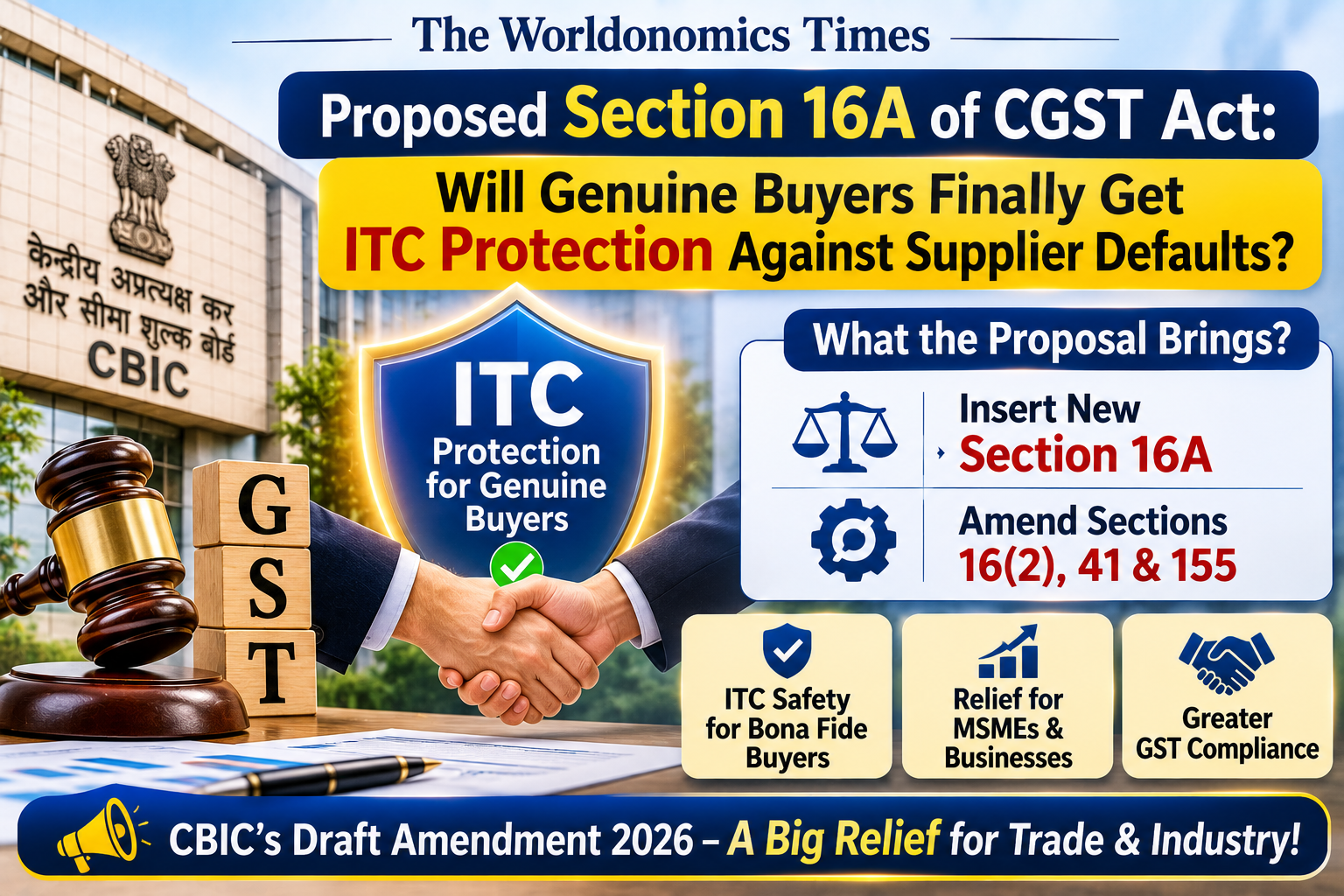
That long-standing friction may finally be nearing a legislative breakthrough. Following deliberations at the 57th GST Council meeting, the Central Board of Indirect Taxes and Customs (CBIC) GST Policy Wing issued Office Memorandum File No. CBIC-20006/77/2026-GST (dated November 10, 2026), circulating a draft agenda note to the Standing Committee of Officers. The proposal outlines sweeping amendments to Sections 16(2), 41, and 155 alongside the insertion of a brand-new Section 16A. With trade associations and practitioner bodies submitting fresh representations on November 25, 2026, to fine-tune the safeguards, every GST-registered business needs to understand what this structural shift entails.
1. The Core Relief: Overhauling Section 16(2)(b) and Section 16(2)(c)
The heart of CBIC’s draft proposal lies in dismantling the strict liability placed on honest recipients for upstream supplier defaults.
- Omission of the Tax-Payment Condition in Section 16(2)(c): The draft agenda note proposes omitting the stringent requirement under Section 16(2)(c) that makes the recipient’s ITC conditional on the supplier’s actual payment of tax to the Government, while retaining the statutory linkage to Section 41. In effect, once a genuine transaction is executed and reported, the department’s primary recourse for unpaid output tax shifts back to where it legally belongs—recovery proceedings against the defaulting supplier rather than penalizing the buyer.
- Tightening Section 16(2)(b) for Supply Chain Integrity: To prevent this relaxation from being exploited by paper-invoice operators, CBIC simultaneously proposes amending Section 16(2)(b). Currently, Section 16(2)(b) requires that the recipient has received the goods or services. The proposed amendment sharpens this condition to mandate receipt of goods or services from the invoicing supplier. This ensures that a buyer cannot claim ITC on an invoice raised by Entity A when the actual goods were procured off-market from an unregistered Entity B—a classic hallmark of bill-trading rackets.
2. Introducing Section 16A: Drawing a Bright Legal Line Against Fraud
To balance ease of doing business with revenue protection, CBIC proposes inserting Section 16A into the CGST Act, 2017. Rather than using a blunt instrument that punishes all buyers whenever a vendor defaults, Section 16A establishes a targeted anti-fraud bar.
Under the proposed Section 16A, Input Tax Credit will be expressly denied where an investigation establishes that the recipient knowingly assisted, participated in, or was concerned with the issuance or utilization of invoices without an actual supply of goods or services—including fraudulent transactions occurring at an earlier stage of the supply chain.
This legislative design directly codifies the distinction repeatedly emphasized by Indian courts in landmark judgments referenced in CBIC’s agenda note, including On Quest Merchandising India Pvt. Ltd., Shanti Kiran India, Maruti Enterprise, and Shaurya Alloys. Across these rulings, the judiciary consistently held that tax statutes must separate two completely different classes of taxpayers:
- Bona fide purchasing dealers who transacted in good faith, paid consideration through verifiable banking channels, and possessed no mechanism to police their vendor’s treasury deposits.
- Collusive participants who knowingly engaged in circular trading, fake invoicing, or tax evasion networks.
By shifting the denial trigger to proven knowledge, collusion, or participation in fake invoicing, Section 16A promises to dramatically curtail arbitrary Section 73/74/74A demands against compliant MSMEs.
3. Consequential Shifts in Sections 41 and 155
A common misconception circulating among traders is that omitting the tax-payment condition in Section 16(2)(c) removes all compliance responsibility from the buyer. A close reading of the draft agenda note confirms this is not the case.
- Section 155 (Burden of Proof): The proposed framework retains the core principle of Section 155—the legal burden of proving eligibility to claim ITC continues to rest squarely on the person claiming the credit. If a departmental audit questions a purchase, the buyer must still produce ironclad evidence of genuine commercial movement and payment.
- Section 41 (Availment and Reversal): Consequential adjustments to Section 41 are proposed so that self-assessed ITC availment and reversal rules operate harmoniously with the modified Section 16(2) and new Section 16A, while explicitly preserving the tax authorities’ statutory powers to recover unpaid tax, interest, and penalties directly from defaulting suppliers.
4. Current Law vs. Proposed Framework: A Practical Comparison
| Statutory Parameter | Existing CGST Framework | Proposed CBIC Draft (Nov 2026) | Practical Impact on Businesses |
| Section 16(2)(c) | ITC blocked unless supplier actually deposits tax with the Government. | Proposes omitting the supplier tax-payment condition (retaining Sec. 41 link). | Shields bona fide buyers from losing working capital over vendor GSTR-3B defaults. |
| Section 16(2)(b) | Requires receipt of goods or services. | Requires receipt of goods or services from the invoicing supplier. | Eliminates “bill-to-ship-to” misuse and third-party invoice substitution. |
| New Section 16A | No standalone statutory clause separating innocent buyers from fraud rings. | Expressly denies ITC where investigation proves knowing participation in fake invoices. | Concentrates enforcement on fraudsters while reducing litigation for genuine MSMEs. |
| Section 155 | Burden of proving ITC eligibility lies on the claimant. | Principle retained alongside Sections 16 and 16A. | Buyers must still maintain complete audit trails to prove bona fide status. |
5. What Finance Teams Should Do Right Now
Crucially, businesses must remember that OM File No. CBIC-20006/77/2026-GST is a draft agenda note, not an enacted amendment. It must pass through the Standing Committee of Officers, receive formal approval from the GST Council, and be enacted through a Finance Bill before taking legal effect.
Until the statutory language is notified, finance teams and MSMEs should not relax their vendor controls. Instead, use this window to build a “Bona Fide Buyer Dossier” for every significant procurement: retain signed lorry receipts, weighment slips, gate-inward registers, e-way bills, and bank payment advices tied directly to the invoicing supplier’s GSTIN, alongside monthly Invoice Management System (IMS) and GSTR-2B reconciliations. If Section 16A becomes law, this exact documentation will serve as your legal shield against departmental scrutiny.
Author Bio:
CMA Vivek Kumar is a qualified Cost and Management Accountant (ACMA), CA Final, and a B.Com (Accounting Honours) graduate with extensive experience in statutory and tax audits, direct and indirect taxation, and ROC/MCA corporate compliances. He is an author at The Worldonomics Times and the founder of VK Chartered Academy (www.cacmacstestseries.com). He specializes in financial statement finalization, GST advisory, and regulatory filings for diverse business entities. Beyond corporate practice, he actively mentors CA, CMA, and CS aspirants by providing structured academic guidance and conceptual clarity, while designing and conducting rigorous, exam-oriented test series and mock evaluations aligned with current statutory standards. He is dedicated to bridging practical industry expertise with focused exam preparation to empower future finance professionals.