India’s securities market has witnessed explosive retail participation over the past five years, pushing demat and mutual fund accounts to historic highs. Yet behind the sleek mobile interfaces of modern broking and wealth-tech apps, the back-end Know Your Client (KYC) plumbing has often struggled to keep pace. Investors switching brokers or opening accounts across multiple asset classes frequently faced repetitive document uploads, mismatched validation statuses, and lingering data-privacy risks when closed accounts remained linked to legacy KYC Registration Agencies (KRAs).
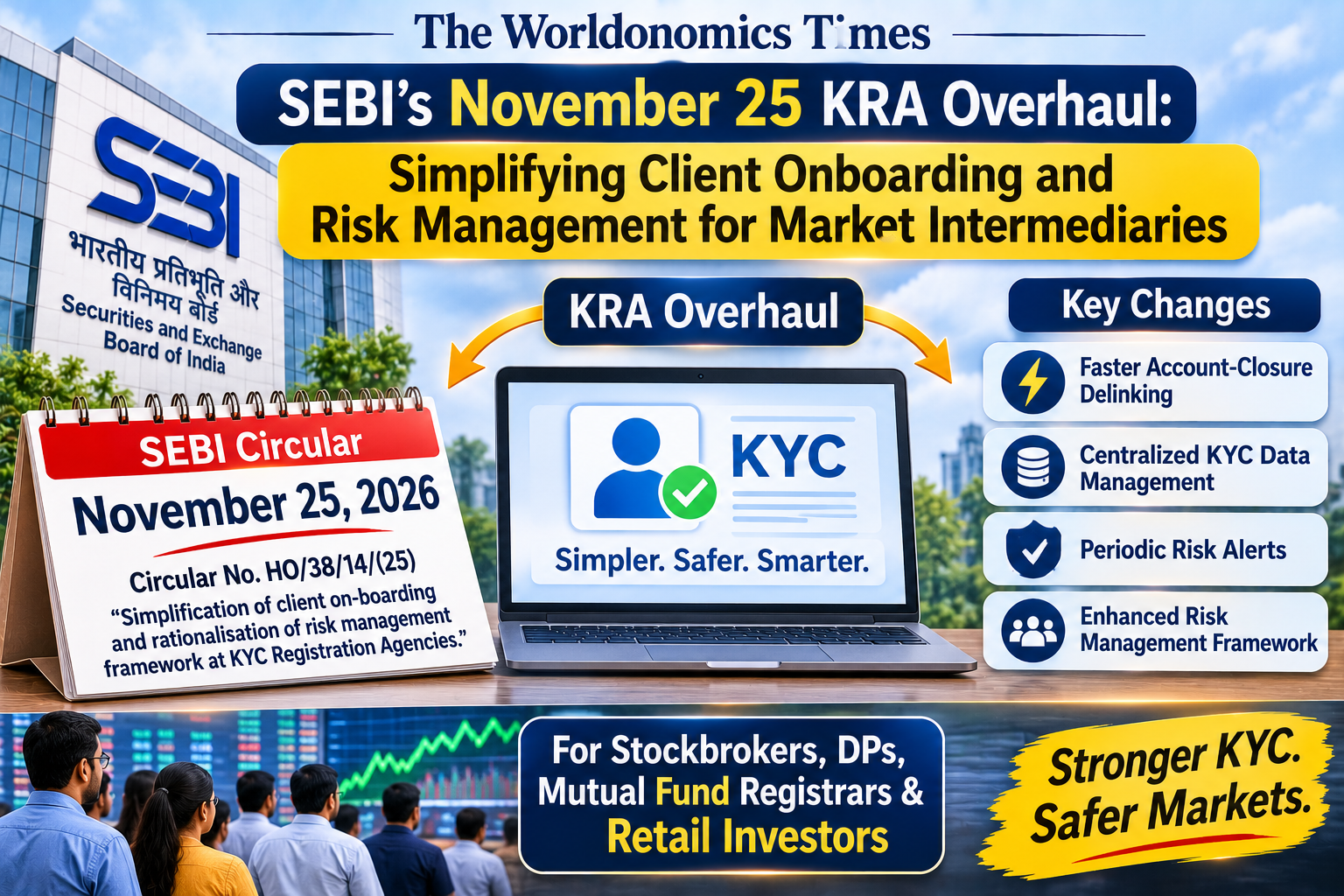
On November 25, 2026, the Securities and Exchange Board of India (SEBI) addressed these operational bottlenecks head-on by issuing Circular No. HO/38/14/(25) titled “Simplification of client on-boarding and rationalisation of risk management framework at KYC Registration Agencies.” Released alongside SEBI’s half-yearly review of Significant Indices under the SEBI (Index Providers) Regulations, 2024, this circular translates SEBI’s January 16, 2026 consultation paper into binding market infrastructure rules. For stockbrokers, depository participants (DPs), mutual fund registrars (RTAs), and retail investors alike, the circular redefines how KYC data is collected, updated, protected, and retired.
1. Why the KRA Ecosystem Needed a Structural Reset
Under the SEBI {KYC (Know Your Client) Registration Agency} Regulations, 2011, KRAs were conceived as centralized repositories so that an investor completing KYC once with one registered intermediary would not have to repeat the process elsewhere. Over time, however, three practical pain points emerged:
- Stale Linkages After Account Closure: When a client closed a trading or demat account, intermediaries had no uniform, tight statutory window to notify the KRA. As a result, dormant intermediaries continued to retain access to or receive modification feeds for former clients’ KYC records—creating avoidable data-privacy and misuse vulnerabilities.
- Fragmented Supplementary Data: While basic identity and address proofs sat with KRAs, supplementary client details—such as updated income brackets, occupation changes, or contact attributes—were repeatedly collected in silos by every new broker or AMC.
- Validation Friction: Minor inconsistencies between Aadhaar, PAN, mobile numbers, and email IDs across KRA databases triggered “KYC On-Hold” flags, freezing legitimate investor transactions until manual re-verification was completed.
2. Faster Account Closure Reporting and Mandatory Delinking
One of the most consequential investor-protection upgrades in SEBI’s 2026 KRA framework is the introduction of strict turnaround timelines for account closures and data delinking.
Following the blueprint established in the January 2026 consultation paper, registered intermediaries (stockbrokers, DPs, mutual funds, portfolio managers, and investment advisers) are now bound to intimate the concerned KRA within a tight window—structured around 3 working days of account closure. Upon receiving this closure intimation, the KRA must promptly update and delink the KYC record within 2 working days.
From a compliance and risk-management standpoint, this closed-loop delinking mechanism accomplishes two critical goals: it cuts off unauthorized post-closure data access by former intermediaries, and it ensures that KRA databases accurately reflect live, active market relationships rather than bloated historical logs.
3. Centralizing Supplementary Data and Proactive Investor Alerts
To genuinely deliver on “Ease of Doing Investment,” the rationalized KRA framework shifts the burden of repetitive data collection away from the investor and onto centralized KRA infrastructure:
- Centralized Supplementary Repository: KRAs are tasked with centralizing supplementary client data alongside core KYC attributes. When an existing investor onboards with a new SEBI-registered intermediary, the intermediary can fetch a comprehensive, standardized data payload directly from the KRA via API—slashing onboarding drop-offs and cutting compliance verification costs.
- Periodic Update Alerts: Instead of waiting for an account to freeze during a sudden compliance sweep, KRAs will proactively trigger periodic update alerts to investors, prompting them to confirm or refresh critical contact and demographic details.
- Structured Legacy Remediation: To ensure the existing universe of tens of millions of investor accounts transitions smoothly without market disruption, the framework establishes phased 3-to-6-month remediation windows for updating legacy KYC records to the new rationalized standards.
4. Connecting the Dots: SEBI’s Broader 2026 KYC Architecture
The November 25 circular does not operate in isolation; it is the capstone of a coordinated year-long overhaul of India’s capital market KYC architecture. Compliance officers must read Circular No. HO/38/14/(25) alongside four other major 2026 SEBI directives:
- August 20, 2026: Enabling seamless KYC information sharing by KRAs with entities regulated by the International Financial Services Centres Authority (IFSCA) at GIFT City.
- October 30, 2026: Rationalizing the periodicity of KYC reviews for Foreign Portfolio Investors (FPIs).
- November 4, 2026: Reviewing and easing KYC onboarding and re-KYC norms for individual Persons Resident Outside India (NRIs/OCIs).
- November 11, 2026: Aligning FATCA and CRS reporting requirements with the newly enacted Income-Tax Act, 2025 read with the Income-Tax Rules, 2026.
Together, these circulars point toward a single regulatory philosophy: frictionless digital onboarding at the front end, backed by automated, audit-ready risk controls at the KRA layer.
5. Compliance Action Plan for Market Stakeholders
| Market Participant | Key Requirement Under the Nov 25 Framework | Immediate Operational Priority |
| Stockbrokers & DPs | Rapid account-closure intimation to KRAs; API pull of centralized supplementary data. | Reconfigure CRM and back-office closure workflows to trigger automated KRA pings within 3 working days. |
| KYC Registration Agencies (KRAs) | 2-working-day delinking SLA; centralized supplementary data hosting; periodic investor alerts. | Upgrade API payloads, alert engines, and audit logs to meet strict delinking turnaround times. |
| Compliance & Audit Teams | Legacy KYC remediation within prescribed 3–6 month timelines; risk-based validation checks. | Run exception reports on dormant/closed accounts and verify alignment with FATCA/CRS 2026 norms. |
| Retail Investors | Respond to periodic KRA update alerts; maintain consistent PAN, mobile, and email records. | Verify KRA status as “Validated” to ensure uninterrupted trading, SIPs, and account portability. |
For market intermediaries, compliance with SEBI’s November 25 KRA overhaul is not merely a regulatory checkbox—it is an operational competitive advantage. Firms that swiftly integrate automated closure delinking and centralized KRA data pulls into their onboarding stacks will reduce client acquisition friction, minimize regulatory inspection findings, and build stronger investor trust in an increasingly digital capital market.
Author Bio:Vivek Kumar is a qualified Cost and Management Accountant (ACMA), CA Final, and a B.Com (Accounting Honours) graduate with extensive experience in statutory and tax audits, direct and indirect taxation, and ROC/MCA corporate compliances. He is an author at The Worldonomics Times and the founder of VK Chartered Academy (Website-https://www.cacmacstestseries.com). He specializes in financial statement finalization, GST advisory, and regulatory filings for diverse business entities. Beyond corporate practice, he actively mentors CA, CMA, and CS aspirants by providing structured academic guidance and conceptual clarity, while designing and conducting rigorous, exam-oriented test series and mock evaluations aligned with current statutory standards. He is dedicated to bridging practical industry expertise with focused exam preparation to empower future finance professionals.