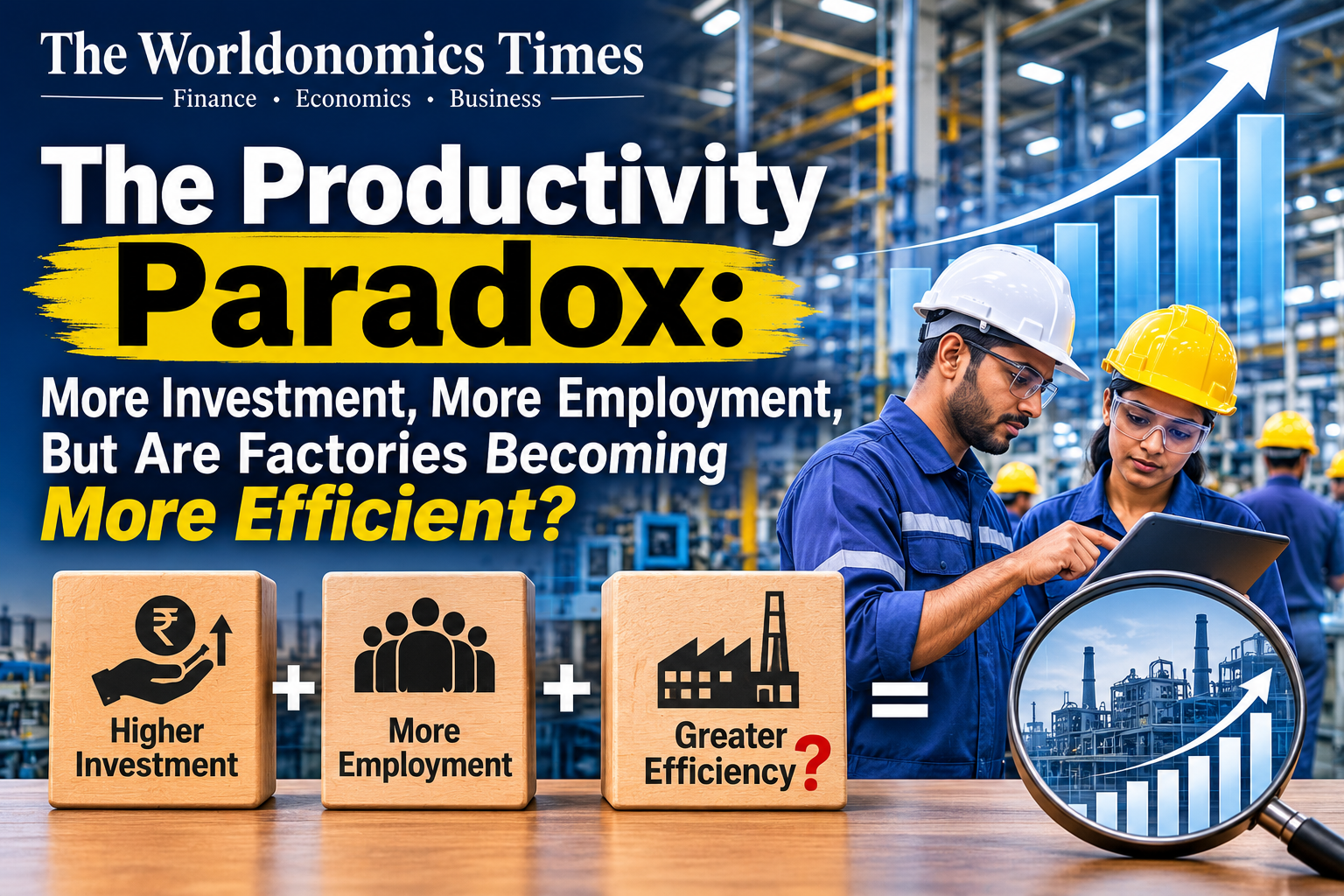
India’s manufacturing sector is entering an important phase of expansion. New factories, industrial investments, infrastructure development and government initiatives are strengthening the country’s ambition to become a global manufacturing hub.
However, industrial expansion alone does not guarantee long-term competitiveness.
A factory can increase its workforce, install additional machinery and produce more goods without achieving a proportionate improvement in productivity. Rising production volumes may look impressive, but businesses must also examine how efficiently they convert labour, capital, energy and raw materials into economic value.
The real challenge for Indian manufacturing is no longer simply building more factories. It is producing more value from every unit of resource invested.
1. Manufacturing Is Growing, But Is Productivity Keeping Pace?
Recent industrial statistics reveal an interesting development.
According to the Ministry of Statistics and Programme Implementation’s Annual Survey of Industries (ASI) 2024–25, released in November 2026, the manufacturing corporate sector recorded:
- 7.57% growth in total persons engaged.
- 9.28% growth in Gross Value Added (GVA).
- 2.25% growth in GVA per person engaged.
- 3.45% growth in the number of factories in operation.
These figures indicate that manufacturing activity and employment are expanding. However, the relatively slower increase in GVA per person engaged raises questions about how effectively additional resources are translating into value creation.
Importantly, GVA per person engaged is a nominal indicator, not a complete measure of real labour productivity. Inflation, industry composition and changes in working hours can also influence the result.
Nevertheless, it highlights why manufacturing growth must be evaluated beyond output and employment figures.
2. The Hidden Cost of Low Productivity
Productivity directly affects the cost of manufacturing and the ability of companies to compete.
Consider two factories producing identical products.
Factory A manufactures 1,000 units using 100 labour hours, while Factory B produces 1,200 units using the same working hours.
Factory B generates 20% more output without increasing labour input.
This difference can create substantial economic advantages through lower labour cost per unit, better capacity utilisation and improved operating margins.
In contrast, low productivity can increase:
- Labour cost per unit of production.
- Electricity and energy expenses.
- Material wastage and defective output.
- Machine downtime and maintenance costs.
- Production delays and delivery expenses.
- Overall manufacturing cost.
For Indian manufacturers competing with international producers, these inefficiencies can weaken price competitiveness even when domestic labour costs are relatively lower.
3. Technology Investment Is Not Enough
Automation, robotics, artificial intelligence and digital manufacturing are increasingly transforming industrial operations.
However, purchasing advanced machinery does not automatically improve productivity.
A manufacturing unit may invest heavily in automated equipment but fail to achieve expected returns because of inadequate employee training, poor integration with existing systems, maintenance problems or insufficient production utilisation.
The financial impact can be significant.
Capital expenditure increases depreciation, interest and maintenance obligations. If production volumes do not increase proportionately, the cost per unit may actually rise.
The Reserve Bank of India’s Order Books, Inventories and Capacity Utilisation Survey for Q1 2026–27 reported manufacturing capacity utilisation of 74.6%, while seasonally adjusted utilisation stood at 76.3%.
This demonstrates why investment decisions must be supported by demand forecasts, production planning and efficient utilisation of installed capacity.
Technology creates potential productivity gains; effective implementation converts that potential into financial returns.
4. Why Indian Manufacturers Need a Productivity-Focused Strategy
Improving manufacturing productivity requires a combination of operational, technological and managerial improvements.
Workforce skills and training: Employees must be equipped to operate modern machinery, understand production processes and minimise operational errors.
Process improvement: Lean manufacturing, waste reduction, preventive maintenance and better production planning can improve output without proportionately increasing expenditure.
Technology adoption: Automation and digital monitoring should be implemented where measurable productivity improvements justify the investment.
Supply-chain efficiency: Reliable suppliers, better inventory management and reduced logistics delays can improve production continuity.
Quality management: Reducing scrap, rework and defective production helps businesses utilise materials and labour more effectively.
For small and medium enterprises, these improvements need not always begin with expensive automation. Better inventory controls, standard operating procedures, employee training and systematic cost monitoring can also generate meaningful gains.
5. The Role of CMAs: Connecting Productivity with Profitability
Cost and Management Accountants can play a crucial role in identifying productivity gaps and translating operational performance into financial information.
Their contribution extends beyond preparing cost statements.
CMAs can help businesses:
- Calculate labour productivity and machine-hour efficiency.
- Analyse material consumption and production variances.
- Measure capacity utilisation and idle-capacity costs.
- Identify bottlenecks and unnecessary production expenses.
- Evaluate the return on automation and technology investments.
- Compare actual manufacturing costs with standard costs.
- Develop departmental performance indicators and profitability reports.
For example, a CMA can evaluate whether investing in automated machinery will reduce labour and processing costs sufficiently to justify depreciation, financing and maintenance expenses.
This connects capital budgeting with operational efficiency and long-term profitability.
Conclusion: India’s Manufacturing Future Depends on Productivity, Not Just Expansion
India’s manufacturing ambitions create significant opportunities for industrial investment, employment and economic development.
However, sustainable competitiveness requires more than increasing the number of factories or expanding production capacity.
Manufacturers must improve workforce capabilities, adopt appropriate technologies, strengthen supply chains, reduce operational waste and ensure that every investment generates measurable economic value.
The latest industrial data suggests that the next phase of manufacturing development should focus increasingly on the relationship between investment, employment and value creation.
India does not simply need to manufacture more. It needs to manufacture more efficiently, more competitively and with greater value addition.
Because the true strength of a manufacturing economy is not measured only by how much it produces, but by how efficiently it transforms resources into wealth.