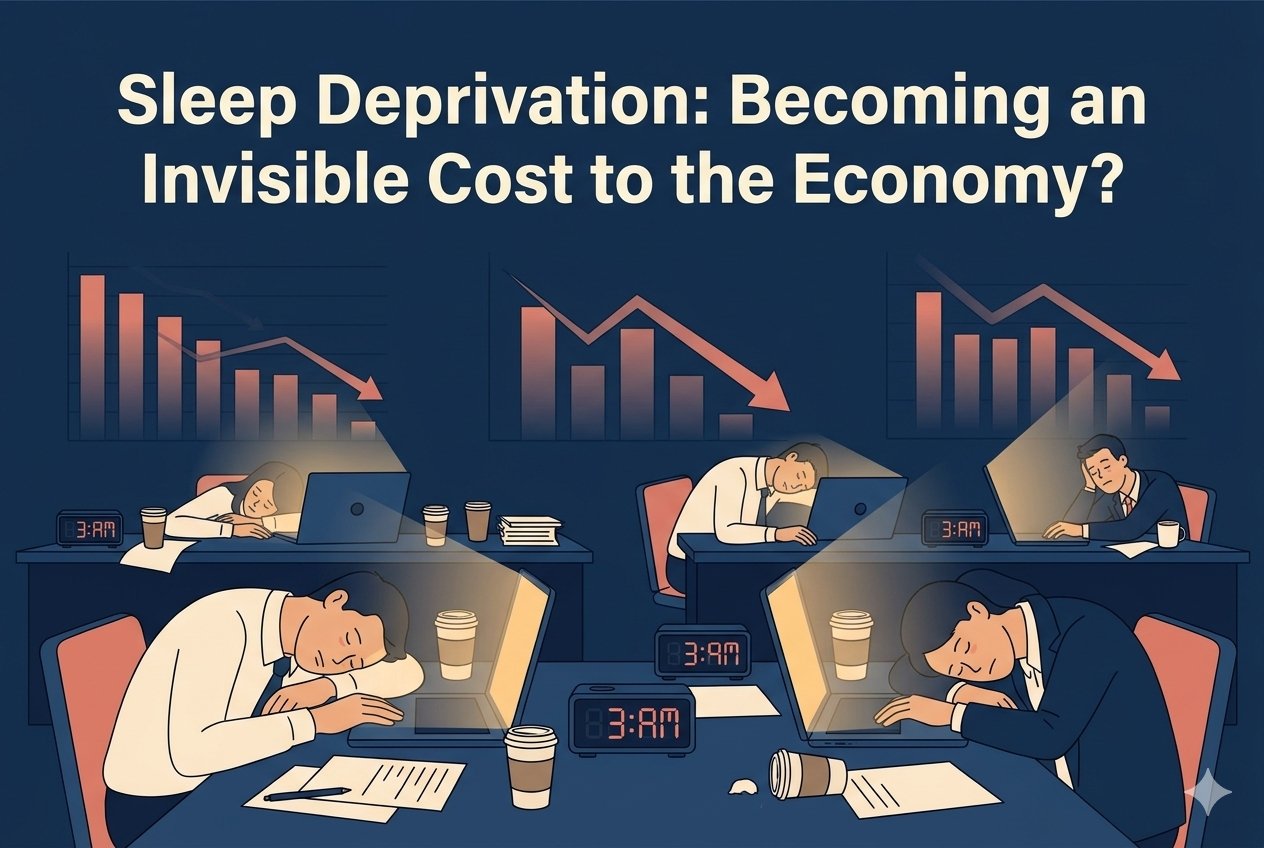
From workplace productivity to national economic growth, why sleep may be one of the most undervalued economic resources.
In today’s competitive world, working longer hours is often celebrated as a sign of dedication. Employees sacrifice sleep to meet deadlines, students compromise rest to prepare for examinations, and businesses increasingly operate around a culture of constant availability.
But what if the extra hours spent working are actually reducing the quality of our work?
Sleep is generally considered a personal health requirement. However, its impact extends far beyond individual well-being. It influences concentration, decision-making, workplace efficiency, accident risks and ultimately economic productivity.
This raises an important question: Is sleep deprivation silently costing businesses and economies more than they realise?
1. Sleep Is an Economic Resource
Every economy depends on human capital — the knowledge, skills, health and productivity of its workforce.
While businesses invest heavily in technology, infrastructure and employee training, adequate sleep is rarely treated as an equally important contributor to performance.
Insufficient sleep can affect:
- Concentration and problem-solving abilities.
- Decision-making and judgement.
- Employee efficiency and workplace safety.
- Absenteeism and presenteeism.
- Long-term health and workforce participation.
Presenteeism is particularly important from an economic perspective. It occurs when employees are physically present at work but perform below their potential.
An employee may complete an eight-hour shift, but fatigue can reduce the value created during those hours.
2. The Hidden Cost to Businesses
Sleep deprivation creates economic costs that are not always visible in company accounts.
These costs may appear through:
Lower productivity: Fatigued employees may take longer to complete tasks and make more mistakes.
Absenteeism: Sleep-related health problems can increase employee absence.
Workplace accidents: Reduced alertness can create safety risks, particularly in manufacturing, transport and other high-risk industries.
Employee turnover: Persistent fatigue and poor work-life balance can contribute to dissatisfaction and burnout.
A RAND Corporation study estimated that insufficient sleep could cost the economies of five developed countries between 1.35% and 2.92% of GDP annually, depending on the country.
These estimates relate to the countries studied and should not be directly applied to India. However, they demonstrate that sleep deprivation can have consequences far beyond personal health.
3. India’s Interesting Sleep-Economics Connection
One particularly interesting study brings this discussion closer to home.
Researchers examined sleep patterns among low-income adults in Chennai, India. They found that participants slept for approximately 5.5 hours per night on average, despite spending around eight hours in bed.
The research also explored whether increasing sleep duration improved economic outcomes.
Interestingly, simply increasing nighttime sleep did not produce measurable improvements in productivity or cognition in the short-term experiment. However, offering opportunities for short afternoon naps at workplaces improved several outcomes, including productivity, cognition and psychological well-being.
This finding highlights an important distinction:
More time in bed does not automatically mean better-quality sleep.
The study also reminds us that living conditions, sleep interruptions and the quality of the sleeping environment matter.
4. The Corporate Culture of Being Always Available
Modern workplace culture has created a new challenge: the expectation of constant availability.
Late-night emails, extended working hours, irregular shifts and digital notifications can interfere with employees’ ability to disconnect from work.
In sectors such as IT, financial services, healthcare, manufacturing and transportation, irregular schedules can make adequate rest particularly challenging.
The irony is that organisations may attempt to improve productivity by extending working hours, while unintentionally weakening the human capacity that drives productivity.
A business that measures employee performance only through hours worked may overlook the more important question: how effectively are those hours being used?
5. Can Better Sleep Become a Business Strategy?
Organisations can consider several practical measures:
- Encouraging reasonable working hours and predictable schedules.
- Avoiding unnecessary late-night communication.
- Providing adequate rest between shifts.
- Promoting awareness of sleep health.
- Exploring suitable workplace rest facilities, particularly in shift-based industries.
- Measuring output and quality rather than rewarding long working hours alone.
These measures should be viewed as investments in workforce sustainability, not merely employee benefits.
6. Sleep and the Future of Productivity
As artificial intelligence and automation transform workplaces, human capabilities such as creativity, critical thinking, judgement and complex decision-making will remain valuable.
These capabilities depend partly on employees being mentally alert and capable of sustained concentration.
In an economy increasingly driven by knowledge and innovation, protecting human performance is just as important as investing in machines and technology.
Perhaps the next stage of productivity improvement will not come from asking employees to work more hours, but from helping them perform better during the hours they already work.
Conclusion: The Economy Cannot Run on Exhausted Minds
Economic growth is usually measured through investment, consumption, employment, industrial output and GDP.
But behind every economic indicator are people whose energy, attention and capabilities drive economic activity.
Sleep may not appear as a separate line item in a company’s financial statements or a country’s national accounts, but its effects can be reflected in productivity, healthcare expenditure, workplace safety and human capital.
It is time for businesses to recognise that employee rest is not necessarily lost working time. Under the right conditions, it can be an investment in better performance.
Because a productive economy does not just need people who work harder. It needs people who can think clearly, make better decisions and perform at their best.
Sometimes, the smartest productivity strategy may simply be getting enough sleep.