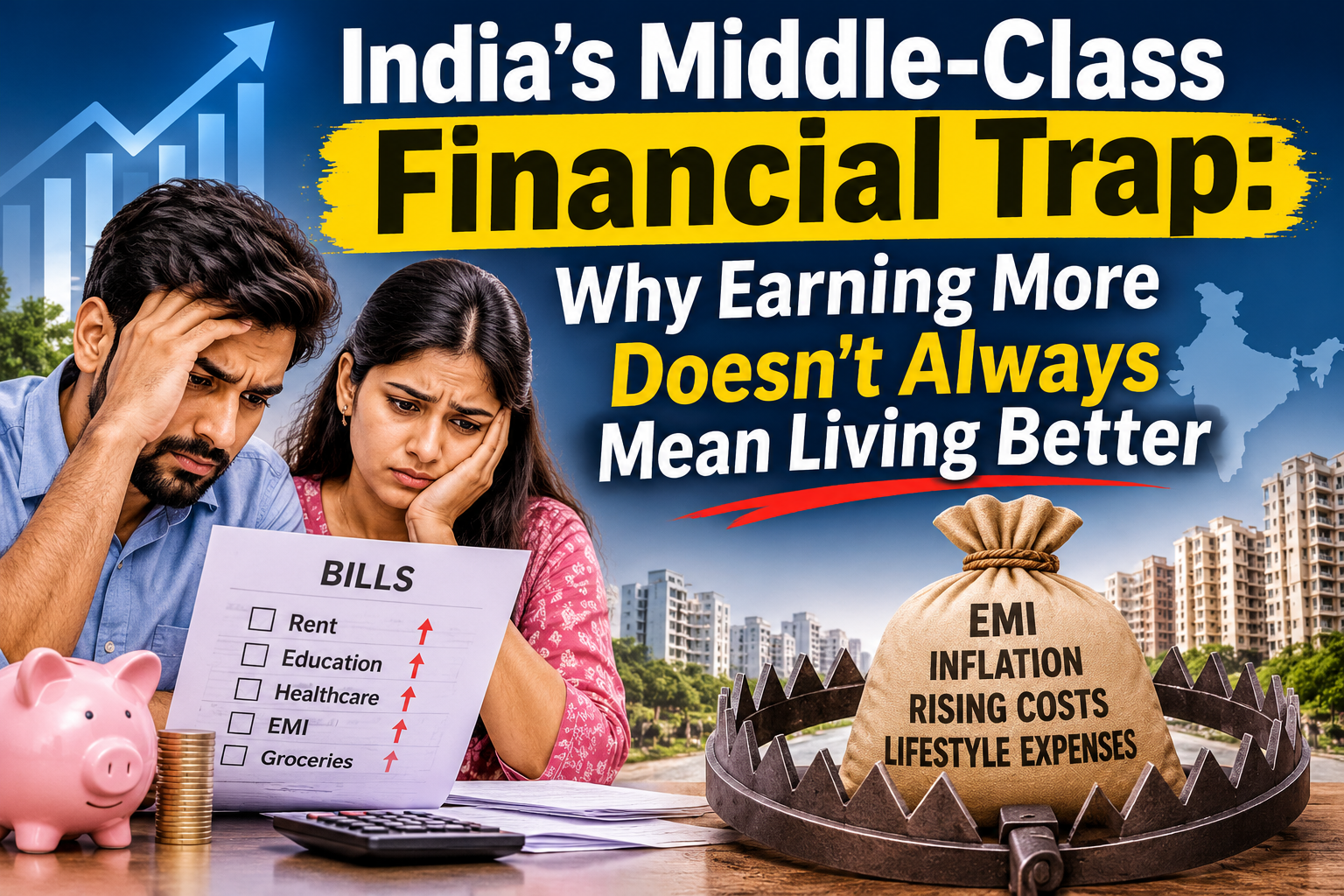
Rising salaries often create the impression of financial progress. But for millions of Indian households, higher income is increasingly accompanied by higher living costs, growing EMIs and greater financial commitments. The real question is no longer just how much people earn—but how much they can actually save, invest and retain.
1. The salary illusion: higher income, limited financial freedom
Imagine a salaried professional whose monthly income rises from ₹50,000 to ₹75,000 over a few years. On paper, this is a 50% increase. But if rent, groceries, transport, insurance, school fees and loan repayments have risen substantially during the same period, the improvement in living standards may be far smaller.
This is the difference between nominal income growth and real purchasing power.
Nominal income measures the amount of money earned. Real purchasing power measures what that money can actually buy after accounting for rising prices.
The problem becomes more complicated when lifestyle expectations rise alongside income. A better salary may lead to a more expensive home, a vehicle loan, private education, paid subscriptions and higher discretionary spending. Some upgrades improve quality of life, but together they can absorb much of the additional income.
As a result, earning more does not automatically mean having more financial security.
2. The rising cost of maintaining a middle-class life
The financial pressure on households comes from several directions at once.
- Housing: Rent, home-loan EMIs, maintenance and deposits can consume a significant share of take-home pay, particularly in major cities.
- Education: School fees, coaching, higher education and professional courses compete with long-term savings.
- Healthcare: Medical expenses and insurance premiums can rise, while an unexpected illness can disrupt an otherwise stable budget.
- Transport: Fuel, vehicle EMIs, insurance and maintenance make mobility expensive.
- Everyday consumption: Food, utilities, mobile plans, digital subscriptions and convenience services create a continuous stream of expenses.
The national consumption data provides useful context. According to India’s Household Consumption Expenditure Survey for 2023–24, average monthly per-capita consumption expenditure was ₹6,996 in urban India and ₹4,122 in rural India, at current prices. These are national averages across households not estimates specifically for the middle class—but they demonstrate the importance of everyday consumption in household finances.
The challenge is that many expenses are difficult to avoid or reduce quickly. A household can cancel subscriptions relatively easily, but it cannot immediately change its children’s school, relocate closer to work or eliminate a housing EMI.
This makes the financial squeeze particularly difficult for salaried households with fixed monthly commitments.
3. Inflation does not affect every household equally
Inflation is commonly discussed through the Consumer Price Index (CPI), but the impact on an individual household depends on what it buys.
A family spending heavily on rent, education, healthcare and transport may experience a different cost-of-living increase from a household whose spending is concentrated on other goods and services.
Even when headline inflation moderates, prices generally do not return to their previous levels. A lower inflation rate means prices are rising more slowly, not necessarily falling.
This creates a cumulative effect. Households must continue paying the higher prices built up over previous years, while their incomes may adjust only annually—or less frequently.
For employees whose salary increases lag behind their household’s actual cost increases, the result is a gradual loss of financial flexibility.
4. The EMI economy: owning more, owing more
Access to credit has made homes, vehicles, consumer electronics and other purchases possible for a wider range of households. Borrowing can be productive when it helps acquire an appreciating asset or finance an investment in future earning capacity.
However, credit can also create the appearance of prosperity without a corresponding increase in net wealth.
A household may own a car, live in a better apartment and use premium services while having very little money available after monthly repayments. The visible standard of living improves, but the household’s ability to withstand a job loss or medical emergency may weaken.
The Reserve Bank of India’s Financial Stability Report highlights the growing importance of retail borrowing. In its December 2025 report, non-housing retail loans accounted for 55.3% of household borrowing from financial institutions as of September 2025. The RBI also noted that consumption-related borrowing was a major component of household loans.
These figures do not mean that every borrower is financially distressed. Many loans are affordable and responsibly managed. The concern is whether households are taking on fixed obligations faster than their dependable income can support.
The key distinction is between using credit to build financial capacity and using credit to sustain a lifestyle that current income cannot comfortably fund.
5. The savings paradox: earning more but feeling less secure
Savings are what convert income into financial resilience. They allow households to handle emergencies, change jobs, fund education, invest for retirement and avoid expensive borrowing when unexpected expenses arise.
Yet savings are often treated as whatever remains at the end of the month. When spending rises with income, that remainder may not grow.
There is an encouraging development in the latest available national data: the RBI’s 2025–26 Annual Report says net household financial savings increased to 7.0% of gross national disposable income in 2024–25, up from 5.8% in 2023–24. Household financial liabilities also declined as a share of disposable income during that period.
This matters because the financial position of Indian households is not uniformly deteriorating. Aggregate savings can improve even while some families remain under pressure. National averages can conceal differences in income, debt, wealth and access to financial assets.
The real question is whether an individual household is accumulating sufficient liquid savings relative to its obligations.
A family with property but little emergency cash may be wealthy on paper yet financially vulnerable in the short term. Selling property or investments to meet an immediate expense can be difficult, costly or poorly timed.
6. A simple illustration: where does the extra salary go?
Consider a hypothetical household whose monthly take-home income increases from ₹60,000 to ₹80,000.
Illustrative monthly household budget
Figures below are examples, not survey averages.
| Monthly finances | Before | After |
| Take-home income | ₹60,000 | ₹80,000 |
| Essential expenses | ₹32,000 | ₹40,000 |
| EMIs and debt payments | ₹10,000 | ₹16,000 |
| Lifestyle and other spending | ₹8,000 | ₹12,000 |
| Monthly savings | ₹10,000 | ₹12,000 |
Savings rate before
16.7%
Savings rate after
15%
The household earns ₹20,000 more per month, but saves only ₹2,000 more. Its savings rate falls despite the salary increase.
This is the central financial trap: the income increase is real, but the improvement in financial security is much smaller.
The example also shows why salary alone is an incomplete measure of financial progress. A better assessment looks at savings, debt obligations, emergency reserves and the growth of assets after accounting for liabilities.
7. The psychological cost of keeping up
Financial pressure is not only about essential expenses. It is also influenced by social expectations.
Social media exposes people to expensive holidays, premium homes, new vehicles, restaurant experiences and carefully curated lifestyles. These images can make ordinary financial progress feel inadequate.
The resulting pressure can encourage households to upgrade before their finances are ready. Credit cards, personal loans and buy-now-pay-later options can make the cost appear manageable by dividing payments into smaller amounts.
But smaller instalments do not necessarily mean lower costs. Multiple commitments can accumulate, leaving less room for saving or dealing with emergencies.
This does not mean that discretionary spending is inherently irresponsible. Enjoying the present is part of a good life. The difficulty arises when consumption decisions are driven by comparison rather than affordability and personal priorities.
A sustainable financial life requires a balance between current well-being and future security.
8. Why this matters for India’s wider economy
Household financial pressure is not merely a private budgeting issue. It can influence the broader economy.
When households have little disposable income after essential expenses and debt payments, they may reduce discretionary consumption. Businesses dependent on consumer demand can feel the impact, particularly in sectors selling non-essential goods and services.
At the same time, heavy financial commitments can make households more sensitive to job losses, income interruptions and interest-rate changes. If many households respond to shocks by cutting spending simultaneously, the effects can spread across businesses and employment.
There is also a long-term human-capital concern. Families under financial pressure may postpone skill development, healthcare, retirement planning or other investments that improve future earning capacity.
However, borrowing and consumption also support economic activity, and access to formal credit can help households improve their lives. The objective is not to discourage consumption or borrowing altogether. It is to ensure that growth in household spending is supported by sustainable income, manageable debt and adequate savings.
For policymakers, this places importance on productive employment, real wage growth, accessible healthcare and education, financial consumer protection and the development of secure long-term savings options.
9. Escaping the financial trap: what households can do
There is no single solution, because household finances differ. But a few principles can help convert income growth into genuine financial progress.
First, measure the savings rate—not just the salary increase. If income rises, decide in advance how much of the increase will go towards savings and investments rather than allowing all additional income to be absorbed by spending.
Second, evaluate debt by affordability. Before taking a loan, account for all existing EMIs, essential expenses and likely future commitments. A lender’s approval does not necessarily mean a loan is comfortable for the household.
Third, build an emergency reserve. A reserve covering several months of essential expenses can reduce dependence on high-cost borrowing during periods of unemployment or unexpected costs. The appropriate amount depends on job stability, dependants and other financial responsibilities.
Fourth, distinguish between assets and appearances. A purchase should be evaluated by its utility, total cost and effect on long-term financial goals—not merely by whether it signals a higher standard of living.
Fifth, review the household budget regularly. Track essential expenses, discretionary purchases, debt repayments and savings. Small recurring payments can become substantial when accumulated over a year.
Finally, invest in earning capacity. Professional skills, relevant qualifications and career mobility can improve long-term income prospects. At the same time, no household should assume that future salary increases will automatically solve present-day financial overcommitment.
These steps cannot eliminate structural pressures such as expensive housing or inadequate public services. But they can help households retain a greater share of the income they earn.
Conclusion: financial progress must be measured differently
India’s middle-class financial challenge cannot be understood through salary growth alone. Higher incomes are valuable, but their benefits depend on how much purchasing power they preserve, how much debt they require and how much wealth households can accumulate over time.
A household that earns more but saves almost nothing, carries heavy EMIs and remains vulnerable to a temporary loss of income may be improving its consumption without improving its financial resilience.
Conversely, a household that increases its savings, manages debt responsibly and steadily builds assets may be making meaningful progress even if its lifestyle changes only modestly.
The wider lesson is simple: earning more is an important step, but financial freedom comes from retaining, protecting and productively using what you earn.
For India’s economic growth to translate into a stronger middle class, the focus must extend beyond higher incomes and greater consumption to include sustainable purchasing power, financial security and the ability to build wealth across a lifetime.