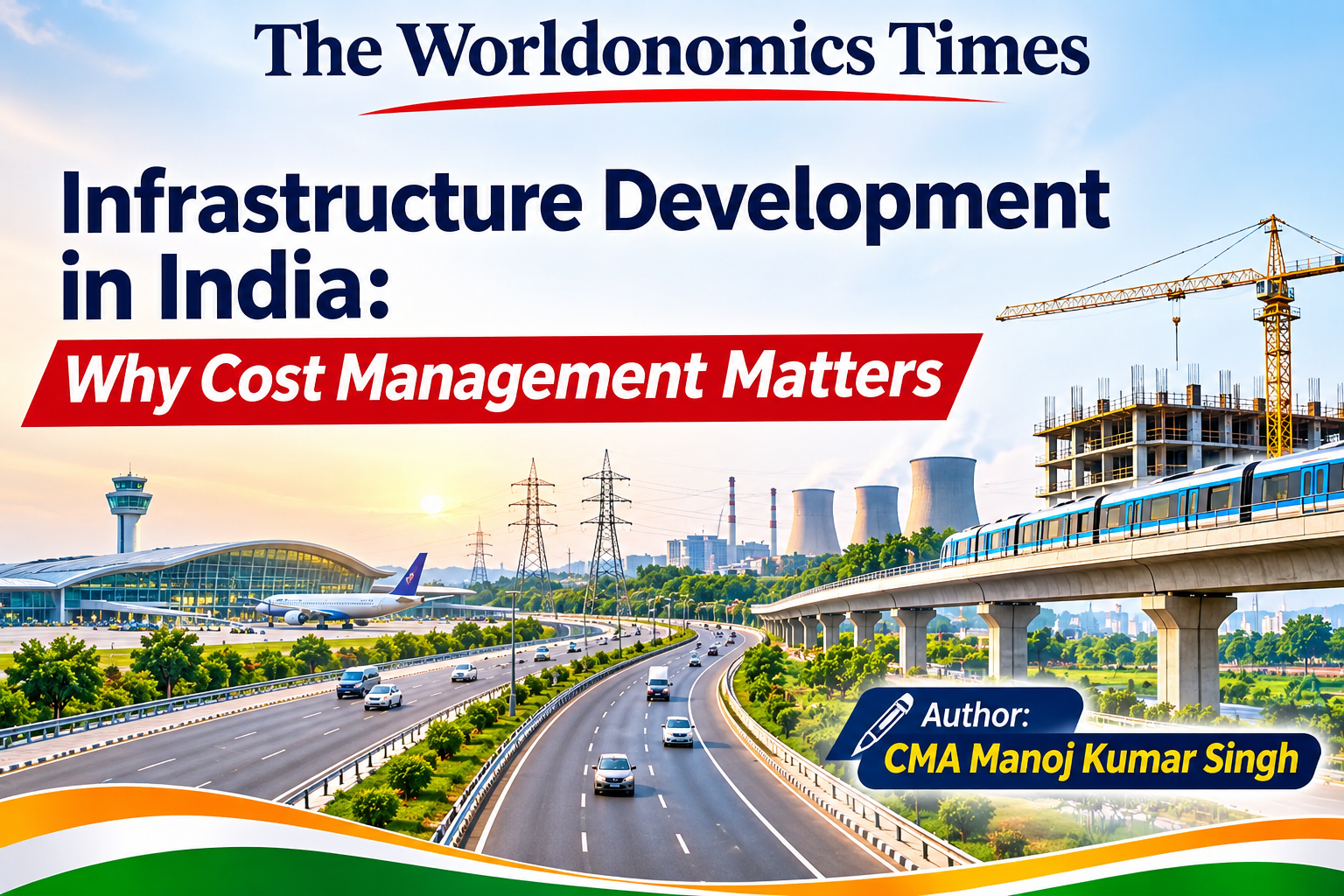
Infrastructure Development in India: Why Cost Management Matters
Strengthening Project Efficiency, Financial Accountability and National Infrastructure Growth
Author: CMA Manoj Kumar Singh
Introduction
Infrastructure development is one of the most important drivers of India’s economic transformation. Roads, railways, airports, ports, power plants, industrial corridors, metro networks and urban infrastructure create the foundation for industrial growth, employment generation, trade expansion and improved living standards.
India’s ambition to become a developed nation by 2047 requires sustained investment in world-class infrastructure. However, the success of infrastructure development cannot be measured merely by the number of projects undertaken or the amount of capital invested. It must also be evaluated through project efficiency, cost competitiveness, timely completion and the economic value generated from public and private investment.
In this context, Cost and Management Accounting has an important role to play. Scientific costing, budgetary control, project cost management and financial performance evaluation can help ensure that every rupee invested generates maximum economic and social value.
1. Infrastructure: The Foundation of Economic Growth
Infrastructure has a multiplier effect on the Indian economy. Improved transportation reduces logistics costs, reliable electricity supports manufacturing, modern ports facilitate international trade and better urban infrastructure attracts investment.
The Government of India’s infrastructure development initiatives, including PM Gati Shakti, Bharatmala, Sagarmala, Dedicated Freight Corridors and the National Infrastructure Pipeline, reflect the importance of coordinated infrastructure investment.
However, large infrastructure projects involve significant financial commitments, complex procurement processes, multiple contractors, fluctuating material prices and long implementation periods.
Effective cost management is therefore essential to ensure that these investments remain financially viable and economically beneficial.
2. Understanding the Challenge of Project Cost Overruns
Cost overruns are a major concern in large infrastructure projects. Delays in land acquisition, changes in project design, inadequate planning, contractual disputes, raw material price fluctuations and inefficient project monitoring can increase the final project cost.
When project expenditure exceeds approved budgets, it can create additional financial pressure on government departments, public sector enterprises and private developers.
The consequences may include:
- Increased borrowing and financing costs.
- Delayed completion of infrastructure facilities.
- Reduced financial returns on investment.
- Additional pressure on public expenditure.
- Inefficient utilisation of scarce economic resources.
Scientific cost estimation and continuous project monitoring can help identify potential problems at an early stage and improve financial discipline.
3. Role of Cost and Management Accountants in Infrastructure Projects
Cost and Management Accountants (CMAs) can contribute throughout the infrastructure project lifecycle, beginning with feasibility assessment and continuing through execution and post-completion evaluation.
Their professional expertise can support the following areas:
A. Project Cost Estimation
Preparation of realistic project cost estimates covering materials, labour, machinery, logistics, overheads, financing and contingency requirements.
B. Budgetary Control
Establishing project budgets and comparing actual expenditure with approved estimates to identify variations and take corrective action.
C. Variance Analysis
Analysing differences between planned and actual costs to identify reasons for cost escalation, wastage and operational inefficiencies.
D. Procurement Cost Management
Evaluating procurement alternatives, analysing vendor quotations and monitoring material consumption to improve purchasing efficiency.
E. Project Profitability Analysis
Assessing project returns, cash flows, financing costs and long-term financial viability.
F. Performance Measurement
Developing cost and operational performance indicators to monitor project progress and resource utilisation.
4. Cost Management in Public Sector Enterprises
Public Sector Undertakings (PSUs) play an important role in India’s infrastructure development, particularly in energy, transportation, engineering, construction and industrial development.
Organisations operating in the power, oil and gas, coal, railway, engineering and infrastructure sectors manage large capital-intensive projects.
For these organisations, cost management is not simply an accounting requirement. It is an essential management function.
Scientific costing can help PSUs evaluate project expenditure, optimise operating costs, improve capacity utilisation, monitor maintenance expenses and strengthen financial performance.
Cost and Management Accountants working in these organisations can contribute to strategic planning, investment appraisal, cost audit, management reporting and operational efficiency.
5. Life-Cycle Costing: Looking Beyond Initial Investment
One important concept in infrastructure cost management is life-cycle costing.
A project should not be evaluated only on the basis of its initial construction cost. Its long-term maintenance, operation, replacement and environmental costs must also be considered.
For example, a highway project with a lower initial construction cost may require higher maintenance expenditure over its operating life. Similarly, an energy project should be evaluated by considering fuel costs, operating efficiency, maintenance requirements and environmental implications.
Life-cycle costing enables decision-makers to evaluate alternative investments on a more comprehensive basis and select solutions that deliver better long-term value.
6. Technology and Digital Cost Monitoring
Digital transformation is creating new opportunities for infrastructure project management.
Artificial Intelligence, data analytics, Building Information Modelling (BIM), Enterprise Resource Planning (ERP) systems and project management dashboards can improve cost visibility and project monitoring.
These technologies can help organisations:
- Monitor expenditure in real time.
- Track material consumption and inventory.
- Identify deviations from approved budgets.
- Improve contractor performance monitoring.
- Forecast potential cost escalations.
- Strengthen project planning and reporting.
CMAs must increasingly develop digital competencies to integrate financial analysis with technology-driven project management.
7. Sustainable Infrastructure and Environmental Costing
India’s infrastructure expansion must also support environmental sustainability.
Renewable energy, energy-efficient buildings, green transportation, water conservation and sustainable construction practices are becoming increasingly important.
Environmental costing helps organisations identify the financial implications of energy consumption, waste generation, emissions and resource utilisation.
Incorporating environmental considerations into project evaluation can support better investment decisions and reduce long-term economic and ecological costs.
The CMA profession can contribute by integrating environmental cost analysis with conventional project costing and financial performance measurement.
8. Strengthening Financial Accountability in Infrastructure Investment
Infrastructure projects often involve public funds, institutional finance and private investment. Therefore, financial accountability and transparency are essential.
Proper cost records, periodic financial reviews, internal controls, cost audits where applicable and independent performance evaluation can improve governance.
A transparent cost management framework helps stakeholders understand whether project resources are being utilised effectively and whether the expected outcomes are being achieved.
It can also strengthen investor confidence and improve the quality of future infrastructure investment decisions.
Conclusion: Cost Efficiency for a Developed India
India’s infrastructure ambitions require substantial investment, effective execution and strong institutional capacity. However, investment alone cannot guarantee economic success.
The ability to estimate, monitor, control and optimise project costs is equally important.
Cost and Management Accountants can become valuable partners in India’s infrastructure transformation by bringing scientific costing, financial discipline, performance evaluation and strategic decision-making into project management.
As the country advances towards Viksit Bharat 2047, the role of professional cost management must expand across government departments, PSUs, infrastructure companies and private enterprises.
The true success of infrastructure development lies not merely in building more assets, but in creating quality infrastructure at the right cost, within the right time and with maximum economic value.
The Worldonomics Times – Connecting Business, Economy and Professional Excellence.