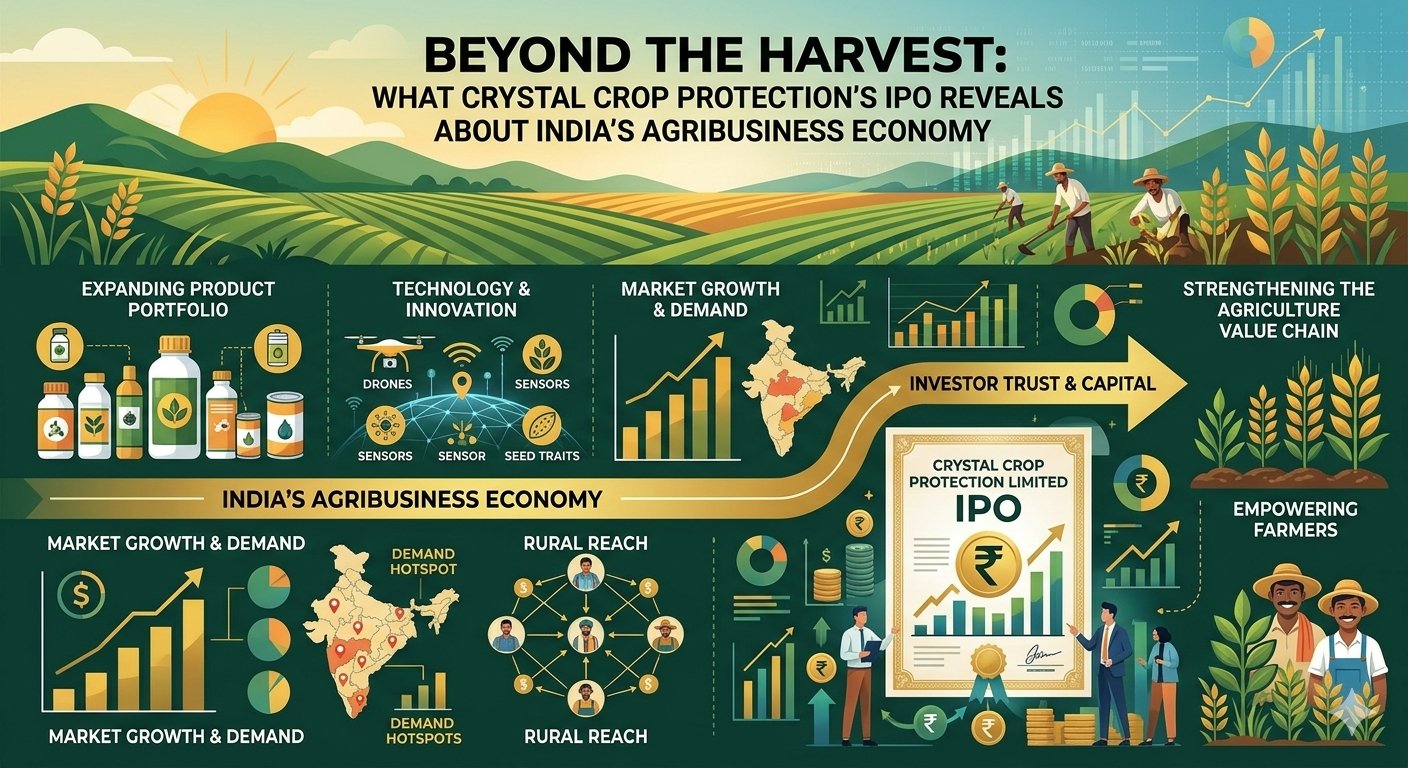
Agriculture is not just about farming anymore. Behind every successful harvest lies an extensive business ecosystem involving seeds, crop protection, fertilisers, technology, manufacturing and finance. Crystal Crop Protection’s upcoming IPO brings this ecosystem into the spotlight.
A new entrant in India’s IPO market
India’s primary market is witnessing growing participation from businesses across different industries. The latest company attracting attention is Crystal Crop Protection, an integrated agricultural inputs company preparing to enter the stock market.
The company has announced its IPO, scheduled to open on November 18, 2026, with a price band of ₹259–₹272 per share.
At the upper end of the price band, the proposed issue implies a market capitalisation of approximately ₹4,438 crore.
But the more interesting aspect of this IPO is not simply its size. It is what the proposed fund utilisation tells us about corporate financial strategy.
Understanding the business
Founded in 1994, Crystal Crop Protection operates across several segments of the agricultural inputs industry.
Its portfolio includes:
- Crop protection: Herbicides, fungicides and insecticides.
- Seeds: Products for field crops, vegetables and flowers.
- Natural crop solutions: Biostimulants, bioprotectants, plant growth regulators and micronutrients.
This diversified portfolio gives the company exposure to different stages of agricultural production.
As Indian agriculture increasingly focuses on productivity, crop quality and efficient resource utilisation, businesses supplying agricultural inputs have an important role to play.
The IPO: Where will the money go?
The proposed IPO comprises two components:
Fresh Issue – ₹355 crore
The company will issue new shares and receive the proceeds.
Offer for Sale – Approximately ₹100.7 crore
Existing promoter shareholder Ankur Aggarwal will sell 37.02 lakh shares. The proceeds from this portion will go to the selling shareholder.
One of the most significant aspects is the planned utilisation of the fresh issue proceeds.
The company intends to use approximately ₹270 crore towards repayment of borrowings, with the remaining amount earmarked for acquisitions and general corporate purposes.
This highlights an important corporate finance principle: raising capital is not always about expansion. Sometimes, strengthening the balance sheet is equally important.
Why debt reduction matters
According to the reported offer-document figures, Crystal Crop Protection had consolidated fund-based borrowings of approximately ₹962.6 crore as of August 2026.
Reducing debt can provide several potential advantages:
- Lower interest expenses.
- Improved financial flexibility.
- Better capacity to fund future investments.
- Reduced financial leverage.
- Potential improvement in cash-flow management.
However, investors should also examine whether the company’s future operating cash flows can support its business expansion without creating excessive borrowing again.
What do the financial numbers indicate?
The company’s reported financial performance offers an additional perspective.
For FY26, Crystal Crop Protection recorded revenue of approximately ₹3,152 crore, representing growth of 17.2% over the previous financial year.
Its profit increased by approximately 22.4% to ₹144.9 crore.
These figures indicate growth in both revenue and profitability. However, investors should examine operating margins, working-capital requirements, debt levels and cash-flow generation before drawing conclusions about the company’s financial strength.
Risks that investors should not overlook
Agribusiness is closely connected to factors that companies cannot fully control.
Weather dependency: Rainfall patterns, droughts and floods can influence agricultural activity and demand for crop inputs.
Raw material prices: Changes in chemical input costs can affect manufacturing expenses and profitability.
Regulatory environment: Agrochemical products operate within a regulatory framework involving product approvals, safety standards and environmental considerations.
Competition: Domestic and international players compete through pricing, product innovation and distribution networks.
Working capital: Credit cycles, inventory requirements and seasonal demand can put pressure on cash flows.
A company may report revenue growth, but sustainable profitability depends on managing these risks effectively.
The larger opportunity: India’s agricultural transformation
India’s agricultural future will depend not only on increasing cultivated output but also on improving productivity, reducing crop losses and adopting better farming practices.
This creates opportunities for businesses involved in agricultural research, crop protection, seeds, precision farming and sustainable agricultural solutions.
For companies operating in this space, innovation and distribution capabilities can become important competitive advantages.
The finance professional’s perspective
Crystal Crop Protection’s IPO offers several interesting learning points for finance professionals:
- Understanding the difference between a fresh issue and an offer for sale.
- Evaluating the impact of debt repayment on financial leverage.
- Analysing revenue growth alongside profitability and operating cash flows.
- Assessing industry-specific business risks.
- Understanding how capital-market funding can support corporate restructuring.
These are not merely IPO-related concepts. They are fundamental elements of corporate financial analysis.
Conclusion: The business behind every harvest
The agricultural sector is evolving into a technology-driven and capital-intensive business ecosystem.
Crystal Crop Protection’s proposed listing highlights how companies operating behind the scenes of India’s agricultural economy are seeking access to public capital markets.
The real question for investors is not simply whether agriculture is a promising sector, but whether an individual business can convert that opportunity into consistent earnings, healthy cash flows and sustainable growth.
Because the future of agriculture will not be shaped by the harvest alone, but also by the businesses, innovation and financial decisions that make it possible.