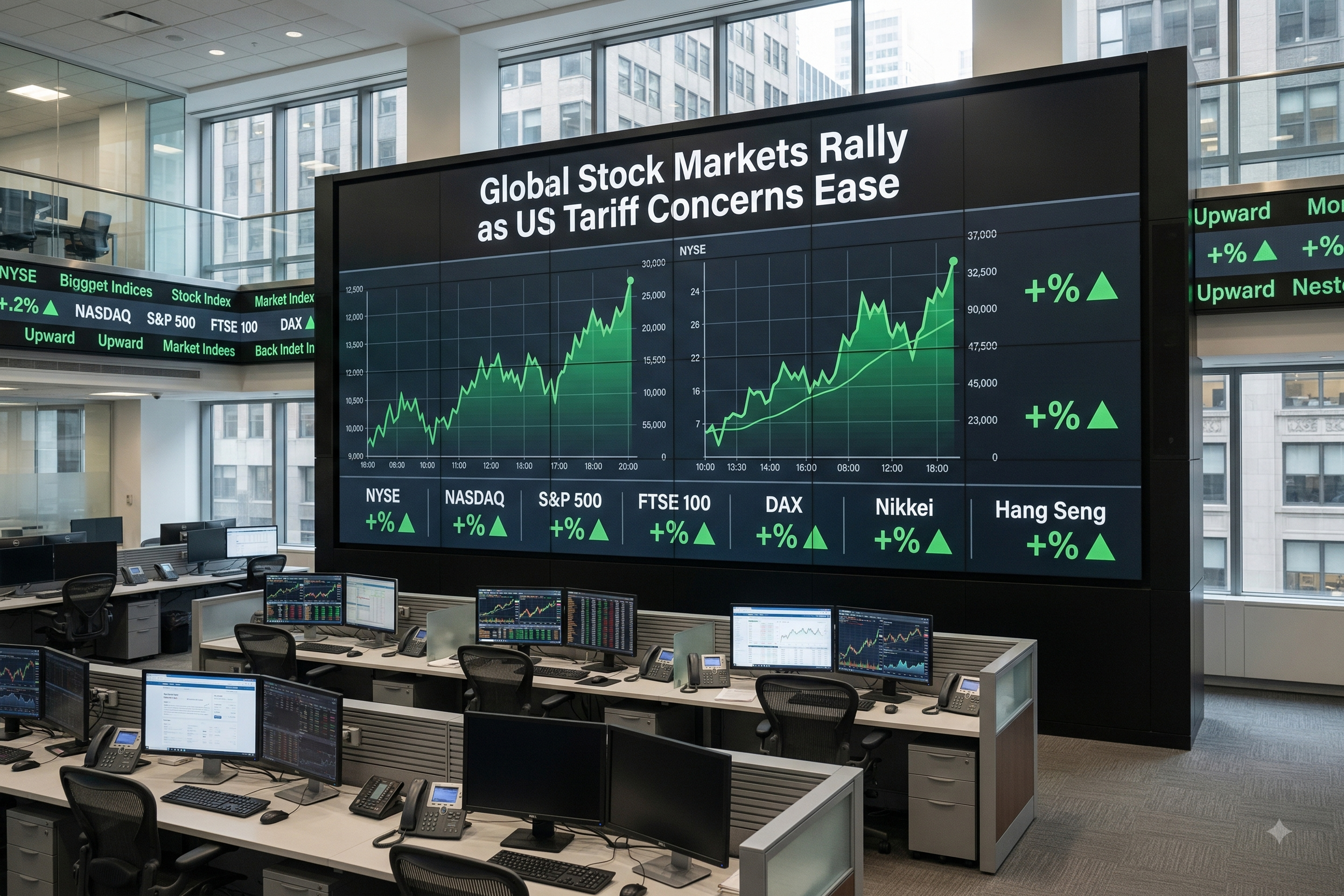
Asian and European markets gain momentum as investors respond positively to Washington’s targeted tariff announcements and hopes of reduced trade uncertainty.
Global stock markets witnessed a positive turnaround as Asian and European equities rallied following the United States’ announcement of new targeted tariffs on 14 trading partners, including China, Japan and the European Union. The announcement brought renewed attention to international trade relations, with investors assessing whether Washington’s latest approach could help reduce broader economic uncertainty and ease concerns surrounding a prolonged global trade conflict.
The market recovery reflects a shift in investor sentiment, as financial markets respond not only to tariff announcements but also to expectations about their potential economic impact. After periods of uncertainty driven by fears of escalating trade restrictions, investors appeared more willing to return to equities, particularly in sectors sensitive to international commerce.
Global Markets Respond Positively
Asian stock markets led the positive sentiment, with investors closely monitoring developments in US trade policy. Markets across the region responded to the possibility that targeted tariff measures could create a more predictable environment for international businesses.
Japan and China remained central to investor attention because of their significant roles in global manufacturing, technology and supply chains. Any changes in trade relations involving these economies can influence regional exports, corporate earnings and investment flows.
European markets also recorded gains as investors evaluated the potential implications of Washington’s announcement for transatlantic trade. The European Union, one of the United States’ major trading partners, has been particularly attentive to tariff developments because of their potential effects on automobiles, industrial goods, machinery and other export-oriented industries.
The rally suggests that investors are cautiously optimistic about the possibility of avoiding a wider trade confrontation. However, market participants remain aware that trade negotiations and policy decisions can change quickly.
Why US Tariff Policies Matter to Global Markets
The United States plays a central role in international trade and financial markets. Consequently, changes in American tariff policies can have significant implications for economies worldwide.
Tariffs are taxes imposed on imported goods. Governments generally use them to protect domestic industries, address trade imbalances or influence negotiations with other countries. However, higher import duties can also increase production costs, raise consumer prices and disrupt established supply chains.
For multinational companies, uncertainty surrounding tariffs can make business planning more complicated. Manufacturers may reconsider sourcing strategies, exporters may face reduced competitiveness, and businesses dependent on imported components may experience pressure on profit margins.
The latest targeted tariff announcement has therefore become an important development for investors seeking clarity about the future direction of global trade.
Investors Look Beyond Immediate Tariff Headlines
Although the market rally indicates improving confidence, investors are not ignoring the potential risks associated with trade restrictions.
Financial markets are influenced by several interconnected factors, including inflation, interest rates, economic growth, corporate earnings and geopolitical developments. Tariff policies can affect all these areas.
For example, higher import costs may contribute to inflation, potentially complicating decisions by central banks. If inflation remains elevated, central banks could maintain higher interest rates for longer, affecting borrowing costs and equity valuations.
On the other hand, greater clarity regarding trade policies could encourage businesses to resume investment plans, support international commerce and improve confidence among institutional investors.
This balance between opportunity and risk will remain important as markets react to further announcements from Washington and its trading partners.
What This Means for Asian and European Economies
The developments carry particular importance for export-driven economies in Asia and Europe.
Japan’s automotive, electronics and industrial manufacturing sectors are closely connected to international demand. Any changes in US trade policy could influence the competitiveness of Japanese exporters and their future earnings expectations.
China also faces significant exposure because of its extensive manufacturing ecosystem and position in global supply chains. Trade restrictions involving Chinese products can affect manufacturers, technology companies and businesses operating across multiple markets.
In Europe, industries such as automotive manufacturing, pharmaceuticals, machinery and luxury goods are sensitive to changes in international trade conditions. A stable trade environment would help businesses manage costs, protect export markets and maintain long-term investment confidence.
For India and other emerging economies, developments in global trade could create both opportunities and challenges. Companies looking to diversify supply chains may consider alternative manufacturing destinations, potentially strengthening investment opportunities in emerging markets. However, weaker global demand or rising trade barriers could also affect exports.
What Investors Should Watch Next
Despite the positive market response, investors should avoid interpreting a single rally as confirmation that global trade tensions have disappeared.
Several developments will determine whether the current optimism can continue:
- Further US trade decisions: Additional tariff announcements could influence market direction and investor confidence.
- International negotiations: Responses from China, Japan and the European Union will be important in determining the future of trade relations.
- Corporate earnings: Investors will assess whether businesses can manage potential tariff-related costs without significantly affecting profitability.
- Inflation and interest rates: Changes in import prices could influence inflation expectations and central bank policies.
- Global economic growth: International trade conditions will remain a major factor in determining the outlook for manufacturing, exports and investment.
The direction of these factors will help establish whether the rally represents a sustainable improvement in market sentiment or a temporary reaction to changing policy expectations.
The Worldonomics Times View
The recent rally across Asian and European stock markets highlights how strongly global financial markets respond to developments in US trade policy. The positive reaction suggests that investors are increasingly looking for clarity, stability and opportunities amid an uncertain international economic environment.
However, optimism should be balanced with caution. Targeted tariffs do not automatically eliminate trade-related risks, and their long-term impact will depend on implementation, negotiations and responses from affected trading partners.
For investors, the key priority should be to monitor economic fundamentals rather than react solely to short-term market movements. Businesses and policymakers must also recognise that predictable trade relations are essential for sustainable economic growth.
Ultimately, the global market rally offers an encouraging signal, but its sustainability will depend on whether major economies can move towards a more stable and cooperative international trading environment.