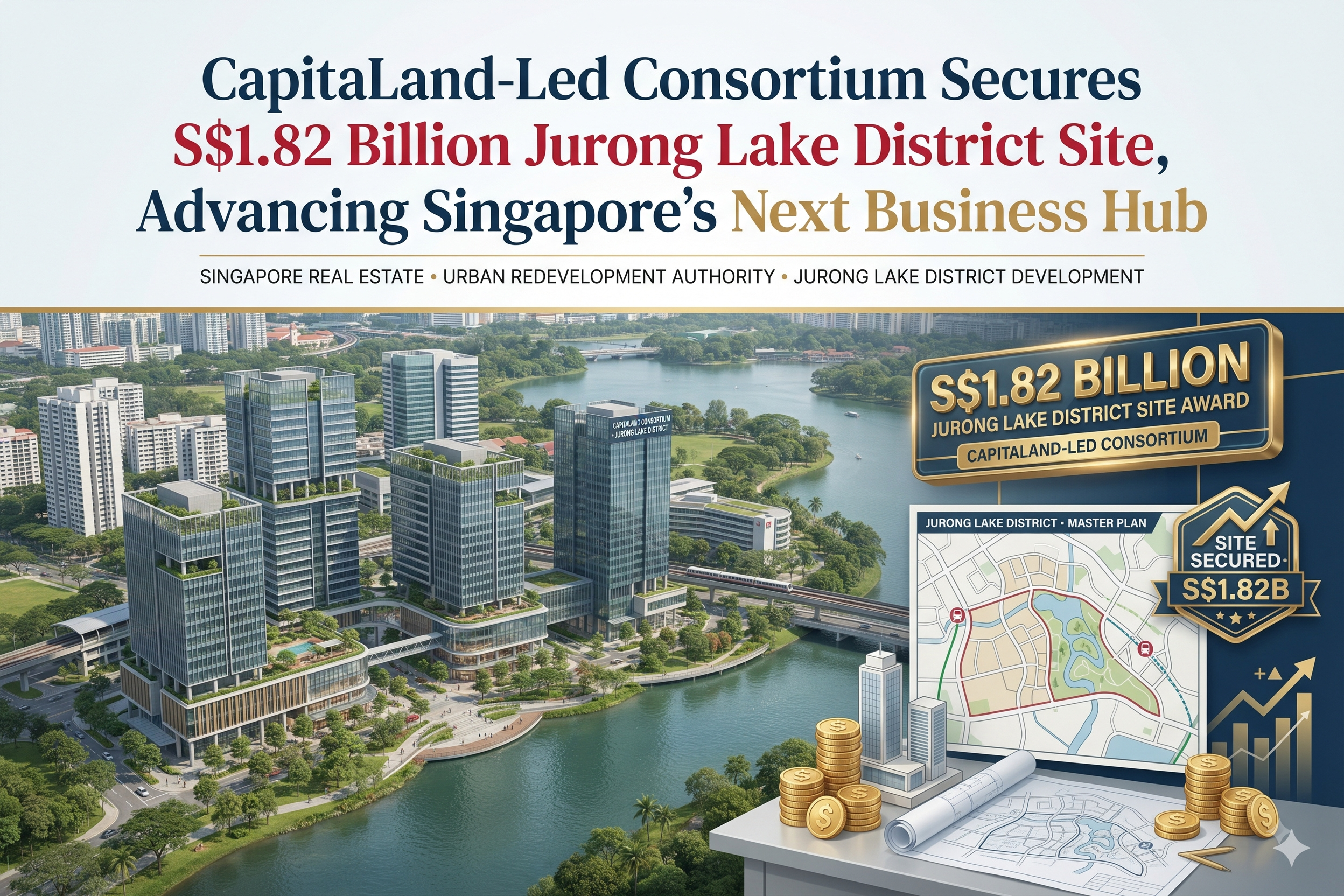
Singapore’s property sector has reached a significant milestone with the award of a major Jurong Lake District development site to a consortium led by CapitaLand Development for approximately S$1.82 billion. The project, located at Town Hall Link, is expected to bring together residential, commercial and lifestyle facilities, supporting Singapore’s ambition to establish Jurong Lake District as a major business centre beyond the traditional city centre.
The consortium comprises CapitaLand Development, Far East Organization and Sing Holdings. The award marks an important development in the transformation of western Singapore and reflects continued private-sector interest in strategically located mixed-use real estate.
S$1.82 Billion Deal Marks Major Property Development Milestone
The Urban Redevelopment Authority (URA) awarded the Town Hall Link site to the highest bidder on 24 November 2026, following a tender that closed on 17 November. The successful bid was approximately S$1.82 billion, equivalent to around S$910 per square foot per plot ratio.
The 3.72-hectare site is held on a 99-year leasehold basis and has the potential to accommodate slightly more than two million square feet of gross floor area. Its mixed-use zoning allows the development of offices, private residences and complementary facilities.
The tender attracted two bids. The second offer, submitted by Sim Lian Land and Sim Lian Development, was approximately S$1.31 billion. The difference between the bids highlights the substantial financial commitment made by the successful consortium and the strategic value developers see in the Jurong Lake District location.
The successful award also provides greater clarity for the next stage of planning and development in the precinct.
Residential and Commercial Development at the Centre
The proposed development is expected to include up to 1,200 private residential units, alongside a substantial office component and facilities designed to support daily business and community activities.
The site must accommodate at least approximately 430,556 square feet of office space. Around 473,612 square feet has been allocated for complementary uses, which may include retail, serviced apartments, hotels, recreational facilities, medical clinics and community spaces.
This combination of uses is central to the concept of an integrated urban district. Instead of separating residential neighbourhoods from commercial centres, mixed-use developments aim to bring workplaces, homes, shopping and leisure facilities closer together.
For residents, this approach could improve access to everyday amenities and employment opportunities. For businesses, the development may provide modern office space in a location supported by transport infrastructure and a growing commercial ecosystem.
The project’s scale also creates an opportunity for the consortium to develop a destination that serves residents, workers and visitors.
Jurong Lake District’s Transformation into a Second Business Hub
Jurong Lake District is part of Singapore’s wider urban decentralisation strategy, which aims to distribute employment and commercial activities beyond the Central Business District.
The district is planned as Singapore’s largest mixed-use business district outside the city centre. Its development is intended to strengthen Jurong East as a major commercial and employment destination while supporting economic activity in the western region.
The Town Hall Link site is particularly important because it represents an early development parcel in the next phase of the district’s transformation. The wider planning vision includes new offices, residential developments, retail facilities, public spaces and improved transport connections.
By developing a stronger business centre in western Singapore, the Government aims to bring jobs closer to homes and reduce the need for workers to travel into the traditional central business area.
This strategy could also encourage companies to consider locations outside the established commercial core when planning future operations.
Transport Infrastructure Strengthens Development Potential
Connectivity is expected to play a major role in the site’s long-term attractiveness. The Town Hall Link location is close to the Jurong East MRT interchange, which connects the East-West and North-South MRT lines.
Future transport improvements are also expected to strengthen accessibility. The Jurong Region Line is scheduled to connect important areas in western Singapore, with its relevant stations at Jurong East and the International Business Park planned to open in 2028. The future Cross Island Line station near the site is planned to open in 2032.
These transport investments could improve access for office employees, residents and visitors while supporting the district’s wider development.
Government-led infrastructure and land preparation work are also intended to support the site’s development. Improved pedestrian connections and supporting facilities can help create a more accessible and integrated urban environment.
Opportunities and Challenges for the Property Market
The S$1.82 billion award reflects confidence in the long-term potential of Jurong Lake District. However, developing a project of this size will involve substantial capital requirements, construction coordination and commercial planning.
The residential component may benefit from demand for homes close to transport connections and employment centres. Retail and lifestyle facilities could also gain from a larger residential and working population as the district develops.
The office component, however, will face the challenge of attracting businesses in a market where hybrid working arrangements and changing corporate space requirements influence demand.
The consortium will need to balance construction costs, financing commitments, market conditions and the timing of different development phases. The success of the project will ultimately depend on the quality of its design, tenant demand and the pace at which the wider district develops.
The Worldonomics Times View
The Worldonomics Times believes that the Jurong Lake District site award represents more than a major property transaction. It is an important step in Singapore’s effort to reshape its urban and economic geography.
The S$1.82 billion bid demonstrates that developers are prepared to commit significant capital to locations with long-term infrastructure support and mixed-use potential. The involvement of CapitaLand Development, Far East Organization and Sing Holdings also brings together developers with experience across different segments of the property market.
Nevertheless, the project’s long-term value will depend on execution rather than the headline land price alone. Office demand, housing affordability, construction costs and the availability of supporting amenities will all influence its commercial success.
Singapore’s decentralisation strategy has the potential to create more balanced employment opportunities and reduce pressure on the traditional city centre. For this vision to succeed, new business districts must offer more than office towers and residential buildings. They need efficient transport, accessible public spaces, community facilities and a strong mix of businesses.
Jurong Lake District therefore represents an important test of how integrated urban development can support economic growth and improve everyday living.
Conclusion
The award of the S$1.82 billion Town Hall Link site to the CapitaLand-led consortium marks a significant milestone in Singapore’s property and infrastructure development plans.
With capacity for up to 1,200 homes, substantial office space and complementary commercial facilities, the project could become an important part of Jurong Lake District’s emerging business ecosystem.
As transport infrastructure expands and development progresses, the district may strengthen its position as a major destination for businesses, residents and investors. The project’s success will depend on delivering a well-connected, commercially sustainable and community-focused urban environment.