How technology, digital payments and regulatory innovation are transforming Singapore into a leading financial technology hub.
Introduction
The financial services industry is experiencing one of the most significant transformations in its history. Traditional banking, which once depended heavily on physical branches, paper documentation and face-to-face transactions, is increasingly being replaced by digital platforms, mobile applications, artificial intelligence and real-time payment systems.
Singapore has emerged as an important centre of this transformation. Its financial technology ecosystem combines established international banks, technology companies, innovative startups and a regulatory environment that encourages responsible experimentation.
For Singapore, FinTech is not simply a technology trend. It is an important part of its strategy to strengthen financial competitiveness and maintain its position as an international financial centre.
Singapore’s approach to financial innovation
The Monetary Authority of Singapore (MAS) has played a central role in developing the country’s FinTech ecosystem.
Rather than treating technology companies and traditional banks as separate industries, Singapore has encouraged cooperation between financial institutions, payment providers and technology businesses.
MAS has supported innovation through regulatory initiatives, digital banking frameworks, payment infrastructure and industry collaboration.
This approach has helped create an environment where financial innovation can develop while remaining subject to appropriate supervision.
Digital banking: A new business model
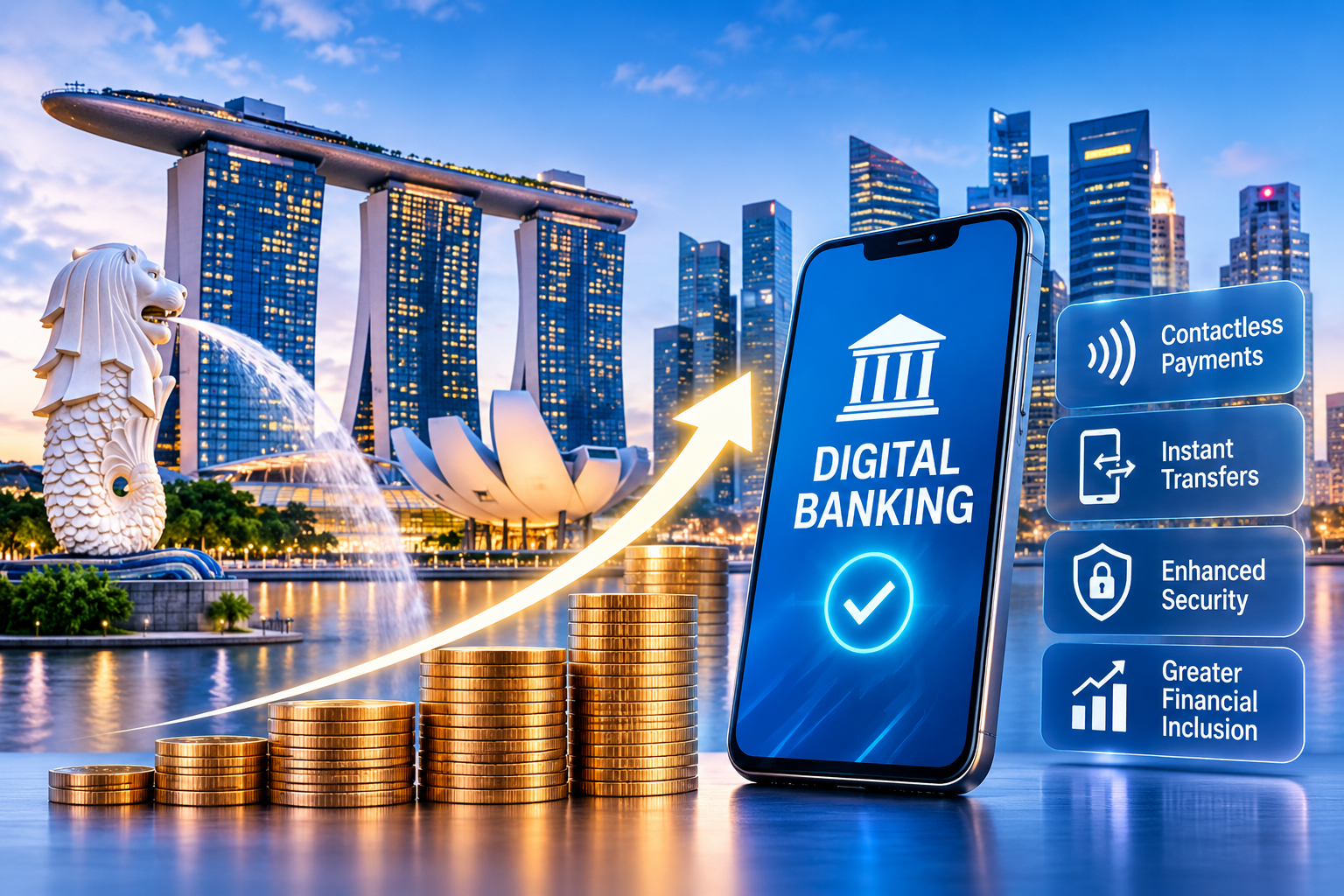
Digital banks provide banking services primarily through digital channels rather than conventional branch networks.
Customers can open accounts, transfer funds, make payments and access financial products through mobile applications.
Singapore’s digital banking framework has introduced new competition into the banking sector. Digital banking licences have enabled new business models to emerge, while established banks have also accelerated their digital transformation.
The potential benefits include:
- Faster customer onboarding.
- Reduced dependence on physical branches.
- Improved access to financial services.
- More efficient transaction processing.
- Better use of customer data for financial products.
However, digital banking also creates risks relating to cybersecurity, fraud, operational resilience and data protection.
Digital payments and financial inclusion
Digital payments are among the most visible examples of Singapore’s FinTech development.
The country has developed electronic payment infrastructure that allows individuals and businesses to transfer money conveniently.
Systems such as PayNow have made account-to-account transfers easier, while cross-border payment linkages have improved connectivity with selected regional markets.
For businesses, digital payments can reduce cash-handling costs, improve transaction records and support faster reconciliation.
For small businesses, this can be particularly valuable because digital payment records help create a more reliable financial trail.
Such records may also assist businesses when applying for loans, managing working capital or preparing financial statements.
Artificial intelligence in financial services
Artificial intelligence is increasingly being used across the financial industry.
Banks and financial institutions can use AI to identify unusual transactions, detect potential fraud, analyse customer behaviour and support credit-risk assessments.
Machine learning can also help financial institutions process large volumes of information and identify patterns that may not be immediately visible through traditional methods.
In Singapore, AI adoption presents opportunities for improving operational efficiency and strengthening risk management.
However, financial institutions must ensure that AI systems are explainable, appropriately governed and subject to human oversight where necessary.
A technology-driven decision should not automatically be treated as a correct decision.
Blockchain and digital assets
Blockchain technology has also attracted attention in Singapore’s financial ecosystem.
Its potential applications include tokenisation of financial assets, digital securities, settlement systems and cross-border transactions.
Tokenisation involves representing ownership rights in an asset through digital tokens recorded on a blockchain or related technology.
This could potentially improve transaction efficiency, expand investor access and reduce certain settlement-related processes.
MAS has explored institutional digital asset applications through initiatives such as Project Guardian.
Nevertheless, digital assets require careful regulatory treatment. Issues such as custody, market integrity, operational security, valuation and investor protection remain important.
Business opportunities for startups
Singapore’s FinTech environment provides opportunities for startups developing products in areas such as:
- Digital lending and alternative credit assessment.
- Payment gateways and merchant solutions.
- Wealth management applications.
- RegTech and compliance automation.
- Cybersecurity and fraud prevention.
- Financial analytics and accounting automation.
The ecosystem benefits from access to financial institutions, investors, technology talent and international markets.
Startups can also use Singapore as a base for testing products before expanding into other Asian markets.
Risks and regulatory challenges
FinTech innovation must be accompanied by strong internal controls and regulatory compliance.
Cybersecurity threats can affect banks, payment companies and customers. A data breach can result in financial losses, legal exposure and reputational damage.
Digital lending platforms must also ensure responsible lending practices.
Another important concern is money laundering and the misuse of digital financial channels. Financial institutions must implement appropriate customer due diligence, transaction monitoring and reporting procedures.
For financial institutions, technology governance is therefore as important as product innovation.
Implications for accountants and finance professionals
The FinTech revolution is changing the role of finance professionals.
Traditional accounting activities such as transaction recording, reconciliation and report preparation are increasingly supported by automation.
This does not eliminate the need for accountants. Instead, it changes the skills required.
Finance professionals will need greater knowledge of data analytics, information systems, cybersecurity risks, internal controls and digital financial products.
Cost and management accountants can also contribute by analysing technology investment costs, measuring process efficiency and evaluating the financial viability of digital transformation projects.
Lessons for India
Singapore’s experience provides valuable lessons for India’s financial services industry.
India has developed significant digital payment infrastructure through UPI and other financial technology initiatives.
The next opportunity lies in strengthening digital lending, financial inclusion, cybersecurity, responsible AI and cross-border payment integration.
India can benefit from collaboration with Singapore in FinTech research, regulatory innovation and digital financial services.
Conclusion
Singapore’s FinTech revolution demonstrates how technology and regulatory innovation can strengthen a country’s financial ecosystem.
Digital banking, electronic payments, artificial intelligence and blockchain applications are reshaping how financial institutions operate and compete.
The long-term success of this transformation will depend not only on technological advancement but also on cybersecurity, customer trust, regulatory supervision and responsible innovation.
For Singapore, FinTech is becoming a strategic economic asset. For India and other emerging markets, it provides a valuable example of how digital infrastructure can support financial development.
About Author:-
CMA Vivek Kumar (ACMA), an Associate Member of ICMAI and B.Com (Accounting Honours) graduate, is an author, finance professional, and Founder of VK Chartered Academy (www.cacmacstestseries.com). He specializes in statutory and tax audits, taxation, financial reporting, GST advisory, and corporate compliance. He also mentors CA, CMA, and CS aspirants through structured academic guidance and exam-oriented test series, bridging practical industry expertise with professional education. Email: cmavivek2026@gmail.com