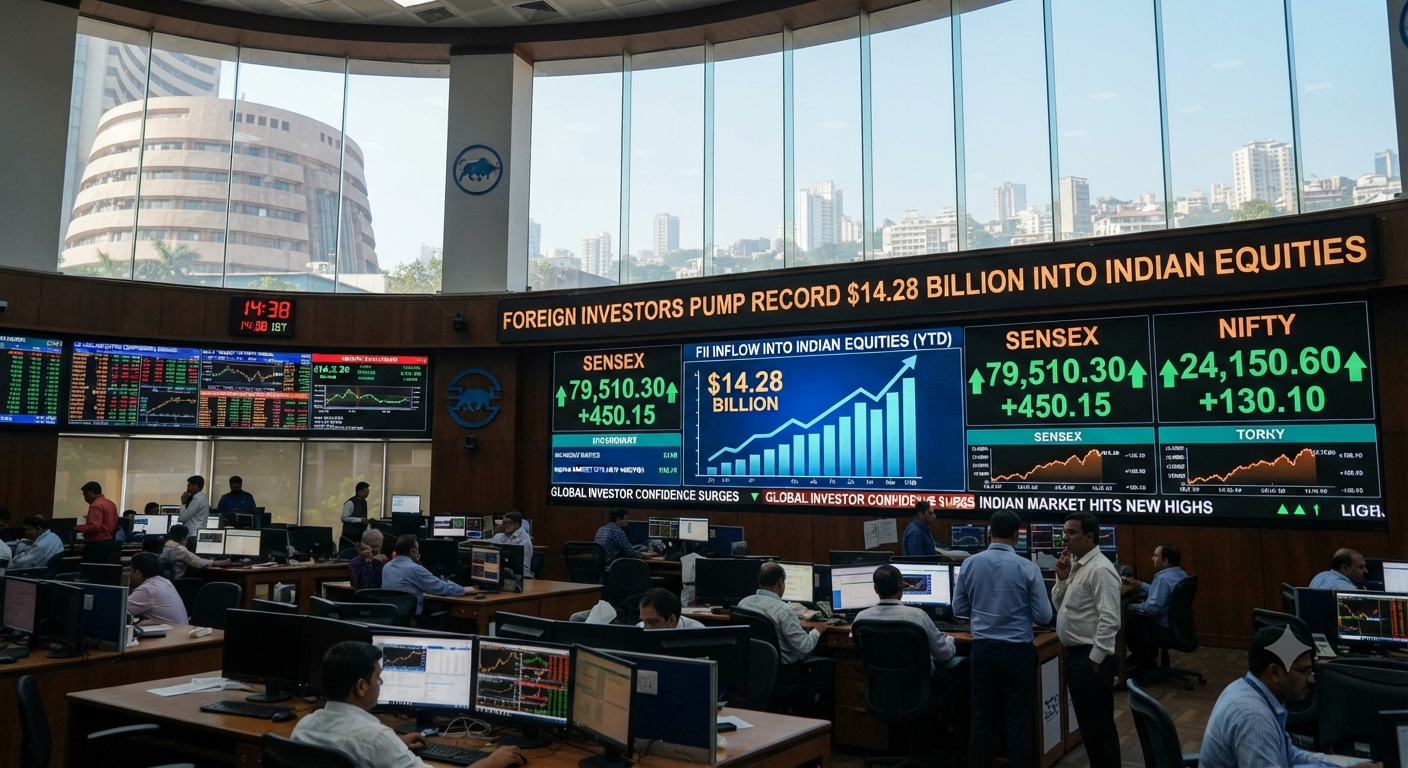
Indian equity markets traded in positive territory on Thursday, November 26, 2026, as buying interest in information technology (IT) shares and sustained foreign institutional investor (FII) inflows supported benchmark indices. The BSE Sensex remained above the 84,000 mark, while the NSE Nifty 50 traded around the 25,850–25,900 range during the morning session.
The positive movement extended the strong recovery witnessed in the previous trading session, when both benchmark indices recorded gains of nearly 2%. Technology stocks emerged as major contributors to Thursday’s early gains, while foreign investor participation provided additional support to market sentiment.
At around 9:20 a.m., the Sensex had climbed 388.12 points, or 0.46%, to 84,326.40, while the Nifty advanced 60.75 points, or 0.23%, to 25,880. However, the market’s upward momentum moderated later in the morning, highlighting the cautious approach adopted by investors amid global uncertainties.
IT Stocks Emerge as Major Market Drivers
Information technology shares were among the strongest performers during Thursday’s trading session. The Nifty IT index advanced more than 2% in early trade, supported by buying in major technology companies.
Stocks including Infosys, Tata Consultancy Services (TCS), HCL Technologies and Tech Mahindra featured among the notable gainers in the Sensex basket.
The sector’s performance provided an important boost to benchmark indices at a time when investors were assessing global technology-sector valuations and concerns surrounding artificial intelligence-related investments.
The movement also reflects the importance of large-cap technology companies in influencing overall market direction. Given their significant weight in benchmark indices, gains in major IT stocks can contribute meaningfully to movements in the Sensex and Nifty.
Metal and private banking stocks also traded positively during the early session, helping support the broader market. In contrast, select automobile, media, cement and oil and gas shares faced selling pressure.
Foreign Investor Inflows Strengthen Market Sentiment
Foreign institutional investment has emerged as a major factor supporting the recent recovery in Indian equities.
According to exchange data cited in market reports, foreign institutional investors purchased equities worth approximately ₹4,479.08 crore on Wednesday, November 25. This extended their buying streak to an 11th consecutive session.
The sustained inflows indicate renewed interest in Indian equities after a period of volatility and foreign fund outflows.
Market analysts have attributed the improving foreign investment trend partly to India’s earnings outlook and changing global investment preferences. Concerns about concentrated exposure to artificial intelligence-related stocks in certain Asian markets have also been cited as a possible factor encouraging portfolio diversification towards India.
The scale of foreign participation has been particularly notable during November. Reuters reported that foreign portfolio inflows had reached approximately US$15.16 billion during the month by November 26, supporting a substantial recovery in domestic benchmark indices.
However, foreign investment flows can change quickly in response to currency movements, global interest-rate expectations, geopolitical developments and changing risk appetite. Continued inflows should therefore not be interpreted as a guarantee of uninterrupted market gains.
Previous Session’s Strong Rally Supports Momentum
Thursday’s positive opening followed a powerful rally on Wednesday, November 25.
The Sensex surged 1,502.29 points, or 1.82%, to close at 83,938.28. The Nifty gained 469.60 points, or 1.85%, settling at 25,819.25.
The strong performance helped restore investor confidence following recent market weakness. Buying across several major sectors contributed to the recovery, while institutional investment activity provided additional support.
The latest gains have also brought benchmark indices closer to important psychological levels. The Sensex’s movement above 84,000 and the Nifty’s approach towards 25,900 have attracted attention from market participants assessing whether the recovery can continue.
Nevertheless, the market’s ability to sustain these levels will depend on continued buying interest, corporate earnings expectations and developments in international markets.
Global Factors Continue to Influence Indian Equities
Despite the positive domestic trend, international developments remain an important source of uncertainty.
Investors are monitoring proposed US tariffs targeting imports from several trading partners, including India. Any escalation in trade-related tensions could influence export expectations, corporate profitability and global investment sentiment.
Technology-sector volatility is another important factor. Concerns surrounding valuations and investment concentration in artificial intelligence-related companies have affected global market sentiment, particularly across some Asian markets.
Crude oil prices also remain relevant for Indian equities. Higher oil prices can increase India’s import bill, add pressure to inflation and affect the profitability of sectors that depend heavily on energy and transportation.
The mixed performance of global markets highlights the need for investors to assess domestic market strength alongside international economic and financial developments.
What Investors Should Watch Next
Market participants are likely to monitor several factors in the coming sessions.
First, the sustainability of foreign institutional buying will remain important. Continued inflows could provide support to large-cap stocks, while a reversal may increase volatility.
Second, investors will watch the performance of IT companies and the broader Nifty IT index. Sustained strength in technology shares could help maintain the positive momentum in benchmark indices.
Third, developments relating to US trade policy, global interest rates and crude oil prices may influence foreign investment decisions and domestic market sentiment.
Finally, corporate earnings and valuations will remain central to determining whether the recent rally has sufficient fundamental support.
The Worldonomics Times View
The latest movement in Indian equity markets reflects improving investor confidence, supported by foreign capital inflows and renewed buying interest in major technology stocks. The recovery is encouraging, particularly after the volatility witnessed in recent sessions.
However, market strength should be assessed carefully. A positive opening or a temporary move above a psychological level does not necessarily indicate the beginning of a sustained upward trend. Investors must also consider valuations, earnings performance, global trade developments and institutional investment patterns.
The continued participation of foreign investors is a positive signal, but domestic institutional activity and the underlying financial performance of listed companies will also be important in determining market direction.
For retail investors, the current environment calls for disciplined investment decisions rather than chasing short-term price movements. A focus on business fundamentals, reasonable valuations and long-term investment objectives remains essential.
Conclusion
The Sensex and Nifty traded higher on November 26, supported by strong buying in IT stocks and sustained foreign investor inflows. The Sensex remained above 84,000, while the Nifty traded close to 25,850–25,900 during the morning session.
Although the recent rally has improved market sentiment, global trade concerns, technology-sector volatility and changing capital flows remain important risks. The sustainability of the recovery will depend on whether positive domestic fundamentals can continue to attract investment amid an uncertain international environment.