New Delhi | 4 November 2026
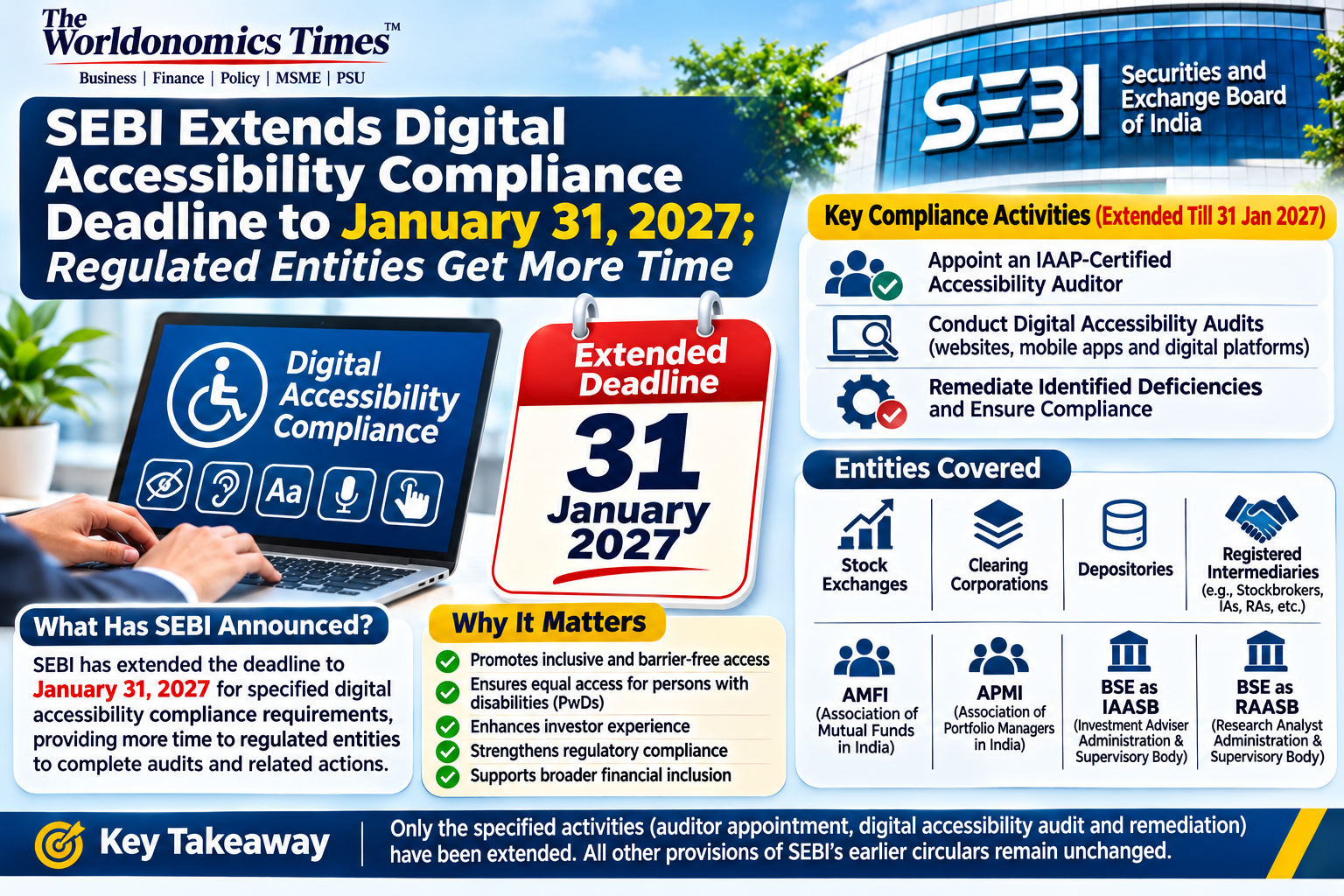
The Securities and Exchange Board of India (SEBI) has extended the deadline for regulated entities to complete important digital accessibility compliance requirements until January 31, 2027. The extension, announced through a circular dated October 30, 2026, provides additional time to stock exchanges, clearing corporations, depositories, stockbrokers and other SEBI-regulated entities to complete accessibility audits and address deficiencies in their digital platforms.
The decision follows representations received from regulated entities seeking additional time to complete the prescribed compliance requirements. SEBI stated that it had considered these requests and reviewed the progress made by market participants before granting the extension.
The revised timeline specifically covers three major activities: appointment of an auditor certified by the International Association of Accessibility Professionals (IAAP), conducting accessibility audits of digital platforms and remediation of findings identified during the audits.
The requirements form part of SEBI’s broader framework for implementing the Rights of Persons with Disabilities Act, 2016, and the rules framed thereunder.
What Has SEBI Extended?
Under its October 30 circular, SEBI has granted an extension until January 31, 2027, for the following compliance activities:
1. Appointment of IAAP-Certified Accessibility Auditor
Regulated entities must appoint qualified accessibility professionals certified by the International Association of Accessibility Professionals to assess their digital platforms. The appointment of specialised auditors is intended to ensure that accessibility assessments are conducted with appropriate professional expertise.
2. Conduct of Digital Accessibility Audits
Entities are required to undertake accessibility audits of their digital platforms, including relevant websites, mobile applications and other digital interfaces provided to investors.
These assessments are intended to identify barriers that may prevent persons with disabilities from accessing and using digital financial services.
3. Remediation of Audit Findings
After completing the audits, regulated entities must address the deficiencies identified and take necessary corrective measures to improve accessibility and ensure compliance with the applicable requirements.
SEBI has clarified that the extension is limited to these specified activities. All other provisions of the earlier circulars remain unchanged and must continue to be complied with.
Which Entities Are Covered?
The digital accessibility framework applies to a broad range of organisations operating in India’s securities market.
The October 30, 2026 circular specifically addresses the following entities:
- All recognised stock exchanges.
- All recognised clearing corporations.
- All registered depositories.
- All registered intermediaries, including stockbrokers.
- Association of Mutual Funds in India (AMFI).
- Association of Portfolio Managers in India (APMI).
- BSE Limited in its capacity as the Investment Adviser Administration and Supervisory Body (IAASB).
- BSE Limited in its capacity as the Research Analyst Administration and Supervisory Body (RAASB).
These organisations provide important financial services and digital platforms used by investors for trading, investment management, financial research and other securities-market activities.
Background: SEBI’s Digital Accessibility Framework
SEBI introduced its digital accessibility requirements through a series of circulars issued during 2025 and 2026.
The framework was initially established through a circular dated July 31, 2025, followed by subsequent communications dated August 29, 2025, September 25, 2025, December 8, 2025 and July 31, 2026.
These regulatory directions were issued in connection with the Rights of Persons with Disabilities Act, 2016, and the applicable rules.
The objective is to ensure that digital services provided by regulated entities are accessible to persons with disabilities, allowing them to participate more effectively in the securities market.
As financial services increasingly move towards digital channels, accessibility has become an important consideration in the design and operation of investor-facing platforms.
Why Digital Accessibility Matters for the Securities Market
Digital platforms have become an integral part of India’s financial ecosystem. Investors increasingly depend on mobile applications, websites and online interfaces to open demat accounts, execute trades, access mutual fund information, monitor portfolios and obtain investment-related services.
However, digital transformation must also ensure that persons with disabilities can use these services independently and effectively.
For example, investors with visual impairments may require compatibility with screen readers and appropriate text descriptions. Individuals with hearing impairments may benefit from captions and accessible multimedia content. People with mobility-related disabilities may require interfaces that support keyboard navigation and alternative methods of interaction.
Improving digital accessibility can help remove barriers that prevent certain groups from accessing financial information and services.
For the securities market, this is also connected with broader objectives of investor protection, financial inclusion and equal access to investment opportunities.
Compliance Responsibilities of Stockbrokers and Financial Intermediaries
The extension is particularly relevant for stockbroking firms, depository participants, investment advisers, research analysts and other financial intermediaries.
These organisations frequently operate digital platforms through which investors access financial products and services. Consequently, accessibility compliance needs to be considered as part of their technology governance and regulatory compliance frameworks.
Stockbrokers and other intermediaries should consider the following actions:
- Identify all investor-facing websites, mobile applications and other digital platforms.
- Review existing accessibility arrangements and identify potential gaps.
- Appoint appropriately qualified IAAP-certified accessibility auditors.
- Complete accessibility assessments within the revised timeline.
- Establish corrective action plans to address audit observations.
- Maintain supporting documentation and records of compliance activities.
- Integrate accessibility reviews into ongoing technology governance and internal audit processes.
Organisations should also ensure coordination between their IT departments, compliance officers, internal audit teams, technology vendors and senior management.
Accessibility should not be treated merely as a one-time technical exercise. It needs to become part of the overall digital platform development and maintenance process.
Role of Compliance Officers, Internal Auditors and Finance Professionals
The revised deadline also creates important responsibilities for professionals working in compliance, finance, internal audit, risk management and corporate governance functions.
Compliance officers will need to monitor the implementation of SEBI’s directions and ensure that applicable reporting and documentation requirements are addressed.
Internal auditors may examine whether accessibility-related controls are adequately incorporated into the organisation’s technology and operational risk frameworks.
Finance professionals and CFOs may also need to evaluate the financial implications of accessibility improvements, including auditor fees, technology upgrades, software modifications, vendor support and ongoing maintenance.
From a governance perspective, organisations should establish clear accountability for completing the required assessments and implementing corrective measures.
The involvement of senior management can help ensure that accessibility-related compliance is treated as an institutional responsibility rather than being restricted to the IT department.
January 31, 2027: Important Compliance Milestone
The extension provides additional time for regulated entities to complete the specified accessibility-related activities. However, it should not be interpreted as a relaxation of the overall digital accessibility framework.
SEBI has expressly clarified that all other provisions of its earlier circulars remain unchanged and must be complied with.
Accordingly, regulated entities should use the additional time to complete pending audits, appoint qualified professionals and implement corrective measures rather than postponing their compliance preparations.
The extension also highlights the importance of maintaining continuous regulatory monitoring as SEBI continues to strengthen governance and investor protection requirements across the securities market.
Towards a More Inclusive Digital Financial Ecosystem
SEBI’s decision to extend the digital accessibility compliance deadline reflects the practical challenges faced by regulated entities in implementing specialised accessibility requirements.
At the same time, the underlying regulatory objective remains significant. India’s securities market is becoming increasingly digital, and the benefits of this transformation should be accessible to all investors, including persons with disabilities.
For stock exchanges, depositories, intermediaries and financial institutions, accessibility is not simply a technology issue. It is also connected with investor rights, operational governance, risk management and regulatory accountability.
With January 31, 2027, now established as the revised deadline for the specified activities, regulated entities have an opportunity to strengthen their digital infrastructure and build more inclusive investor-facing services.
The effective implementation of these requirements can contribute to a securities market in which digital participation is more accessible, transparent and inclusive.
The Worldonomics Times | Banking, Finance & Capital Markets