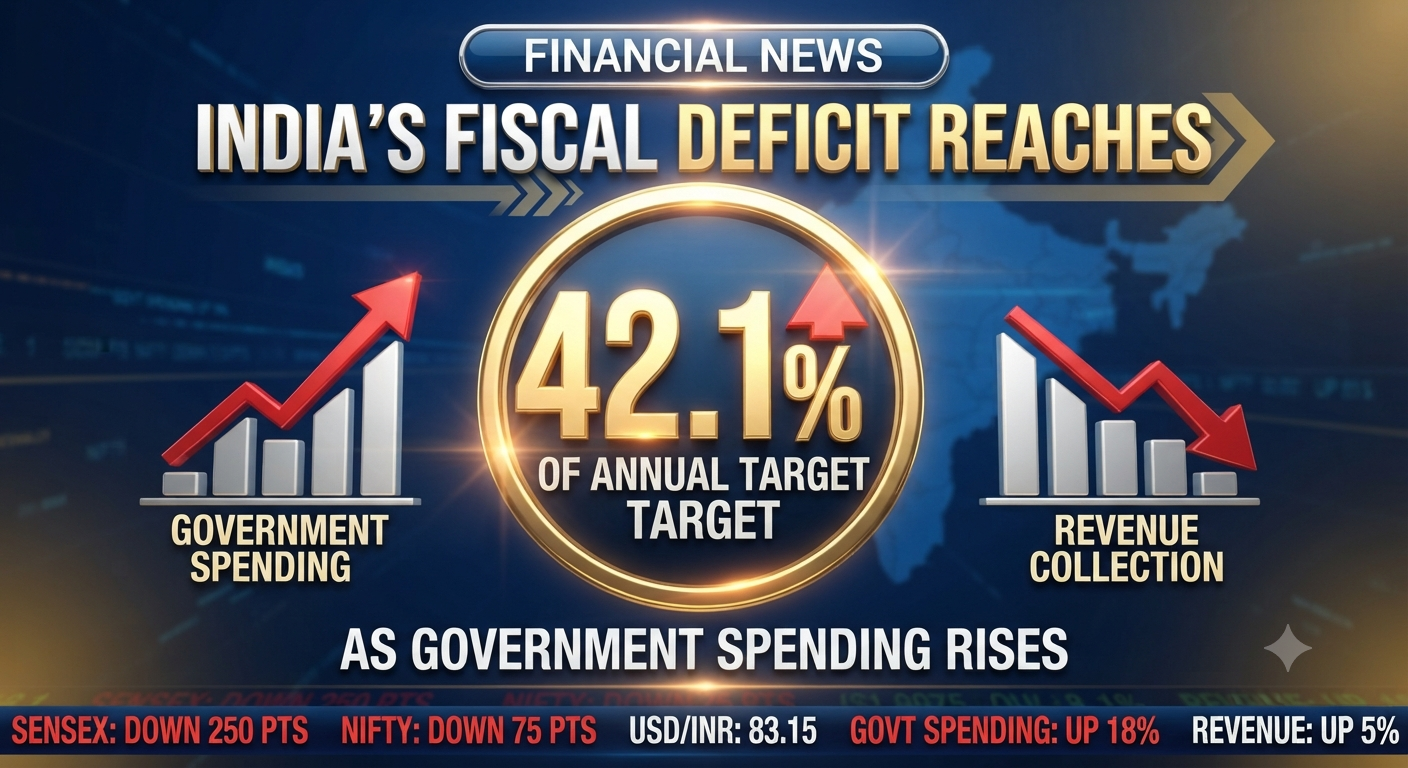
India’s fiscal deficit climbed to approximately ₹7.14 lakh crore during April–September FY27, accounting for 42.1% of the government’s full-year target. The latest figures, released by the Controller General of Accounts (CGA), indicate that the Centre’s expenditure continued to grow at a faster pace, supported by infrastructure investment and higher subsidy commitments.
The deficit was significantly higher than the 36.5% of the annual target recorded during the corresponding period of FY26. In absolute terms, it increased from approximately ₹5.73 lakh crore in the first half of the previous financial year. The government has set its FY27 fiscal deficit target at ₹16.96 lakh crore, equivalent to 4.3% of gross domestic product (GDP).
The latest numbers highlight the balancing act facing policymakers: sustaining economic growth through public investment while maintaining fiscal discipline and keeping government borrowing under control.
Government Expenditure Gains Momentum
Total government expenditure reached approximately ₹25.50 lakh crore during the first six months of FY27, representing 47.7% of the annual Budget Estimate. This compares with 45.5% during the same period last year.
Capital expenditure remained one of the major contributors to the increase. Spending on infrastructure and asset creation reached ₹6.55 lakh crore, or 53.6% of the full-year allocation of approximately ₹12.22 lakh crore. The corresponding figure a year earlier was ₹5.81 lakh crore, representing a year-on-year increase of around 12.7%.
Higher capital expenditure reflects the government’s continued focus on strengthening roads, railways, logistics networks, urban infrastructure and other long-term development projects. Such investments can improve productivity, support industrial activity and encourage private-sector participation.
However, the faster pace of capital spending also means that the government must carefully manage its remaining budget allocations to prevent expenditure pressures from becoming difficult to absorb later in the financial year.
Subsidies and Revenue Spending Add to Pressure
Apart from infrastructure investment, subsidy commitments have contributed to the increase in government expenditure. Spending on major subsidies, including food and fertiliser support, rose to approximately ₹2.23 lakh crore during April–September FY27, compared with around ₹2.02 lakh crore in the corresponding period last year.
Food subsidy expenditure and fertiliser support remain important components of public spending. These allocations help protect vulnerable households and support agricultural activity, but they also create recurring demands on the government’s finances.
Revenue expenditure, which includes routine administrative costs, interest payments and subsidies, stood at approximately ₹18.95 lakh crore, accounting for 45.9% of the annual estimate.
Interest payments alone reached around ₹6.46 lakh crore, representing 46% of the budgeted amount. A substantial interest burden limits the resources available for other development priorities and makes effective debt management increasingly important.
Revenue Collections Provide Some Support
Government receipts offered partial support to the fiscal position. Total receipts stood at approximately ₹18.35 lakh crore during the first half of FY27, equivalent to 50.3% of the full-year Budget Estimate.
Revenue receipts reached ₹17.57 lakh crore, or 49.7% of the annual target. Net tax revenue contributed approximately ₹12.76 lakh crore, representing 44.5% of the budgeted amount. Non-tax revenue stood at around ₹4.81 lakh crore, reaching 72.2% of its annual estimate.
The performance of tax collections will remain particularly important in the coming months. Stronger income-tax, corporate-tax and indirect-tax receipts could help the government finance its spending commitments without relying excessively on additional borrowing.
At the same time, changes in economic activity, consumption patterns and business profitability may influence the pace of revenue collection during the second half of the financial year.
What the Deficit Means for the Economy
A fiscal deficit occurs when the government’s total expenditure exceeds its receipts, excluding borrowings. The government finances this gap through borrowing and other financing mechanisms.
A rising deficit is not automatically a sign of economic weakness. Borrowing to finance productive infrastructure can support growth, create employment and improve the economy’s long-term capacity. The impact depends significantly on how public funds are allocated and whether the resulting investments generate sustainable economic benefits.
Nevertheless, a persistently elevated deficit can increase borrowing requirements, place pressure on government bond yields and potentially reduce the availability of funds for private businesses. Higher interest costs may also make future budgets less flexible.
For investors, the fiscal position is an important indicator because it influences expectations about government borrowing, interest rates, liquidity and the broader macroeconomic environment.
The Road Ahead for Fiscal Consolidation
The government faces a demanding second half of FY27. It will need to maintain the momentum of infrastructure development while ensuring that revenue collections remain strong and expenditure growth stays within manageable limits.
The pace of spending could moderate as the financial year progresses, while seasonal tax collections and other receipts may improve the overall fiscal position. However, higher subsidy requirements, interest payments and changes in economic conditions will remain important risks.
It is also essential to interpret the six-month deficit figure carefully. The CGA has clarified that the fiscal deficit recorded during part of a financial year is not necessarily an indication of the final annual outcome. Differences in the timing of receipts and expenditure can influence monthly and half-yearly figures. The published accounts are provisional and unaudited.
The Worldonomics Times View
India’s fiscal deficit reaching 42.1% of its annual target deserves attention, but the headline figure should be considered alongside the quality of government expenditure and the strength of revenue collections.
Infrastructure investment can create long-term economic value by improving connectivity, supporting manufacturing and encouraging private investment. Such spending should remain a priority. However, productive investment must be accompanied by disciplined management of recurring expenditure, subsidies and borrowing costs.
The government’s 4.3% of GDP deficit target for FY27 will be an important test of its fiscal strategy. Stronger tax mobilisation, efficient project implementation and careful allocation of public resources will be essential to achieving it.
Ultimately, India’s economic priorities require both growth and stability. The challenge is not simply to reduce the deficit, but to ensure that every rupee borrowed contributes meaningfully to the country’s productive capacity and long-term development.