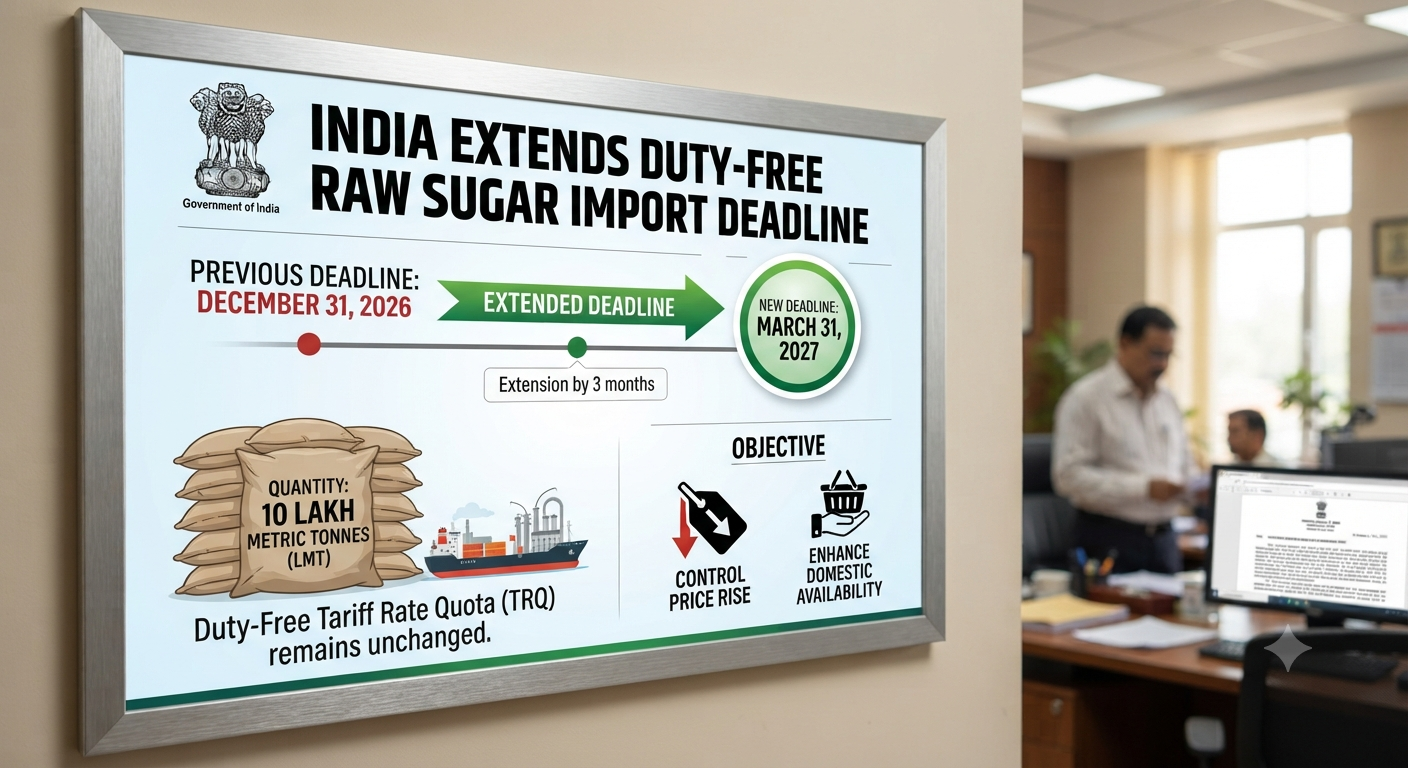
India has extended the deadline for duty-free imports of 10 lakh metric tonnes (1 million MT) of raw sugar by three months, providing additional time for eligible importers to bring supplies into the country. The revised deadline is March 31, 2027, replacing the earlier date of December 31, 2026.
The Directorate General of Foreign Trade (DGFT), under the Ministry of Commerce and Industry, announced the extension through Notification No. 51/2026-27 dated November 25, 2026. The decision is part of the government’s efforts to improve domestic sugar availability and manage price pressures in the market.
The extension does not increase the original import quota. Instead, it gives importers additional time to utilise the existing allocation of 10 lakh MT under the Tariff Rate Quota (TRQ) mechanism. All other conditions attached to the original policy remain unchanged.
Understanding the Duty-Free Import Extension
Under the revised notification, raw sugar classified under Exim Code 170114 of Chapter 17 of the ITC (HS), 2022, will continue to be eligible for duty-free imports under the TRQ arrangement until March 31, 2027.
A Tariff Rate Quota allows a specified quantity of a commodity to enter a country at a preferential customs duty rate. In this case, eligible imports within the 10-lakh-tonne quota can enter India without the applicable customs duty, subject to the prescribed conditions.
The government initially introduced the duty-free import facility in August 2026, with an import deadline of October 31. It subsequently extended the deadline to December 31, 2026. The latest notification marks the second extension of the import window.
The repeated extensions indicate that importers have required additional time to arrange shipments and utilise the available quota.
Processing Deadline Also Extended
Alongside the import deadline, the government has provided additional time for processing imported raw sugar.
Through a separate public notice, DGFT extended the deadline for converting imported raw sugar into white or refined sugar and selling the processed product in the domestic market until September 30, 2027.
This provision is important because raw sugar generally requires further processing before it can be supplied to consumers and many commercial buyers.
The additional time gives eligible importers and refiners greater flexibility to coordinate international shipments, port operations, refining capacity and domestic distribution.
However, the extended processing timeline does not remove the existing eligibility requirements or other conditions governing the import arrangement.
Why India Is Allowing Duty-Free Sugar Imports
India is one of the world’s largest sugar producers and consumers. Despite its substantial domestic production capacity, variations in output, opening stocks and consumption can create temporary supply pressures.
The government introduced the duty-free import arrangement amid rising domestic sugar prices and concerns about available supplies ahead of the 2026–27 sugar season.
The country had returned to raw sugar imports after nearly a decade, reflecting the need to supplement domestic availability under changing market conditions.
Sugar prices had experienced considerable upward pressure as the new season approached. Lower opening stocks and strong seasonal demand contributed to concerns about market availability.
The government also took measures to manage domestic supplies, including stockholding restrictions for certain bulk consumers. The import arrangement was intended to provide an additional source of raw material for domestic refiners and help moderate supply pressures.
Impact on Sugar Mills and Refiners
The extended import window provides greater operational flexibility to sugar refiners and eligible importing businesses.
International sugar procurement involves several stages, including identifying suppliers, negotiating prices, arranging shipping, securing documentation and completing customs procedures. Delays in any of these stages can affect the utilisation of an import quota.
By extending the deadline, the government has reduced the immediate time pressure on businesses seeking to import the remaining eligible quantity.
Refiners may also benefit from the extended processing deadline, which allows them to plan production schedules and manage the conversion of imported raw sugar into refined products.
For domestic sugar mills, however, the policy presents a mixed picture. Additional imports can improve market availability and moderate prices, but they may also increase competition for locally produced sugar.
The overall impact will depend on the quantity actually imported, the timing of shipments, domestic production levels and demand during the remaining months of the season.
Implications for Consumers and the Food Industry
Sugar is an important raw material for several industries, including beverages, confectionery, packaged foods, bakeries and pharmaceuticals.
Higher sugar prices can increase production costs for businesses that rely heavily on the commodity. These costs may eventually influence retail prices, depending on competition, inventories and manufacturers’ pricing strategies.
Additional supplies through duty-free imports could help ease pressure on domestic availability and provide some relief to bulk buyers.
However, the effect on consumer prices will depend on how quickly imported sugar reaches the domestic market and whether domestic production strengthens during the crushing season.
The government will also need to monitor inventory levels and market prices to ensure that imports complement domestic production rather than create unnecessary supply imbalances.
The Worldonomics Times View
India’s decision to extend the duty-free raw sugar import deadline reflects a practical effort to manage domestic supply conditions while providing businesses with greater procurement flexibility.
The unchanged quota of 10 lakh MT indicates that the government has extended the utilisation period rather than substantially expanding the import commitment. The additional processing time until September 30, 2027, further supports operational planning for eligible refiners.
Nevertheless, the long-term stability of India’s sugar market will continue to depend primarily on domestic production, seasonal demand, opening stocks and effective supply management.
Policymakers must maintain a balance between consumer interests and the financial stability of domestic sugar mills and farmers. Duty-free imports can help address temporary supply gaps, but predictable policies and accurate production assessments remain essential.
Ultimately, the success of the extension will be measured by how effectively the additional time improves domestic availability, supports industrial users and prevents excessive price volatility without undermining the domestic sugar industry.