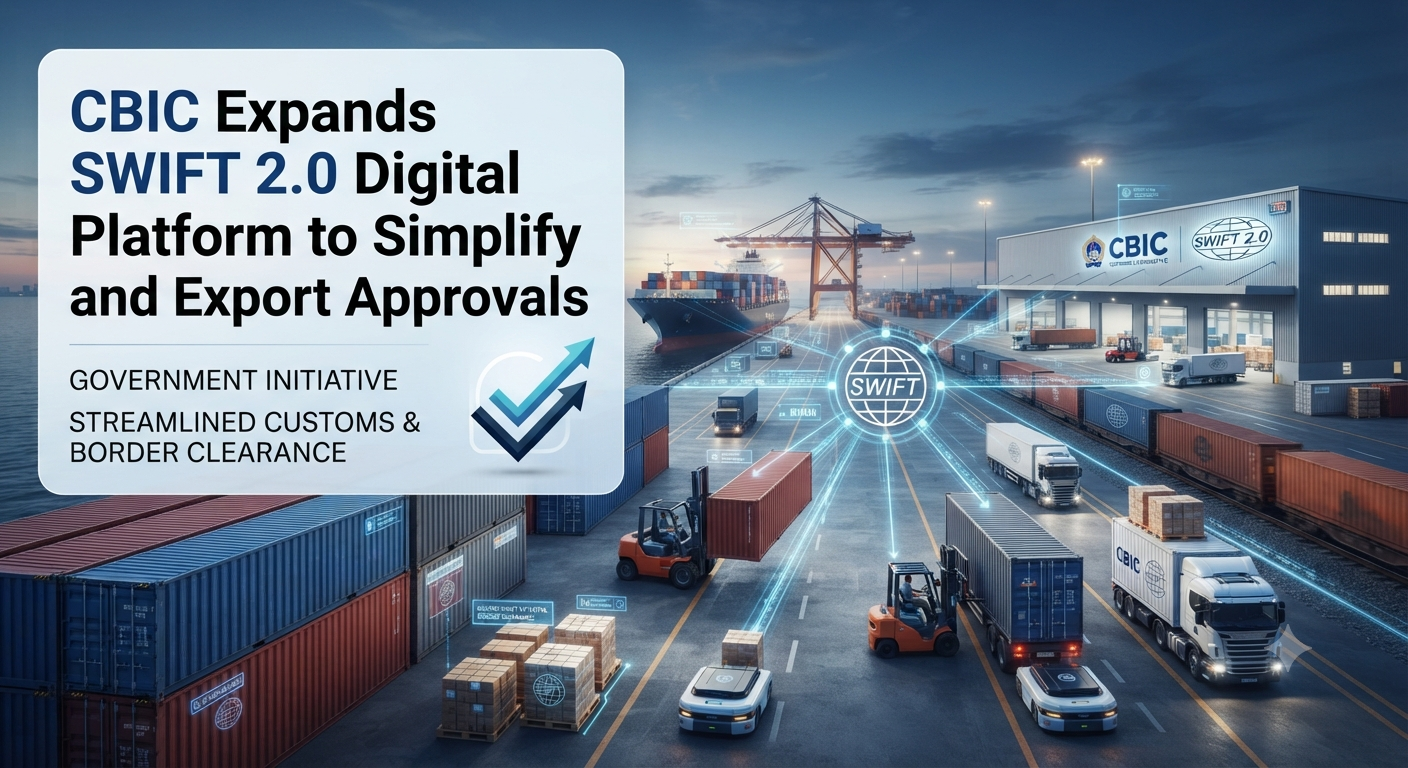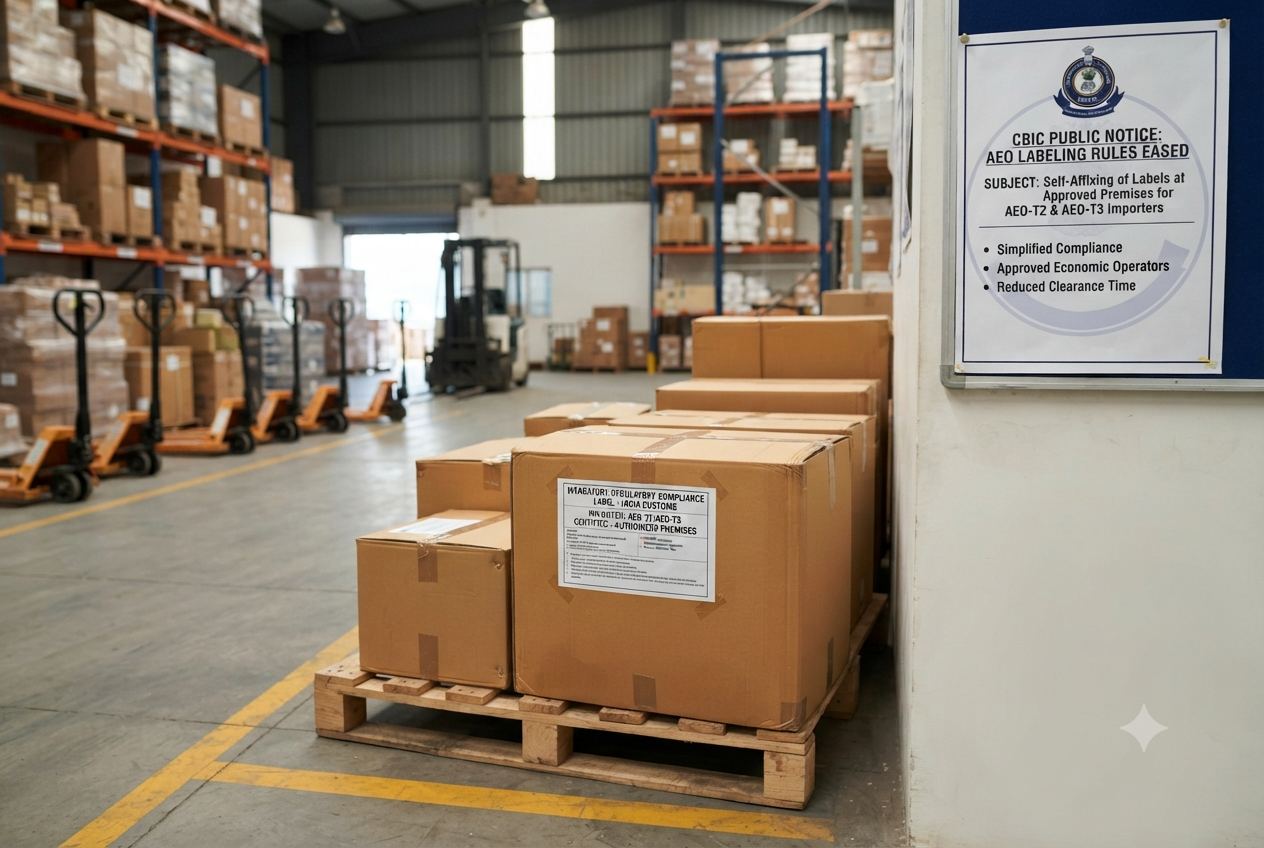
India’s import compliance framework has received a significant trade-facilitation boost after the Central Board of Indirect Taxes and Customs (CBIC) clarified the rules governing mandatory labelling of imported pre-packaged commodities. Under Circular No. 49/2026-Customs, dated November 25, 2026, importers holding valid Authorised Economic Operator (AEO) Tier-2 and Tier-3 certification may affix mandatory declarations at their approved premises.
The clarification is expected to reduce procedural delays, improve operational flexibility and bring greater consistency to customs procedures across the country. It addresses concerns raised by trade and industry associations over differing practices followed by Customs field formations regarding the stage at which mandatory declarations must be affixed.
The measure is particularly relevant for businesses importing packaged consumer goods, electronics, household products and other commodities covered under the Legal Metrology (Packaged Commodities) Rules, 2011.
What Has Changed Under the New Circular?
The CBIC circular operationalises the facility introduced through the Legal Metrology (Packaged Commodities) Third Amendment Rules, 2026, notified through G.S.R. 418(E) on May 29, 2026.
The amendment inserted Explanation-2 under Rule 4, allowing mandatory declarations to be made at bonded warehouses of AEO Tier-2 and Tier-3 certified operators, provided all prescribed declarations are affixed before retail packages leave those premises.
Following consultations with the Department of Consumer Affairs, CBIC has clarified that eligible AEO Tier-2 and Tier-3 importers may undertake the labelling or relabelling process at their approved premises in accordance with the facilitation framework under Circular No. 33/2016-Customs.
This provides greater flexibility to eligible importers by allowing them to complete the required labelling process at approved locations rather than facing inconsistent requirements at individual ports of import.
Conditions Importers Must Follow
The facility is subject to specific compliance requirements. Importers cannot use the relaxation without meeting the prescribed conditions.
The importer must hold a valid AEO Tier-2 or AEO Tier-3 certification issued by CBIC. The imported products must also fall within the scope of the Legal Metrology (Packaged Commodities) Rules, 2011.
Eligible businesses must maintain proper records covering the import, receipt, storage, labelling or relabelling and subsequent clearance of goods. These records must be made available to Customs authorities whenever required.
Most importantly, all mandatory declarations must be affixed before the goods are removed from the approved premises for sale, distribution or home consumption.
The clarification therefore changes the permitted location and operational stage of labelling for eligible importers, but does not eliminate the underlying consumer-protection and disclosure requirements.
Different Rules for Other Importers
CBIC has also clarified the procedure applicable to importers that do not hold AEO Tier-2 or Tier-3 certification.
Such importers may affix mandatory declarations only in a Customs bonded warehouse licensed under Section 57 or an importer’s bonded warehouse licensed under Section 58 of the Customs Act, 1962.
The declarations must be completed before the goods are cleared for home consumption.
The circular also makes an important clarification for Customs field formations: officers should not insist that mandatory Legal Metrology declarations be affixed at the port of import or before clearance from the Customs station.
This instruction is intended to prevent inconsistent practices and reduce unnecessary operational complications for importers.
Why the Change Matters for Businesses
Labelling requirements are an essential part of India’s consumer-protection framework. Imported pre-packaged commodities must carry prescribed information so that consumers can make informed purchasing decisions.
These declarations can include details such as the manufacturer’s or importer’s identity, country of origin, product description, quantity, applicable retail sale price and consumer-care information, as required under the relevant rules.
However, the timing and location of labelling can influence supply-chain efficiency. When importers face uncertainty over where declarations must be affixed, goods may remain in storage longer, increasing handling expenses and delaying distribution.
Allowing eligible AEO importers to complete the process at approved premises can help integrate labelling into their existing warehouse and inventory-management operations.
The clarification may be particularly useful for companies handling large volumes of imported packaged products. Greater flexibility can improve inventory planning, reduce additional handling and support faster movement of goods into domestic distribution networks.
Strengthening India’s AEO Programme
The Authorised Economic Operator programme is designed to recognise businesses that maintain strong compliance, security and supply-chain management standards.
AEO certification provides eligible importers and exporters with various customs facilitation benefits, including procedural efficiencies and priority treatment under applicable provisions.
The latest clarification reinforces the programme’s role in promoting trusted-trader arrangements. By extending operational flexibility to AEO Tier-2 and Tier-3 importers, the government is recognising the importance of reliable compliance systems while seeking to facilitate legitimate international trade.
The development also reflects a broader policy objective: improving India’s trade infrastructure without weakening regulatory oversight.
The Worldonomics Times View
CBIC’s clarification is a practical step towards reducing avoidable procedural friction in India’s import ecosystem. Businesses operating with recognised AEO certification can benefit from greater flexibility in completing mandatory declarations, while Customs authorities retain the ability to inspect records and verify compliance.
The success of this measure will depend on consistent implementation across Customs formations and clear communication with importers, warehouse operators and logistics providers.
Importers should review their AEO status, approved premises, documentation procedures and internal labelling controls to ensure that they meet every condition before using the facility.
Ultimately, efficient trade procedures and strong consumer protection must work together. By allowing eligible importers to undertake labelling at approved premises while retaining mandatory disclosure requirements, CBIC has taken a step towards making India’s import processes more predictable, efficient and business-friendly.