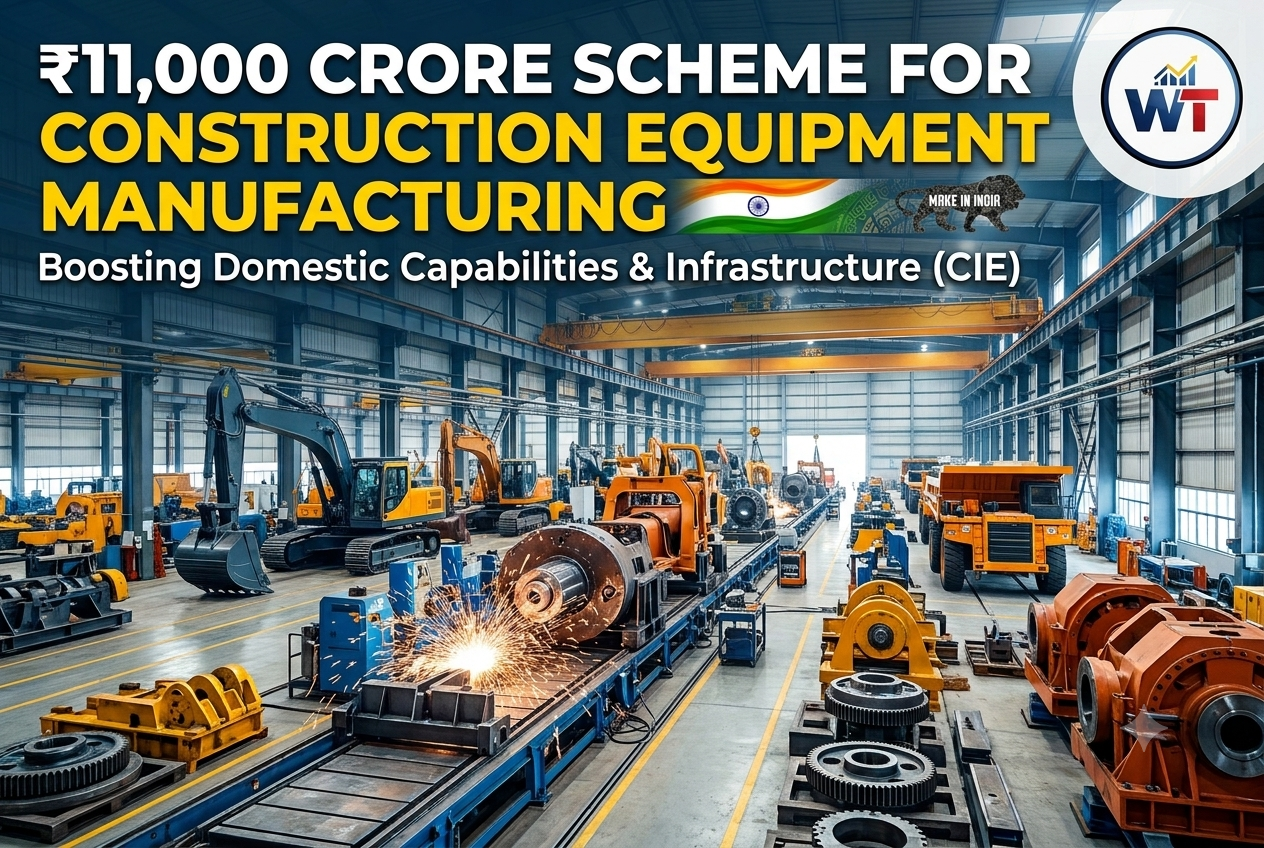
New Delhi, November 27, 2026 — The Union Cabinet has approved an ₹11,000 crore scheme to strengthen India’s construction and infrastructure equipment manufacturing ecosystem, marking a major policy initiative to expand domestic production of advanced industrial machinery.
Approved on November 25, 2026, the Scheme for Enhancement of Construction and Infrastructure Equipment (CIE) Manufacturing Ecosystem will be implemented by the Ministry of Heavy Industries. It aims to encourage domestic manufacturers, strengthen component supply chains, reduce import dependence and improve India’s competitiveness in the global construction equipment market.
The initiative comes at a time when India’s infrastructure development programme is generating demand for sophisticated machinery used in roads, ports, housing, tunnels and large-scale construction projects.
Focus on Advanced Construction and Infrastructure Machinery
The scheme is designed to promote manufacturing of technologically advanced equipment that is essential for major infrastructure projects. The targeted products include hydraulic excavators, tunnel boring machines, ship-to-shore cranes and off-highway trucks.
Other equipment categories covered include loaders, piling rigs and drilling machines. These machines are widely used in road construction, underground transportation projects, mining, port development and industrial infrastructure.
India’s construction and infrastructure equipment industry is currently the world’s third-largest, after China and the United States. Its market size was estimated at approximately ₹97,500 crore in FY2024-25. According to the government, the market could more than double to around ₹2,28,100 crore by FY2029-30, supported by expanding infrastructure and housing activity.
Sales-Linked Incentives for Domestic Manufacturers
A central feature of the scheme is its sales-linked incentive structure, which will encourage eligible manufacturers to increase domestic production.
The incentives will be available to two categories of approved applicants:
- Original Equipment Manufacturers (OEMs), which manufacture complete construction and infrastructure equipment.
- Component manufacturers, which produce essential parts and systems used in these machines.
Eligible applicants will receive graded incentives ranging from 13% to 8% of incremental sales value over a five-year period. The structure is intended to reward additional production and sales rather than simply provide support for existing manufacturing activity.
This approach could encourage companies to invest in new production lines, expand manufacturing capacity and develop more advanced equipment within India.
It may also create opportunities for smaller component manufacturers that supply engines, transmission systems, hydraulic components, electronics and other specialised parts to equipment producers.
The government expects the incentive framework to encourage investment across the manufacturing value chain and strengthen the domestic industrial ecosystem.
Dedicated Testing Facility to Strengthen Quality Standards
Another important element of the scheme is the establishment of a dedicated Construction and Infrastructure Equipment testing facility.
The government has provided for a grant of up to ₹375 crore in the form of viability gap funding for the facility. It is intended to provide advanced testing infrastructure for construction and infrastructure equipment manufactured in India.
Testing is essential for machinery that operates under demanding conditions. Equipment used in tunnelling, mining, ports and large construction projects must meet requirements relating to safety, durability, performance and reliability.
A dedicated domestic testing facility can help manufacturers evaluate their products, improve technical standards and reduce the need to depend on overseas testing infrastructure.
It can also support product development and help Indian manufacturers demonstrate that their equipment meets the requirements of domestic and international markets.
Eight-Year Implementation Framework
The scheme will operate for eight years, covering FY2026-27 to FY2033-34. Its implementation has been divided into three phases.
| Period | Key activity |
|---|---|
| FY2026-27 to FY2027-28 | Two-year gestation period for establishing manufacturing facilities |
| FY2028-29 to FY2032-33 | Five-year period for incentive disbursement |
| FY2033-34 | Final settlement of incentives linked to incremental sales in FY2032-33 |
The two-year initial period will allow approved manufacturers to establish or expand their production facilities before the incentive-disbursement phase begins.
The five-year incentive period will then support eligible incremental sales, while the final year will be used to settle incentives relating to the last year of the programme.
This phased structure provides manufacturers with a defined timeline for investment planning, capacity creation and production expansion.
Reducing Import Dependence and Strengthening Supply Chains
India’s infrastructure expansion has increased demand for specialised construction equipment. However, domestic manufacturers continue to face challenges in producing certain advanced machines and components at competitive costs and technological standards.
Import dependence can expose infrastructure projects to international supply disruptions, foreign exchange fluctuations and changes in global trade conditions. Greater domestic manufacturing capacity could improve supply-chain security and provide Indian companies with more control over equipment availability and maintenance.
The proposed scheme is therefore significant beyond its direct financial incentives. It seeks to build manufacturing capabilities across complete machines as well as critical components, supporting a more integrated industrial ecosystem.
For domestic companies, the opportunity will involve developing advanced engineering capabilities, improving production efficiency and investing in research and technology. For infrastructure developers, a stronger local supplier base could gradually improve access to equipment and technical support.
Opportunities for Employment and Industrial Development
The expansion of construction equipment manufacturing can generate opportunities across several industrial activities, including engineering, fabrication, electronics, component production, testing and maintenance.
The development of specialised machinery also requires skilled technicians, engineers, designers and manufacturing professionals. Increased investment in these areas could support employment and strengthen India’s technical workforce.
Small and medium-sized enterprises may benefit by becoming suppliers to larger equipment manufacturers. A stronger network of domestic component producers can encourage technology development and create opportunities for businesses operating in industrial clusters.
The scheme is also aligned with the objectives of Aatmanirbhar Bharat and the broader vision of Viksit Bharat 2047, which emphasises domestic industrial capabilities and global competitiveness.
The Worldonomics Times View
The approval of the ₹11,000 crore CIE Manufacturing Ecosystem scheme represents an important step towards strengthening India’s domestic construction equipment industry. As infrastructure investment expands, the availability of advanced machinery will become increasingly important for timely project execution and efficient construction.
The sales-linked incentives and proposed testing facility address two important requirements of the industry: encouraging manufacturers to expand production and helping them meet technical and quality standards.
The scheme also creates opportunities for component manufacturers and smaller industrial suppliers to participate in a broader domestic manufacturing network. This could support investment, employment and technology development across the value chain.
However, the long-term success of the initiative will depend on effective implementation, transparent incentive allocation, timely establishment of manufacturing facilities and the ability of domestic companies to produce equipment that is competitive in both price and performance.
Reducing import dependence will require more than increasing production volumes. Manufacturers must also focus on research, product reliability, after-sales service and continuous technological improvement.
If implemented effectively, the scheme could strengthen India’s position in the global construction equipment market while supporting the country’s infrastructure development priorities. It represents an opportunity to convert rising domestic demand into a stronger and more self-reliant industrial manufacturing base.