An analysis of Apple’s Singapore tax payments, corporate tax incentives and the impact of the global minimum tax framework.
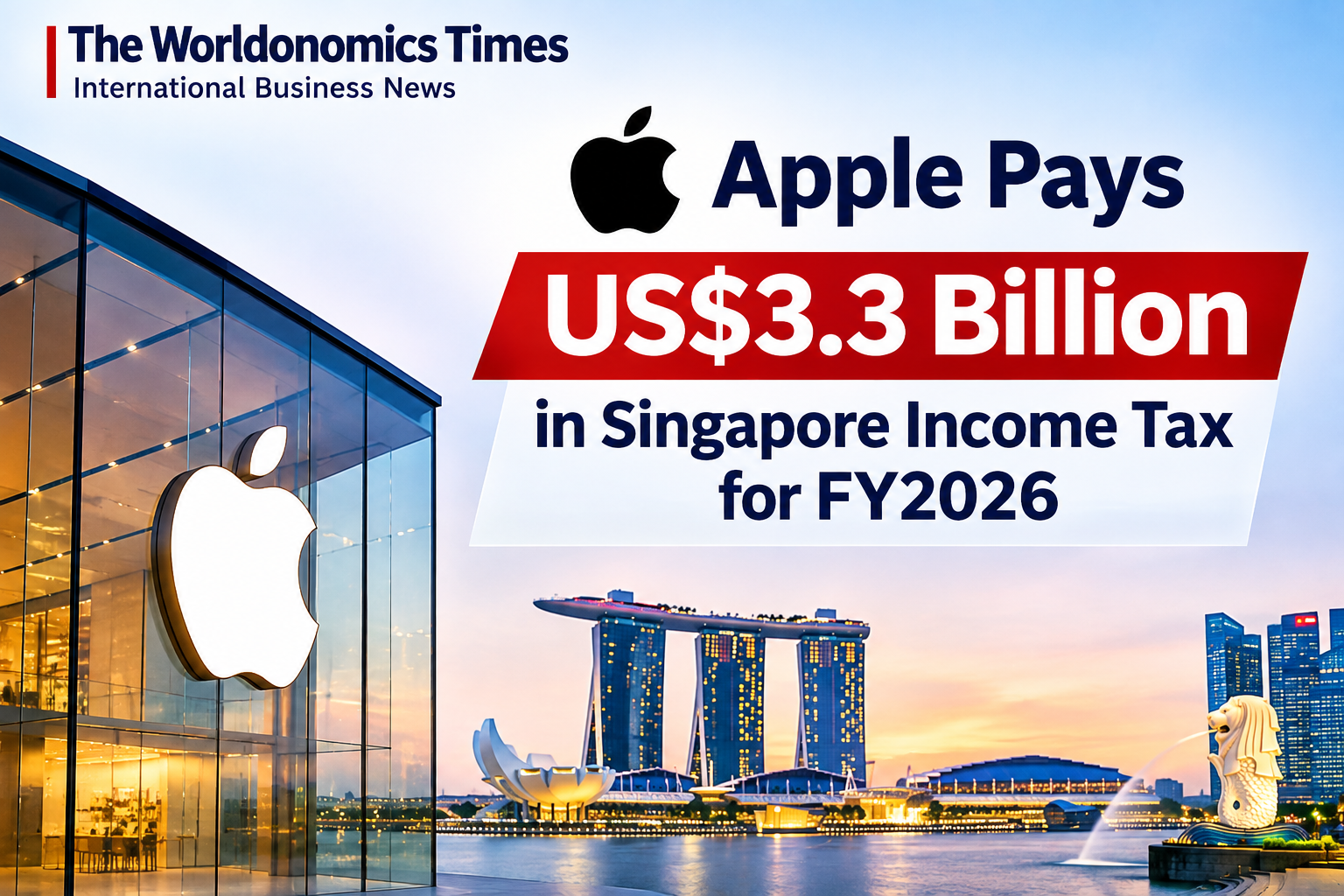
SINGAPORE, 11 November 2026: Technology giant Apple Inc. paid approximately US$3.25 billion (around S$4.16 billion) in income taxes to Singapore during its financial year 2026, highlighting the country’s growing importance as a global business and financial hub.
The payment, disclosed in Apple’s annual report for the financial year ended 26 September 2026, represented approximately 9.4% of the company’s worldwide cash income tax payments of US$34.59 billion.
The disclosure has attracted attention from international tax professionals, policymakers and corporate finance experts because it demonstrates how multinational companies benefit from Singapore’s competitive corporate tax environment, investment incentives and established business infrastructure.
At the same time, Apple’s disclosures provide an important illustration of how the global minimum tax framework is changing international corporate taxation. The Straits Times+1
Apple Benefits from Singapore’s Competitive Tax Environment
Singapore has developed a reputation as one of Asia’s leading destinations for multinational corporations, supported by a stable regulatory environment, skilled workforce, modern infrastructure and competitive tax policies.
The country’s standard corporate income tax rate is 17%. However, qualifying businesses may benefit from tax incentives, exemptions and preferential arrangements designed to attract investment, encourage innovation and support high-value economic activities.
Apple’s FY2026 annual report disclosed that Singapore’s tax rate differences and incentives reduced its tax expense by approximately US$5.49 billion compared with the amount calculated using the US federal statutory corporate tax rate of 21%.
This figure reflects a tax-expense comparison in Apple’s financial reporting. It should not be interpreted as a direct cash tax saving or as the amount of tax paid in Singapore.
The disclosure demonstrates how differences in corporate tax regimes can influence the global tax position of multinational enterprises. sec.gov+1
Global Minimum Tax Reduces the Benefit of Tax Incentives
An important aspect of Apple’s Singapore tax disclosure is the impact of the global minimum tax framework.
Singapore has implemented the 15% global minimum effective tax rate framework for qualifying multinational enterprise groups, applicable to financial years beginning on or after 1 January 2025.
Under this framework, large multinational groups within its scope are generally subject to a minimum effective tax rate of 15% in each relevant jurisdiction. Where the calculated effective rate falls below the minimum, additional tax may become payable under the applicable top-up tax rules.
Apple reported a US$2.51 billion tax expense relating to Singapore’s Qualified Domestic Minimum Top-up Tax (QDMTT) in FY2026.
This top-up tax partially offset the benefit arising from Singapore’s lower tax rates and incentives.
Apple also reported US$311 million in other Singapore-related tax adjustments. After considering these items, the net reduction in its tax expense attributable to Singapore was approximately US$2.67 billion compared with the US federal statutory tax benchmark.
Importantly, Apple has not separately disclosed its exact effective tax rate in Singapore. sec.gov+1
Singapore’s Growing Importance as a Global Business Centre
Singapore has positioned itself as a major international headquarters location for technology companies, financial institutions, trading businesses and multinational corporations.
Its strategic location in Southeast Asia provides access to important Asian markets, while its developed financial services sector supports international trade, investment and cross-border business operations.
For companies such as Apple, Singapore offers several advantages:
- Competitive taxation: A standard corporate income tax rate of 17%, alongside qualifying tax incentives.
- Business infrastructure: Advanced digital connectivity, logistics and financial services.
- Regional access: A strategic location for managing operations across Asia-Pacific.
- Regulatory stability: A transparent legal and business environment.
- Skilled workforce: Access to professionals in technology, finance, engineering and management.
These factors have helped Singapore attract significant international investment and establish itself as an important regional business headquarters.
Apple’s Global Financial Performance in FY2026
Apple also reported strong financial performance during FY2026.
The company’s worldwide revenue increased 15% to approximately US$478.83 billion, compared with the previous financial year. Net profit rose 18% to US$132.18 billion.
Growth was supported by stronger demand for iPhones, expansion in services revenue and a recovery in Greater China sales.
| Financial indicator | FY2026 |
|---|---|
| Worldwide revenue | US$478.83 billion |
| Net profit | US$132.18 billion |
| Worldwide cash income tax | US$34.59 billion |
| Singapore income tax paid | US$3.25 billion |
| Singapore share of worldwide cash tax | 9.4% |
The company reported that its worldwide cash income tax payments declined from US$43.37 billion in FY2025 to US$34.59 billion in FY2026.
The Singapore payment is particularly significant because it represents a substantial contribution to Apple’s global cash tax payments. The Straits Times+1
Implications for International Tax Planning
Apple’s tax disclosure provides an important case study for multinational companies and international tax professionals.
Historically, differences in corporate tax rates and investment incentives encouraged businesses to locate regional headquarters, intellectual property operations and other activities in jurisdictions offering competitive tax arrangements.
However, the introduction of the OECD/G20-led global minimum tax framework has changed the international tax landscape.
Under the framework, qualifying multinational groups with consolidated annual revenues of at least €750 million are generally subject to a 15% minimum effective tax rate in each jurisdiction where the rules apply.
Singapore’s implementation of the domestic minimum top-up tax allows it to collect applicable top-up taxes on qualifying profits rather than leaving the additional tax collection to another jurisdiction under the international rules.
For tax advisers, chartered accountants, cost accountants and corporate finance professionals, this development creates additional requirements concerning tax calculations, jurisdictional reporting, financial disclosures and compliance.
Businesses operating across multiple countries must increasingly evaluate not only headline corporate tax rates but also the effective tax burden after considering incentives, exemptions and top-up tax provisions.
What Does This Mean for India?
Singapore’s corporate tax environment also provides an interesting comparison for India.
India has been working to attract foreign investment through manufacturing incentives, infrastructure development, startup support and reforms to its corporate taxation framework.
India’s domestic corporate tax regime includes a 22% concessional rate for eligible domestic companies opting for the applicable provisions, while qualifying new manufacturing companies may opt for a 15% base rate under Section 115BAB, subject to statutory conditions. Applicable surcharge and cess are additional.
For large multinational groups covered by global minimum tax rules, the effective tax position must also be evaluated under the relevant international framework.
The Apple disclosure highlights the importance of combining competitive tax policies with infrastructure, skilled manpower, regulatory certainty and access to international markets when attracting multinational investment.
For India, the broader lesson is that tax competitiveness is only one part of a successful international investment strategy.
Conclusion
Apple’s US$3.25 billion income tax payment to Singapore in FY2026 highlights the country’s importance in the global operations of multinational corporations.
The disclosure also demonstrates the changing relationship between corporate tax incentives and international tax regulations. While Singapore continues to offer a competitive business environment, the implementation of the 15% global minimum tax framework has introduced additional tax obligations for large multinational enterprises.
For businesses, investors and tax professionals, Apple’s annual report offers valuable insights into international tax planning, corporate taxation and the financial implications of operating across multiple jurisdictions.
As global tax transparency and minimum taxation rules continue to evolve, Singapore is likely to remain an important destination for international business and investment.
The Worldonomics Times | International Business, Taxation & Finance