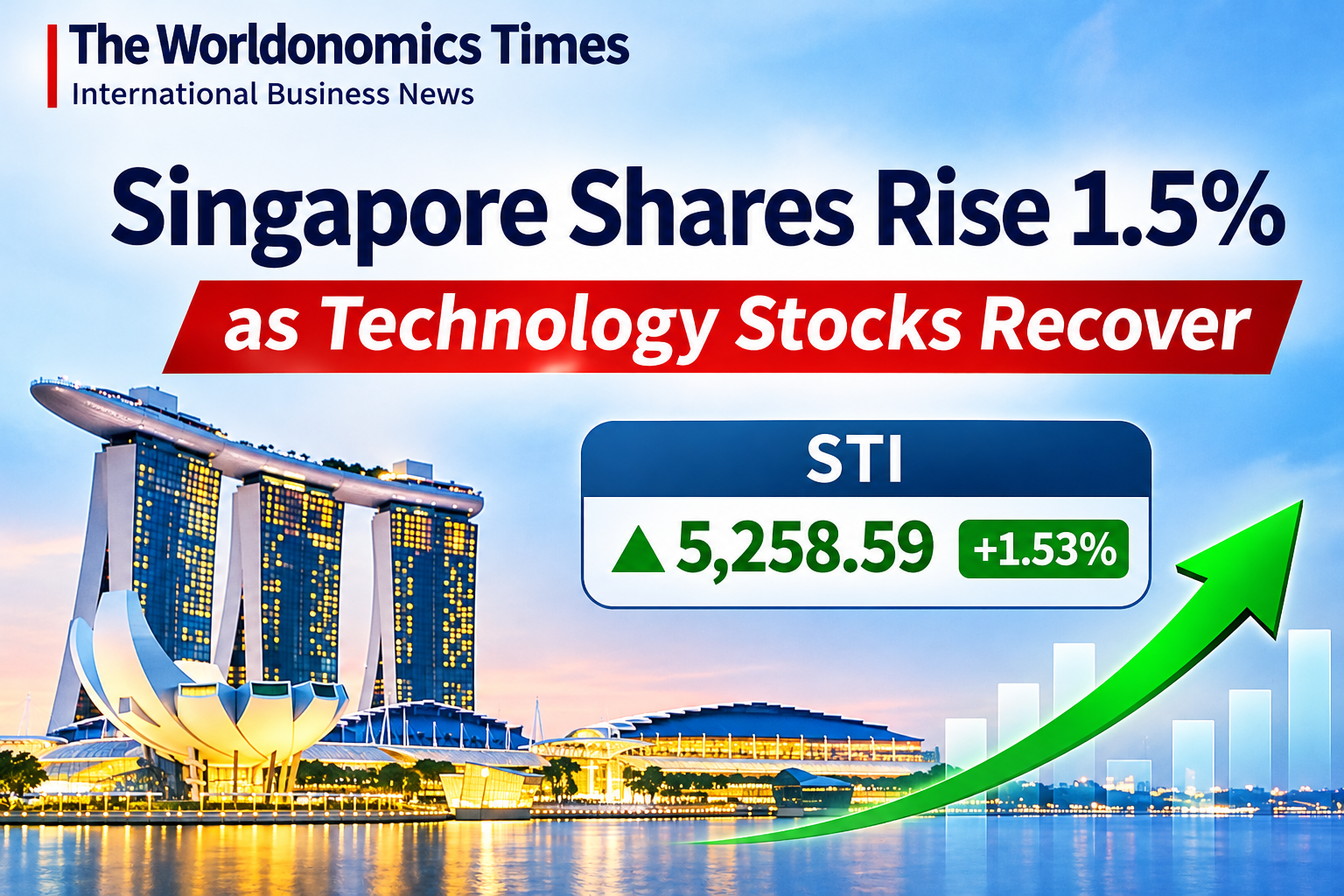
Singapore, 10 November 2026: Singapore’s equity market staged a strong recovery on Tuesday as technology stocks rebounded following last week’s sharp sell-off. The benchmark Straits Times Index (STI) gained 79.42 points, or 1.53%, to close at 5,258.59, supported by buying interest in technology, banking and industrial stocks.
The positive movement reflected improving investor sentiment across Asian markets and renewed interest in technology companies after recent corrections. Singapore’s three major banking stocks also finished higher, providing additional support to the benchmark index.
According to Singapore Exchange (SGX) market data, the STI opened at 5,214.85 and traded within a range of 5,213.11 to 5,276.26 during the session.
Technology Stocks Lead Market Recovery
Technology shares were among the strongest performers as investors returned to selected counters following significant losses in the previous week.
AEM Holdings emerged as one of the notable gainers, rising as much as 12% during morning trading before closing at S$6.84. The stock had suffered a substantial decline during the previous week’s technology-sector sell-off.
UMS Integration gained 3.6% to close at S$1.75, while CSE Global advanced approximately 5% during the session before settling at S$0.85.
The recovery in these companies reflected renewed investor interest in semiconductor-related businesses, technology equipment manufacturers and industrial technology providers.
Market participants viewed the rebound as part of a broader recovery in technology shares, following improved performance in US technology stocks on Monday.
However, the recovery does not necessarily indicate a complete reversal of the recent market correction. Investors continue to assess corporate earnings, business outlooks and global technology demand before increasing their exposure to the sector.
Banking Stocks Provide Additional Support
Singapore’s three major domestic banks also recorded gains, contributing to the positive market performance.
The following were the closing prices of the three banking stocks:
| Bank | Closing price | Daily gain |
|---|---|---|
| DBS Group | S$70.37 | 0.9% |
| OCBC Bank | S$28.60 | 3.1% |
| UOB | S$37.38 | 1.4% |
OCBC recorded the strongest percentage increase among the three banks.
The positive performance of banking shares was an important factor behind the broader market recovery, given the significant representation of financial institutions in Singapore’s benchmark index.
Investors continue to monitor the financial performance of Singapore’s banking sector, particularly net interest income, loan growth, asset quality and regional economic developments.
Yangzijiang Shipbuilding Leads STI Gainers
Among the constituent companies of the Straits Times Index, Yangzijiang Shipbuilding was the leading gainer.
The company’s shares increased 5.5%, or S$0.24, to close at S$4.59.
The shipbuilding sector remains an important part of Singapore’s broader industrial and maritime ecosystem, with investor interest influenced by international shipping demand, vessel orders and global trade conditions.
On the other hand, Frasers Logistics & Commercial Trust was the weakest performer among STI constituents. Its shares declined 3.2% to close at S$0.895.
The mixed performance highlighted the importance of sector-specific developments even during a broadly positive trading session.
Broader Market Records Positive Market Breadth
The recovery extended beyond the major blue-chip companies.
Market breadth remained positive, with 390 stocks advancing compared with 212 declining.
Approximately 1.3 billion securities changed hands, representing a total trading value of around S$2.8 billion.
The positive market breadth suggested that buying interest was distributed across a wider range of listed securities rather than being limited to a small number of heavyweight companies.
Among stocks included in the iEdge Singapore Next 50 Index, AEM was the strongest performer, while Food Empire recorded the largest decline, falling 5.9% to S$1.75.
Asian Markets Also Witness Positive Momentum
Singapore’s market recovery took place alongside gains in several major Asian equity markets.
Japan’s Nikkei 225 advanced 2.9%, while South Korea’s Kospi increased 4.4%. Hong Kong’s Hang Seng Index gained 0.4%. Malaysia’s FTSE Bursa Malaysia KLCI, however, declined 0.8%.
The improvement in international technology shares helped support investor confidence in Asian equities.
Market strategists also observed that investors were increasingly willing to buy selected stocks following price corrections, suggesting that market participants were shifting between sectors rather than withdrawing completely from equity investments.
What Should Investors Watch Next?
Despite the positive performance, investors should remain attentive to developments in global financial markets.
The sustainability of the technology-sector recovery will depend on corporate earnings, semiconductor demand, artificial intelligence-related investment, global interest rate expectations and broader economic conditions.
Singapore’s banking stocks will also remain important indicators of market direction, given their influence on the STI.
Investors should additionally monitor developments in US technology markets and regional economic performance, as international capital flows can influence sentiment towards Singapore-listed companies.
Conclusion
Singapore’s stock market delivered a strong performance on 10 November 2026, with the Straits Times Index rising 1.53% to 5,258.59.
The recovery in technology shares, gains in the three major domestic banks and positive market breadth contributed to the upward movement.
While the session provided encouraging signs of renewed investor confidence, the sustainability of the recovery will depend on corporate earnings, global technology demand and international market conditions.
For investors, the latest trading session highlights the importance of monitoring sectoral developments and maintaining a disciplined approach to equity market participation.
The Worldonomics Times | Global Stock Markets & Business News