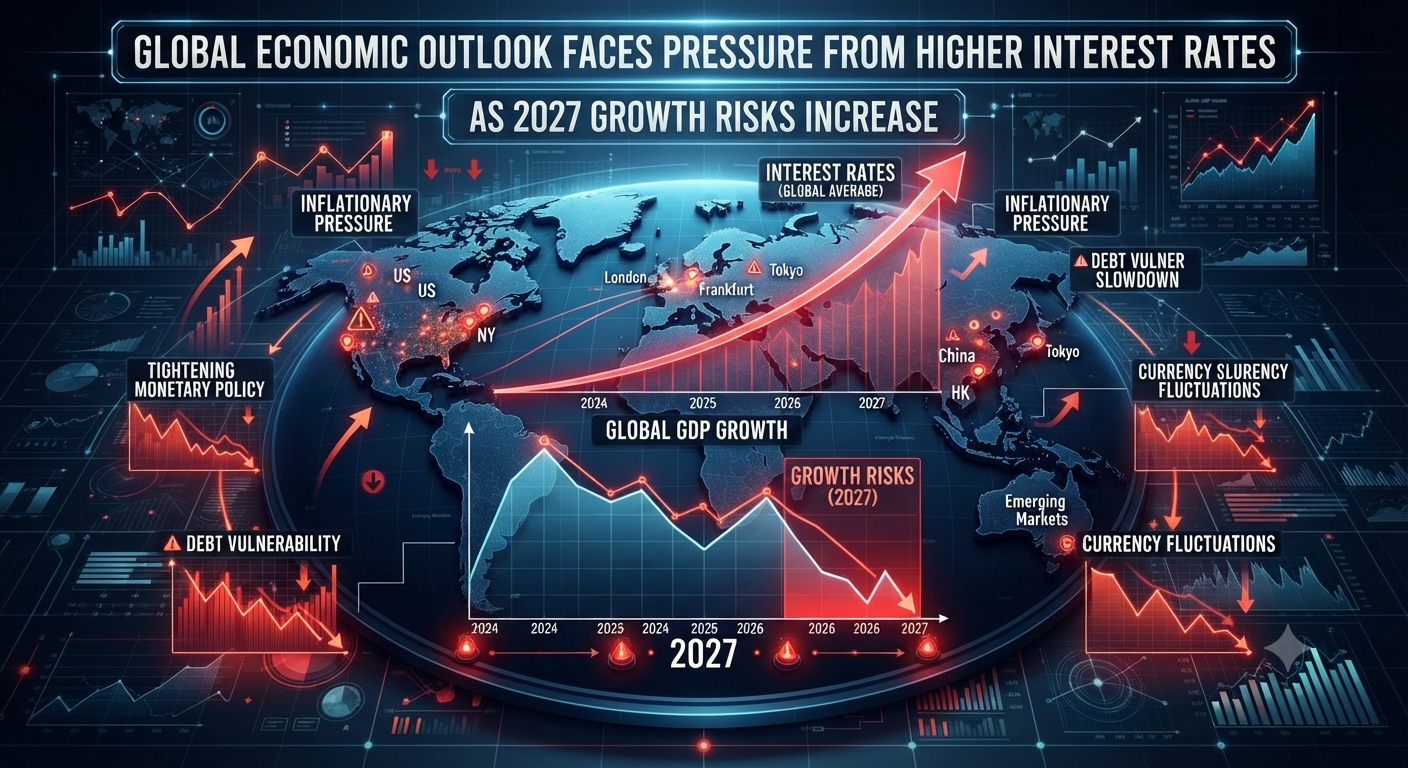
The global economy is entering a challenging phase as persistent inflationary pressures, rising government bond yields and tighter financial conditions create fresh uncertainty over the growth outlook for 2027. S&P Global Market Intelligence’s November 2026 economic outlook highlights the growing pressure on businesses, governments and financial markets as major central banks prepare to maintain restrictive monetary policies.
The report identifies a combination of inflation risks, higher borrowing costs and fiscal pressures as important factors shaping the international economic environment. While falling crude oil prices could ease some near-term inflation concerns, broader price pressures are emerging across major economies.
The outlook suggests that the global economy may continue expanding, but the cost of financing investment and government spending is increasing. This could limit economic momentum and create additional challenges for countries already facing high debt levels and uncertain trade conditions.
Inflationary Pressures Remain a Major Global Concern
Inflation continues to be one of the most important considerations for central banks and financial markets.
According to S&P Global Market Intelligence, recent economic data indicate that price pressures are becoming broader in several major economies. Although the direct impact of earlier energy price increases on core inflation has remained relatively limited in some markets, newer data suggest that inflation is spreading into additional categories.
In the United States, core consumer prices increased by 0.3% month-on-month for the third consecutive month in October. The three-month annualised rate was approaching 4%, indicating that underlying inflation remains stronger than policymakers would prefer.
In the eurozone, core inflation remained at 2.5% in October, while headline inflation reached 4.0%. Higher food prices, partly associated with unusually hot and dry European weather conditions, have added to the inflation challenge.
These developments make it more difficult for central banks to reduce interest rates without risking a renewed increase in inflation.
However, the recent decline in crude oil prices could provide some relief. Brent crude averaged approximately US$96 per barrel during the first half of November, down from a peak above US$116 in late October. Lower energy prices could gradually reduce headline inflation, although the extent of this relief will depend on how other prices develop.
Major Central Banks Expected to Maintain Monetary Tightening
The inflation outlook has strengthened expectations of additional interest-rate increases by major central banks.
S&P Global Market Intelligence expects the US Federal Reserve, European Central Bank and Bank of Japan to increase their policy rates by 25 basis points in December 2026.
The report forecasts that the European Central Bank’s policy rate could reach 2.75%, while the Bank of Japan’s rate could rise to 1.50%. The Federal Reserve is also expected to deliver another increase, although the possibility of a larger move has received renewed attention following stronger inflation data.
The outlook for 2027 remains uncertain. S&P Global expects limited additional tightening from the ECB and BOJ, while the possibility of further US monetary tightening has increased.
For businesses and consumers, higher interest rates mean more expensive borrowing. Companies may reconsider investment plans, households could reduce discretionary spending and governments may face larger interest payments on newly issued debt.
The combination of higher borrowing costs and cautious financial conditions could gradually reduce demand across major economies.
Rising Government Bond Yields Tighten Financial Conditions
Government bond markets are becoming another important source of pressure on the global economy.
Rising sovereign bond yields increase the cost at which governments borrow and can influence interest rates across the wider financial system. Higher yields may also affect corporate borrowing, mortgage rates and the valuation of financial assets.
S&P Global’s November outlook highlights the significant increase in French government bond yields. France’s 10-year government bond yield had risen by nearly 180 basis points since the beginning of the US-Iran conflict.
The country’s fiscal challenges and uncertain political outlook ahead of the spring 2027 elections have contributed to investor concerns. Higher borrowing costs could also spread to other highly indebted European economies.
More broadly, rising sovereign yields and widening bond spreads are making financial conditions less supportive of economic expansion.
This is particularly important for governments that need to refinance existing debt while continuing to finance public services, infrastructure and other spending commitments.
Financial Conditions Could Weigh on Global Growth in 2027
One of the central messages of the November outlook is that tighter financial conditions are likely to influence economic performance throughout 2027.
S&P Global Market Intelligence’s financial conditions growth indexes, which cover eight major economies representing approximately half of global GDP, indicate that financing conditions have become less supportive of growth.
Higher short-term and long-term interest rates are the primary contributors, while weaker equity market developments have also played a role.
The impact is already becoming visible in interest-sensitive sectors. In the United States, existing home sales fell again in October, marking the fourth decline in five months and bringing sales activity to its lowest pace since 2010.
Housing is particularly sensitive to borrowing costs because higher mortgage rates reduce affordability and can discourage buyers. Similar pressures can affect commercial property, construction and business investment.
For 2027, S&P Global reports a generally downward direction in its growth forecast revisions for major economies. Brazil and France have experienced particularly significant downward revisions, reflecting concerns about fiscal conditions.
Economic Conditions Vary Across Major Regions
The global outlook is not uniform, with economic performance differing considerably between countries.
The United States has demonstrated relatively resilient economic momentum, supported by stronger activity and employment data. However, persistent inflation and higher borrowing costs remain important risks.
Europe faces a combination of inflationary pressure, fiscal challenges and rising sovereign yields. France is a particular area of concern because of its public finances and political uncertainty.
Japan has also reported weaker economic performance. Its real GDP contracted during the July–September quarter, ending a sequence of four consecutive quarterly increases. Investment remained a comparatively stronger component of activity.
In mainland China, technology-related industries have shown pockets of strength, but weaker domestic demand continues to affect the broader economic picture. Manufacturing, retail activity and consumer sentiment indicate that export demand remains an important source of support.
These differences suggest that global growth will depend not only on monetary policy but also on domestic demand, investment, fiscal conditions and international trade.
Implications for Emerging Economies and India
Emerging economies could face additional challenges if global borrowing costs remain elevated.
Higher US interest rates can make dollar-denominated investments more attractive, potentially influencing capital flows towards emerging markets. Countries that depend on external financing may experience higher borrowing costs and greater currency volatility.
Rising government bond yields in advanced economies can also affect international investment decisions, as investors reassess the returns available across different markets.
For India, the global interest-rate environment has implications for the rupee, foreign portfolio investment, external borrowing and imported commodity costs.
Higher international energy prices can increase India’s import bill, while tighter global financial conditions may influence investment flows into domestic equity and debt markets.
However, India’s domestic demand, infrastructure investment and economic diversification can provide important sources of support. The overall impact will depend on how global financial conditions evolve and how effectively domestic economic growth is sustained.
The Worldonomics Times View
S&P Global Market Intelligence’s November outlook highlights an important shift in the global economic environment. Inflationary pressures are proving more persistent than expected in several major economies, while rising government bond yields are making borrowing increasingly expensive.
The challenge for central banks is to control inflation without unnecessarily weakening economic activity. Further interest-rate increases may be required if price pressures continue, but prolonged monetary tightening could reduce investment, consumption and employment growth.
Government finances are another critical factor. Countries with high debt levels and large fiscal deficits may find it increasingly difficult to manage rising borrowing costs. France’s bond market illustrates how fiscal uncertainty can influence sovereign yields and broader financial conditions.
For 2027, businesses and investors should prepare for an environment in which financing costs remain relatively high and economic growth faces additional headwinds. Nevertheless, falling oil prices could provide some relief, while resilient domestic demand and investment may help offset the impact of tighter monetary conditions.
Conclusion: The global economic outlook for 2027 is becoming more uncertain as inflation, rising bond yields and restrictive monetary policies place pressure on economic activity. Although the global economy is expected to continue growing, the combination of higher financing costs and fiscal challenges could limit its momentum. The direction of inflation and central-bank decisions will remain crucial in determining the strength of the next phase of global growth.