India’s renewed push for collateral-free credit highlights an important economic reality: sometimes, the biggest barrier to entrepreneurship is not the absence of ideas, but the absence of accessible finance.
Introduction: When a Business Idea Cannot Find a Bank
Imagine a young entrepreneur with a promising business idea, a workable business plan and the determination to succeed.
There is just one problem: access to finance.
Traditional lending often requires collateral, credit history and financial documentation that many first-time entrepreneurs and micro-business owners may struggle to provide.
This creates a financing gap between entrepreneurial ambition and business execution.
To address this challenge, India has continued strengthening its credit guarantee ecosystem.
The Latest Government Decision
On 11 November 2026, the Union Cabinet approved the continuation of the Credit Guarantee Fund for Micro Units (CGFMU) for another five years, up to 31 March 2031.
The major highlights include:
- Approved corpus: ₹5,000 crore.
- Expected facilitation of PMMY loans: ₹12.6 lakh crore over five years.
- Eligible Mudra loans covered: Up to ₹20 lakh.
- Annual guarantee fee reduced from 1% to 0.75% for the relevant loan categories.
- Coverage also extends to specified Jan Dhan overdrafts and eligible Self-Help Group loans.
The fund operates through the National Credit Guarantee Trustee Company Limited (NCGTC), providing guarantee coverage to lending institutions against eligible credit defaults.
How Does a Credit Guarantee Actually Work?
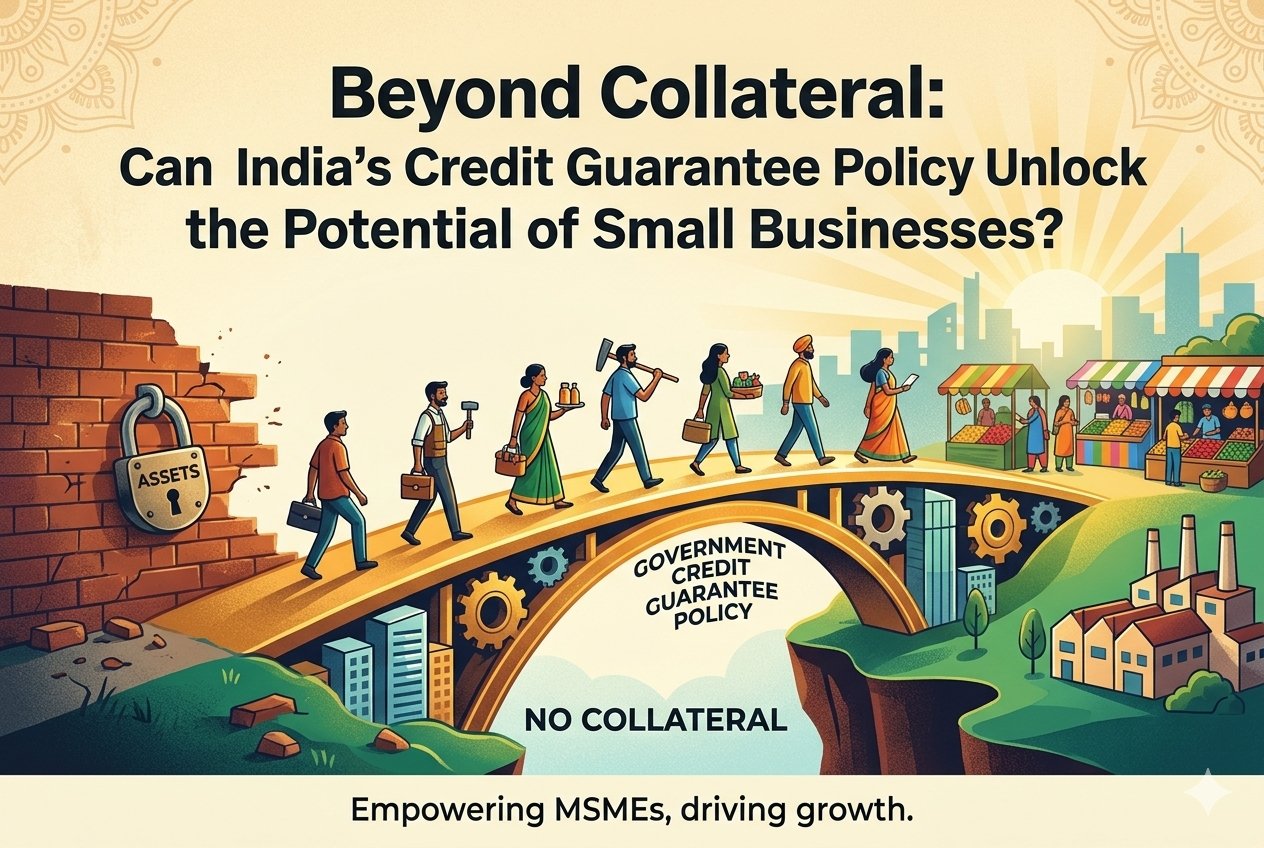
A credit guarantee is not the same as a direct government loan.
Under this arrangement, the government-supported guarantee mechanism provides eligible lenders with protection against a specified portion of credit risk.
This can encourage banks and other lending institutions to extend credit to borrowers who may otherwise face difficulties accessing formal finance.
For example:
A small manufacturing unit requires finance to purchase machinery and expand production but does not have sufficient collateral.
Under an eligible credit guarantee arrangement, the lender can extend financing with the benefit of the prescribed guarantee coverage.
However, the borrower must still meet the lender’s credit assessment requirements and remains responsible for repayment.
The important distinction: A credit guarantee reduces the lender’s risk; it does not eliminate the borrower’s repayment obligation.
Why Does This Matter for India’s MSME Ecosystem?
Micro and small businesses play an important role in employment generation, local manufacturing and economic activity.
Improved access to formal credit can support:
1. Business Expansion: Entrepreneurs can invest in machinery, equipment and additional production capacity.
2. Employment Generation: Growing enterprises can create new employment opportunities.
3. Financial Inclusion: Small businesses can gradually become part of the formal banking and financial ecosystem.
4. Women Entrepreneurship: Better access to finance can support women-led enterprises and self-employment.
5. Local Economic Development: Increased business activity can strengthen smaller towns, rural markets and regional supply chains.
The Financial Perspective: What Should We Measure?
The success of a credit guarantee scheme should not be measured only by the amount of loans facilitated.
A meaningful evaluation should also consider:
- Incremental credit reaching previously underserved businesses.
- Employment generated per unit of credit.
- Business survival and repayment rates.
- Reduction in dependence on informal borrowing.
- Growth in turnover and productive capacity.
- Guarantee claims and recovery performance.
- Regional distribution of credit.
For finance professionals and cost accountants, this presents an interesting area of analysis involving credit risk, financial inclusion, cost of borrowing and the economic impact of public expenditure.
The Other Side: Credit Access Must Also Mean Credit Discipline
Easier access to finance must be accompanied by responsible lending.
Excessive borrowing, weak cash-flow management and poor financial planning can turn an opportunity into a repayment burden.
Therefore, financial literacy, proper project appraisal, transparent documentation and monitoring of loan utilisation remain essential.
The objective should not simply be to distribute more credit, but to ensure that credit creates sustainable economic value.
Conclusion: Finance Should Follow Potential, Not Just Property
India’s credit guarantee framework reflects an important shift in the approach towards entrepreneurship.
Access to finance should not become an insurmountable barrier for individuals who have the capability and determination to build businesses.
The continuation of CGFMU through 2031 is an opportunity to strengthen the connection between formal finance and grassroots entrepreneurship.
But the real measure of success will be the businesses that survive, the jobs they create and the economic value they generate.
Because a country’s entrepreneurial potential should not be limited by the absence of collateral.
The future of small businesses depends not only on access to capital, but on the ability to convert that capital into sustainable growth.