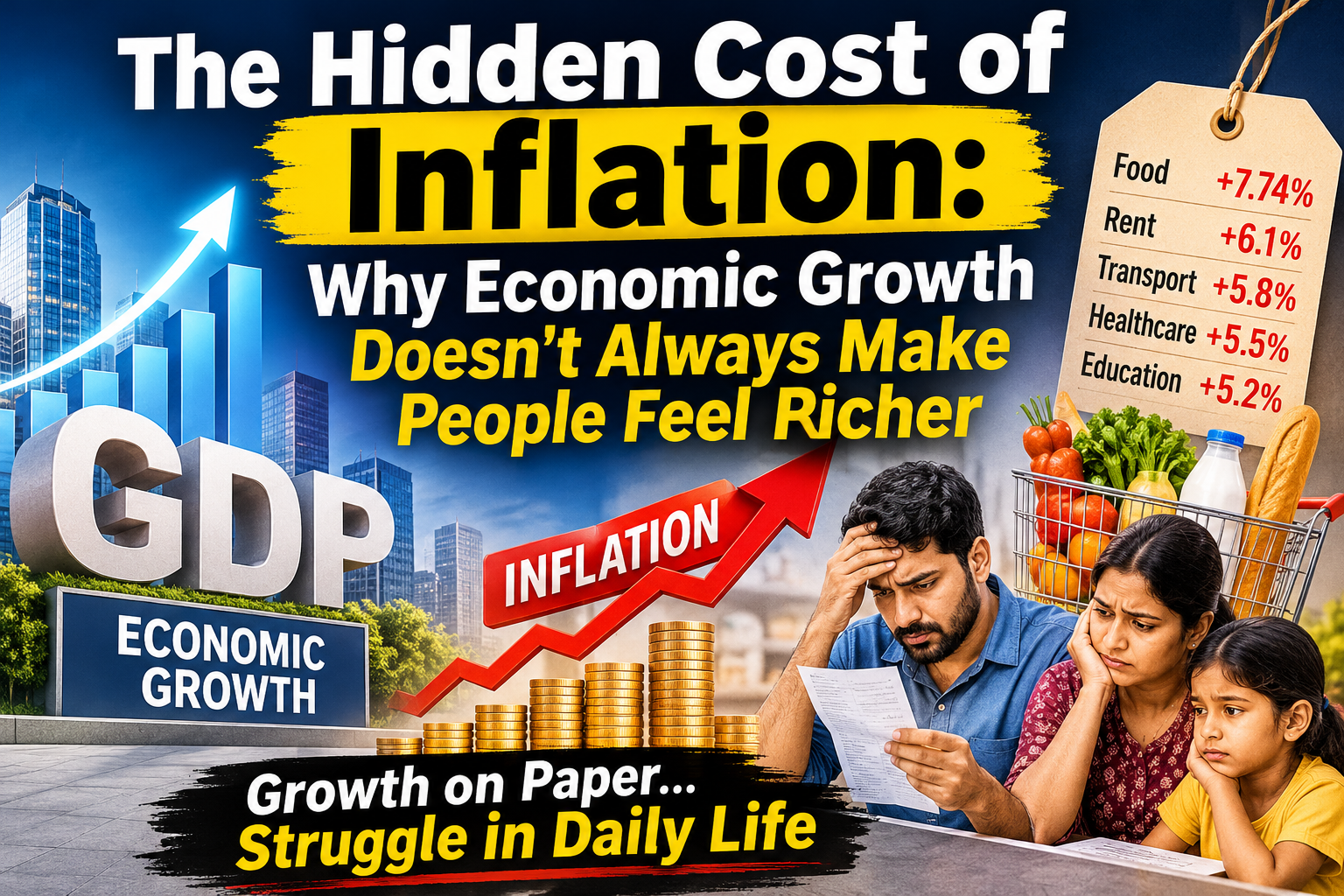
The central question: If an economy is growing, businesses are expanding and incomes are rising, why do so many people still feel financially stretched?
The answer lies in the difference between economic growth and everyday purchasing power. A country can produce more wealth while households struggle with rising food prices, rent, healthcare, education and transportation costs.
This article examines how inflation affects household finances, why economic growth does not benefit everyone equally, and what policymakers can do to turn economic progress into a better standard of living.
1. GDP Growth and Household Prosperity Are Not the Same
Gross Domestic Product (GDP) measures the value of goods and services produced within an economy. It is a key indicator of economic activity, but it does not tell us whether every household is becoming financially better off.
Economic growth may be driven by infrastructure investment, exports, technology and industrial expansion. However, the benefits may not reach all workers equally or immediately.
Consider a simple example:
- The economy grows by 7%.
- A worker’s salary increases by 4%.
- The prices of the goods and services the worker buys rise by 6%.
Despite earning more, the worker loses purchasing power.
This distinction explains why economists look beyond nominal income to real income—income adjusted for changes in prices.
The real question is not simply whether people earn more money. It is whether their income allows them to afford more goods and services and maintain a better standard of living.
2. The Hidden Mathematics of Inflation
Inflation measures the rate at which the general price level rises over time. Its effects become particularly significant when price increases continue year after year.
Consider this illustrative household budget:
| Monthly household finances | Before | After |
|---|---|---|
| Income | ₹30,000 | ₹31,200 |
| Essential expenses | ₹20,000 | ₹21,200 |
| Other expenses | ₹5,000 | ₹5,000 |
| Savings remaining | ₹5,000 | ₹5,000 |
In this example, income and essential expenses both increase by ₹1,200. The household’s savings remain unchanged in nominal terms, but it has received no additional financial flexibility despite earning more.
If essential expenses rise faster than income, savings begin to shrink.
Inflation also compounds. If prices rise by 6% every year for three consecutive years, the overall price level increases by approximately 19.1%.
This creates a crucial distinction:
Lower inflation does not mean prices have fallen. It means prices are rising more slowly.
Once the cost of food, rent, healthcare or education increases, households may continue paying those higher prices even after inflation moderates.
3. Why Food Inflation Hurts More Than Headline Inflation Suggests
Food is a necessity, not a discretionary purchase. Families can postpone buying electronics or reduce entertainment expenses, but they cannot indefinitely avoid purchasing food.
This makes food inflation especially burdensome for lower-income households, which generally devote a larger share of their budgets to essential goods.
India’s September 2026 consumer price data showed retail inflation at 5.54% year-on-year, while food inflation reached 7.74%. Press Information Bureau
A recent Reuters report published on 3 November 2026 also highlighted concerns about food supply, weak monsoon conditions and rising costs affecting several essential commodities in India. Reuters
The consequences extend beyond grocery bills:
- Families may switch to cheaper or less nutritious food.
- Savings intended for education or emergencies may be diverted to daily expenses.
- Restaurants and small retailers may face higher operating costs.
- Workers may demand higher wages to compensate for rising living expenses.
When these pressures spread through the economy, inflation can become a wider cost-of-living challenge rather than simply a temporary increase in a few prices.
4. Inflation Does Not Affect Everyone Equally
The same inflation rate can have very different consequences for different households.
Low-income households are particularly vulnerable because food, transport and other necessities consume a large share of their income. Even modest price increases can force difficult choices between nutrition, healthcare and other essential needs.
Middle-income households may face pressure from rent, school fees, loan repayments, insurance and medical expenses. Their salaries may rise while the money left for savings and discretionary spending declines.
Small businesses face rising raw-material, energy and transport costs. Businesses unable to pass these costs on to customers may experience shrinking profit margins.
Inflation can also redistribute wealth between borrowers and lenders, depending on interest rates, loan terms and whether inflation was anticipated.
The broader lesson is that national inflation figures are averages. They cannot fully represent the financial pressure experienced by every income group.
The IMF’s October 2026 World Economic Outlook examines how cost-of-living shocks can erode purchasing power, increase inequality and deepen poverty. International Monetary Fund+1
5. The Savings Trap: Earning More but Becoming Less Secure
Inflation affects not only daily spending but also the value of accumulated savings.
Suppose someone has ₹1,00,000 in a savings account earning 4% annual interest while inflation is 6%.
After one year, the balance becomes ₹1,04,000. Although the account contains more money, its purchasing power has decli
This creates a dilemma for households. Keeping money in low-return savings may erode its purchasing power, while investments that offer potentially higher returns also involve risk
The pressure is especially important for retirees, people with fixed incomes and families saving for long-term goals such as education or home ownership.
Inflation can therefore weaken financial security without any visible reduction in the amount of money shown in a bank account.
6. Why Economic Growth Does Not Always Translate Into Higher Wages
Economic growth can be driven by capital-intensive industries, automation, infrastructure and technology. These sectors may generate substantial output without creating jobs or wage growth at the same pace.
Meanwhile, businesses face a difficult balancing act when their costs increase.
If they raise prices, consumers lose purchasing power. If they absorb higher costs, profit margins shrink. If they reduce expenses by delaying recruitment or investment, employment opportunities may weaken.
The distribution of productivity gains also matters. When output per worker increases, the benefits can flow to employees, business owners, investors and consumers in different proportions.
If corporate profits and productivity grow while real wages stagnate, national income may increase without producing an equivalent improvement in living standards for workers.
This is why the quality and distribution of economic growth matter as much as its headline rate.
Sustainable growth should create productive employment, support real wage increases and allow households to build financial security.
7. Why Central Banks Cannot Solve Every Inflation Problem
Central banks use interest rates to influence borrowing, spending and inflation expectations. Higher interest rates can help moderate demand and prevent persistent inflation from becoming entrenched.
However, monetary policy has limitations.
If food prices rise because of poor harvests or supply disruptions, higher interest rates cannot immediately produce more crops or improve transportation infrastructure.
Higher rates can also make home loans and business borrowing more expensive, potentially slowing investment and employment.
A balanced policy response therefore requires more than monetary tightening.
- Improve supply chains: Reduce storage losses, transport bottlenecks and distribution inefficiencies.
- Strengthen agricultural resilience: Invest in irrigation, crop diversification and climate preparedness.
- Protect vulnerable households: Provide targeted, temporary support when essential costs rise sharply.
- Encourage productive employment: Improve skills, labour-market access and business competitiveness.
- Maintain credible monetary policy: Prevent temporary price shocks from becoming persistent inflation.
The IMF recommends targeted, temporary income support during cost-of-living crises, rather than relying excessively on broad price-suppression measures that can be costly and distort market signals. International Monetary Fund
The objective is to control inflation without unnecessarily undermining employment, investment and long-term economic growth.
Conclusion: Prosperity Must Be Measured in Purchasing Power, Not Just GDP
Inflation exposes a fundamental weakness in how economic progress is often understood. Rising GDP signals that an economy is producing more, but it does not automatically mean ordinary households are living better.
True prosperity depends on whether people can afford essential goods and services, earn incomes that keep pace with living costs, accumulate savings and withstand financial shocks.
When prices rise faster than wages, economic progress can feel distant. When essential expenses consume a growing share of income, even employed households may experience financial insecurity.
The solution is not to choose between economic growth and price stability. Sustainable prosperity requires both.
Governments must encourage productivity and employment, strengthen supply chains and protect vulnerable households. Businesses must generate value that supports sustainable operations and competitive wages. Policymakers must look beyond headline GDP and inflation figures to understand how economic changes affect different income groups.
Ultimately, an economy should not be judged solely by how much wealth it produces, but by how effectively that wealth improves people’s everyday lives.
The real measure of economic progress is not simply whether a country becomes richer. It is whether its people can afford to live better.