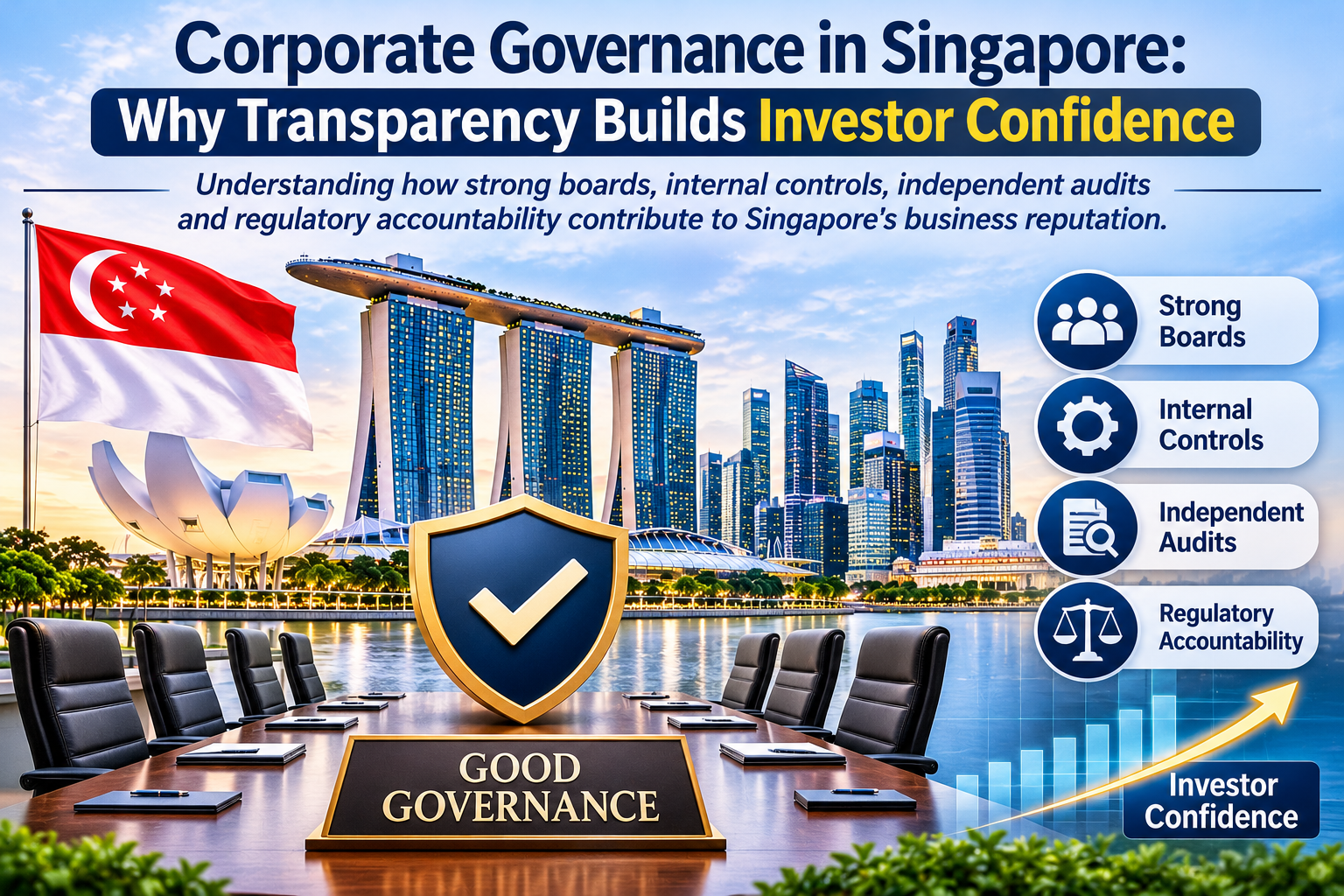
Understanding how strong boards, internal controls, independent audits and regulatory accountability contribute to Singapore’s business reputation.
Introduction
Corporate governance is one of the most important foundations of a successful business environment. It determines how companies are directed, controlled and held accountable to shareholders and other stakeholders.
A company may generate impressive revenue and profits, but weak governance can expose it to financial mismanagement, fraud, conflicts of interest and reputational damage.
Singapore has developed a strong reputation for corporate governance through its legal framework, regulatory institutions, accounting standards and emphasis on transparency.
For international investors, governance quality is an important consideration when deciding where to invest and establish business operations.
Understanding corporate governance
Corporate governance refers to the system of rules, practices and processes through which a company is managed and supervised.
It establishes the responsibilities of directors, management, shareholders, auditors and other stakeholders.
Effective governance generally includes:
- Accountability of the board of directors.
- Transparency in financial reporting.
- Protection of shareholder rights.
- Independent oversight.
- Effective internal controls.
- Risk management.
- Ethical business conduct.
The objective is to ensure that management decisions are consistent with the long-term interests of the company and its stakeholders.
Singapore’s corporate governance framework
Singapore’s corporate governance environment is supported by several institutions.
The Accounting and Corporate Regulatory Authority (ACRA) oversees company registration, corporate compliance and the regulation of public accountants.
The Singapore Exchange (SGX) establishes listing requirements and disclosure obligations for listed companies.
The Monetary Authority of Singapore (MAS) regulates financial institutions and contributes to the broader financial regulatory framework.
The Singapore Code of Corporate Governance 2018 provides principles and provisions concerning board responsibilities, remuneration, accountability, risk management and shareholder engagement.
The Code follows a comply-or-explain approach for its provisions, requiring meaningful explanations where companies adopt alternative practices. Rulebooks+1
1. Role of the board of directors
The board of directors is responsible for providing strategic direction and overseeing management.
Directors must evaluate business risks, monitor financial performance and ensure that appropriate governance arrangements are established.
An effective board should not merely approve management proposals. It should independently assess significant decisions and challenge assumptions where necessary.
Board composition is also important. A combination of financial, legal, operational and industry expertise can improve the quality of decision-making.
2. Audit committees and financial transparency
The audit committee plays an important role in protecting the integrity of financial reporting.
Its responsibilities generally include reviewing financial statements, evaluating internal controls, considering audit findings and monitoring the independence of external auditors.
An effective audit committee should pay particular attention to:
- Significant accounting estimates.
- Related-party transactions.
- Revenue recognition.
- Asset impairment.
- Going-concern assessments.
- Internal audit observations.
- Material weaknesses in controls.
This oversight helps investors obtain more reliable financial information.
3. Internal controls and risk management
Internal controls are essential for preventing and detecting financial errors, fraud and operational irregularities.
A company should establish controls over procurement, sales, payments, payroll, inventory and financial reporting.
For example, segregation of duties helps ensure that the same employee does not independently initiate, approve and record a significant transaction.
Regular internal audits can identify weaknesses and recommend corrective measures.
Risk management should also extend beyond accounting. Cybersecurity, business continuity, regulatory compliance and strategic risks require board-level attention.
4. Regulatory developments
Singapore continues to strengthen its corporate and accounting regulatory framework.
The Corporate and Accounting Laws (Amendment) Act 2025 introduced changes intended to strengthen corporate accountability, safeguard shareholders and improve the regulatory framework for public accountants.
The Act has commenced in phases, with further changes taking effect in October 2026. These include updated annual return requirements and enhanced regulatory provisions. Accounting and Corporate Regulatory Authority+1
Such developments demonstrate that corporate governance is not a static compliance exercise. Regulatory frameworks must evolve as business structures and financial risks change.
5. The importance of external auditing
External auditing provides independent assurance on financial statements.
An effective audit process helps investors and other stakeholders assess whether financial statements are prepared in accordance with the applicable reporting framework.
However, an audit does not guarantee that every fraud or error will be detected.
The auditor must exercise professional judgement, maintain independence and obtain sufficient appropriate audit evidence.
Singapore’s regulatory emphasis on audit quality supports confidence in corporate financial information.
Governance challenges in the modern business environment
Despite a developed governance framework, companies continue to face several challenges.
Cybersecurity: Data breaches can create financial, operational and reputational damage.
Related-party transactions: Conflicts of interest can affect the fairness of corporate decisions.
Management accountability: Weak oversight can allow excessive risk-taking.
Sustainability reporting: Companies must improve the reliability of non-financial information.
Artificial intelligence: Automated decision-making creates new questions about accountability and risk ownership.
These developments require companies to continuously strengthen their governance systems.
Lessons for Indian companies
Singapore’s experience offers important lessons for Indian businesses.
Corporate governance should not be viewed merely as a statutory obligation under company law.
Companies should develop effective audit committees, independent oversight, internal audit functions and transparent reporting practices.
Small and medium-sized enterprises can also benefit from basic governance structures, including documented approval procedures, financial controls and periodic management reviews.
For finance professionals, governance provides opportunities in internal audit, risk management, statutory audit, compliance and financial reporting.
Conclusion
Singapore demonstrates that investor confidence is built through strong institutions, effective regulation and transparent corporate practices.
Corporate governance protects more than shareholders. It supports employees, creditors, customers and the wider business environment.
As financial markets become more complex, companies that integrate governance into their business strategies are better positioned to manage risks and build sustainable value.
About Author:-
CMA Vivek Kumar (ACMA), an Associate Member of ICMAI and B.Com (Accounting Honours) graduate, is an author, finance professional, and Founder of VK Chartered Academy (www.cacmacstestseries.com). He specializes in statutory and tax audits, taxation, financial reporting, GST advisory, and corporate compliance. He also mentors CA, CMA, and CS aspirants through structured academic guidance and exam-oriented test series, bridging practical industry expertise with professional education. Email: cmavivek2026@gmail.com