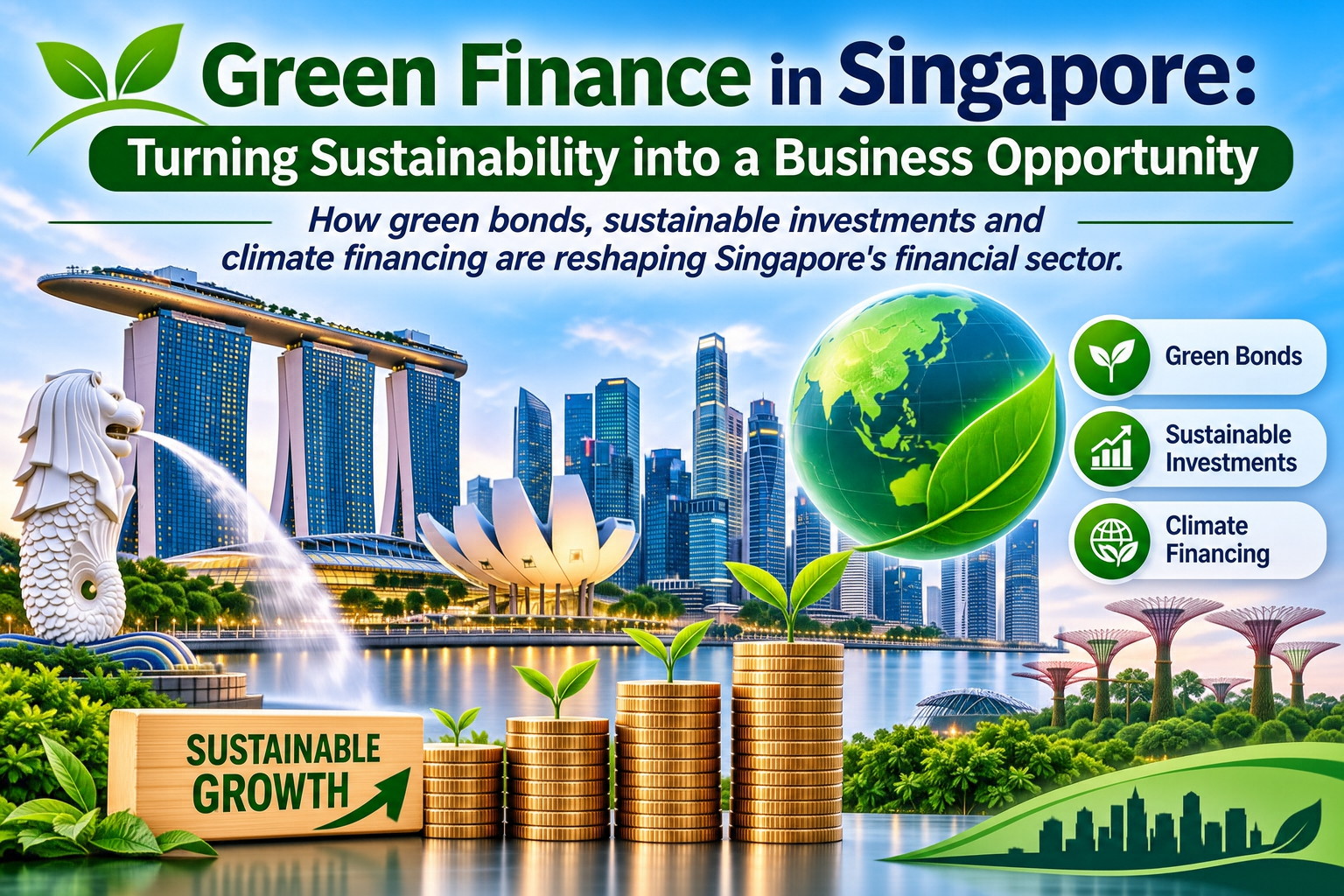
How green bonds, sustainable investments and climate financing are reshaping Singapore’s financial sector.
Introduction
Climate change is no longer only an environmental issue. It has become an important financial and economic consideration for governments, companies, banks and investors.
Businesses increasingly face pressure to reduce emissions, improve resource efficiency and disclose environmental risks.
At the same time, the transition towards a sustainable economy requires substantial investment in renewable energy, green buildings, clean transportation and climate-resilient infrastructure.
This has created opportunities for green finance, and Singapore is positioning itself as an important sustainable finance centre in Asia.
Understanding green finance
Green finance refers to financial products and services that support activities delivering environmental benefits.
It includes green bonds, sustainability-linked loans, climate-related investments and specialised financing arrangements.
The purpose is to direct capital towards projects that contribute to environmental objectives.
Examples include:
- Renewable energy projects.
- Energy-efficient buildings.
- Sustainable transport systems.
- Water management infrastructure.
- Waste reduction and recycling.
- Climate adaptation projects.
Green finance also provides financial institutions with opportunities to develop new products and attract investors interested in sustainability.
Singapore’s green finance strategy
Singapore has developed policies and financial frameworks to support sustainable investment.
The Monetary Authority of Singapore has promoted sustainable finance through taxonomy development, industry collaboration and regulatory initiatives.
The Singapore Green Plan 2030 provides a broader national framework for sustainability.
Singapore also uses public-sector financing to support sustainable infrastructure development.
According to the Ministry of Finance’s Green Bond Report for FY2025, Singapore’s public sector had issued approximately S$25.8 billion in green bonds as of 31 March 2026.
The country aims to reach S$35 billion in public-sector green bond issuance by 2030. Ministry of Finance (MOF)+1
This demonstrates how government borrowing can support environmental infrastructure while also helping develop the domestic green finance market.
Green bonds as a financing instrument
A green bond is a debt instrument through which the issuer raises funds for eligible environmental projects.
The issuer receives capital from investors and is generally required to allocate the proceeds according to the relevant green bond framework.
Green bonds can be issued by governments, financial institutions and companies.
For example, a company may issue green bonds to finance energy-efficient manufacturing facilities or renewable energy infrastructure.
Investors receive returns according to the bond’s terms, while the issuer gains access to financing for eligible projects.
However, the green label does not eliminate credit risk. Investors must still assess the issuer’s financial position, repayment capacity and project risks.
The Singapore-Asia Taxonomy
One important development in Singapore’s sustainable finance framework is the Singapore-Asia Taxonomy.
A taxonomy provides criteria for identifying economic activities that qualify as green or are transitioning towards greener practices.
It helps investors and financial institutions assess whether projects meet defined environmental standards.
This is important because inconsistent sustainability definitions can create confusion and increase the risk of greenwashing.
A clear taxonomy can improve transparency and help investors compare financing opportunities. mas.gov.sg+1
The role of banks and financial institutions
Banks are essential to the development of green finance.
They can provide loans to businesses investing in clean technologies, offer sustainability-linked financing and evaluate climate-related risks in their lending portfolios.
Institutional investors can also allocate funds to sustainable infrastructure and green financial products.
However, sustainable finance requires reliable information. Financial institutions need appropriate due diligence, monitoring and reporting systems to verify the use of funds and evaluate environmental outcomes.
Greenwashing: A major challenge
Greenwashing occurs when a company or financial product presents itself as environmentally responsible without sufficient supporting evidence.
It can mislead investors and weaken confidence in sustainable finance.
For this reason, green finance requires:
- Clear project eligibility criteria.
- Independent verification where appropriate.
- Transparent allocation of proceeds.
- Periodic impact reporting.
- Reliable environmental data.
- Effective governance and accountability.
Financial institutions should not rely solely on marketing claims when assessing environmental performance.
Accounting and auditing implications
Green finance creates new responsibilities for accounting and auditing professionals.
Accountants may be involved in tracking green bond proceeds, preparing sustainability-related disclosures and evaluating project expenditure.
Auditors and assurance professionals may be required to examine selected sustainability information and assess the reliability of reported data.
Management accountants can help organisations calculate the financial benefits of energy efficiency, analyse environmental costs and evaluate investment returns.
For example, a manufacturing company considering solar power must compare installation costs, maintenance expenses, electricity savings, financing costs and expected asset life.
Such analysis connects sustainability objectives with conventional capital budgeting.
Opportunities for India
India has substantial requirements for sustainable infrastructure, renewable energy, public transportation and climate-resilient development.
Singapore’s green finance experience can support cooperation in sustainable project financing, investment structuring and environmental risk assessment.
Indian companies can also learn from Singapore’s emphasis on defined taxonomies, transparent fund allocation and measurable project outcomes.
Conclusion
Singapore’s green finance strategy demonstrates how environmental objectives can be integrated into financial markets and public investment.
Its green bond programme and sustainable finance frameworks provide opportunities for governments, banks, investors and companies.
Nevertheless, the credibility of green finance depends on transparency, reliable measurement and effective governance.
About Author:-
CMA Vivek Kumar (ACMA), an Associate Member of ICMAI and B.Com (Accounting Honours) graduate, is an author, finance professional, and Founder of VK Chartered Academy (www.cacmacstestseries.com). He specializes in statutory and tax audits, taxation, financial reporting, GST advisory, and corporate compliance. He also mentors CA, CMA, and CS aspirants through structured academic guidance and exam-oriented test series, bridging practical industry expertise with professional education. Email: cmavivek2026@gmail.com