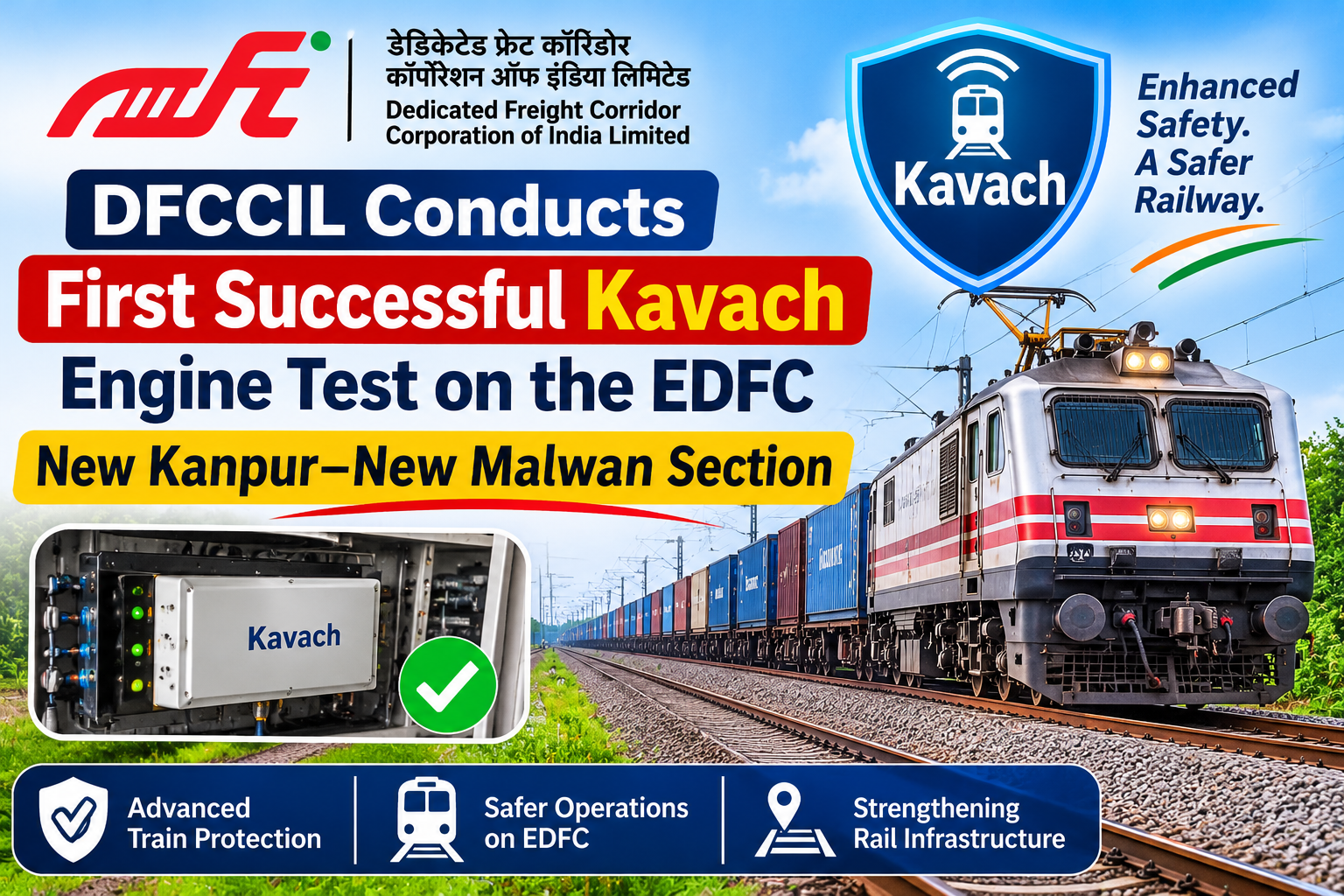
New Delhi, November 24, 2026: The Dedicated Freight Corridor Corporation of India Limited (DFCCIL) has achieved a significant milestone in railway safety by successfully conducting the first-ever Kavach engine test on the Eastern Dedicated Freight Corridor (EDFC). The test was carried out on the 40-kilometre New Kanpur–New Malwan section using a locomotive equipped with the indigenous Kavach Automatic Train Protection (ATP) system.
The successful trial represents an important step towards integrating advanced train-protection technology into India’s dedicated freight rail network. It also reflects DFCCIL’s continued efforts to strengthen operational safety through the adoption of modern railway technologies.
Key Kavach Functionalities Successfully Tested
During the trial, DFCCIL validated several essential functionalities of the Kavach system. These tests focused on the system’s ability to respond to signalling information, identify trackside RFID tags and initiate automatic braking under specified conditions.
The major functionalities successfully demonstrated included:
- Movement Authority: The system validated movement authority in accordance with signal conditions, helping ensure that locomotive movement remains aligned with the signalling instructions.
- RFID Tag Reading and Verification: The locomotive successfully read and verified RFID tags installed along the track, in accordance with the approved TAG/TIN layout.
- Automatic Braking: The test validated the automatic braking function designed to prevent Signal Passing at Danger (SPAD) when the signal ahead is red.
Signal Passing at Danger is a critical railway safety concern, as it involves a train passing a stop signal without the required authorisation. The automatic braking functionality of Kavach is designed to intervene when necessary, providing an additional layer of protection in train operations.
DFCCIL appreciated the dedicated efforts of its Prayagraj Unit, whose contribution played an important role in successfully conducting the test.
Kavach: Strengthening India’s Indigenous Railway Safety Framework
Kavach is India’s indigenously developed Automatic Train Protection system, designed to support safe train operations by monitoring movement and signalling conditions. It assists locomotive pilots in operating trains within prescribed speed limits and can automatically apply brakes when necessary if the driver fails to respond appropriately.
The system is an important component of Indian Railways’ broader railway modernisation and safety programme. It is designed to reduce the risk of accidents arising from certain operational errors, particularly those involving signal violations and excessive speed.
The implementation of Kavach involves multiple technological components, including station-based equipment, RFID tags along railway tracks, optical fibre communication networks, telecom infrastructure and Kavach equipment installed on locomotives.
The successful engine test on the EDFC demonstrates the validation of important onboard and trackside interactions on the tested section. It is a meaningful step in the process of extending the benefits of indigenous train-protection technology to the dedicated freight corridor network.
Significance for the Eastern Dedicated Freight Corridor
The Eastern Dedicated Freight Corridor is a major railway infrastructure project developed to improve freight transportation capacity and efficiency in India. Dedicated freight corridors are intended to provide a more specialised rail network for goods movement, helping reduce congestion on conventional railway routes and supporting more efficient logistics operations.
The New Kanpur–New Malwan section is part of this important freight corridor. Successful Kavach engine testing on this 40-kilometre stretch adds a significant safety dimension to the development of the EDFC.
For freight operations, safety and reliability are essential to maintaining predictable movement, efficient asset utilisation and dependable logistics services. The integration of automatic train-protection technology can provide an additional safeguard against operational risks while supporting the long-term modernisation of railway infrastructure.
However, the successful engine test should be viewed as a validation milestone on the specified section, rather than confirmation that Kavach has been commissioned across the entire Eastern Dedicated Freight Corridor. Further implementation and deployment activities may be required before wider operational coverage is achieved.
DFCCIL’s Role in Modernising Freight Transportation
DFCCIL, a public sector enterprise under the Ministry of Railways, is responsible for developing and managing dedicated freight corridor infrastructure. Its projects are central to India’s strategy of strengthening rail-based logistics, improving freight movement and creating additional capacity for the transportation sector.
The adoption of advanced safety systems such as Kavach complements the corporation’s infrastructure-development objectives. As freight volumes and operational requirements evolve, technology-led improvements in signalling, communication and train protection will remain important for ensuring the safe and efficient utilisation of dedicated corridors.
The latest achievement also highlights the importance of coordination between locomotive equipment, trackside infrastructure and signalling arrangements. Successful testing of these interconnected systems is essential before technology can be progressively implemented across larger railway sections.
A Step Forward for Indigenous Railway Technology
The successful Kavach engine test on the New Kanpur–New Malwan section is also noteworthy from the perspective of India’s indigenous railway technology capabilities. Kavach represents the country’s effort to develop and deploy its own automatic train-protection solution, reducing dependence on imported technologies while building domestic expertise in railway safety systems.
As Indian Railways continues expanding the deployment of Kavach across its network, successful trials on dedicated freight corridors can contribute to broader experience in adapting the technology to different railway operating environments.
The latest test by DFCCIL therefore carries significance beyond the 40-kilometre section. It demonstrates progress in applying indigenous safety technology to freight infrastructure and reinforces the importance of technology-led railway modernisation.
The Worldonomis Times View
DFCCIL’s first successful Kavach engine test on the EDFC New Kanpur–New Malwan section is a positive development for India’s railway safety and freight infrastructure ecosystem. The validation of movement authority, RFID tag verification and automatic braking demonstrates the practical importance of integrating onboard and trackside safety technologies.
For a country seeking to increase the share of railways in freight transportation, safety and operational reliability must develop alongside infrastructure capacity. Dedicated freight corridors can deliver their full potential only when supported by dependable signalling, communication and train-protection systems.
The successful trial is an encouraging step, but the larger priority will be systematic implementation, comprehensive testing and operational readiness across relevant sections of the corridor. Continued progress in these areas could strengthen confidence in India’s indigenous railway technologies and support a safer, more efficient freight transportation network.
DFCCIL’s achievement underlines an important message: the future of India’s freight corridors will depend not only on faster and higher-capacity infrastructure but also on intelligent systems that make railway operations safer and more reliable.