By The Worldonomics Times
Category: Global Economy & International Investment | November 2026
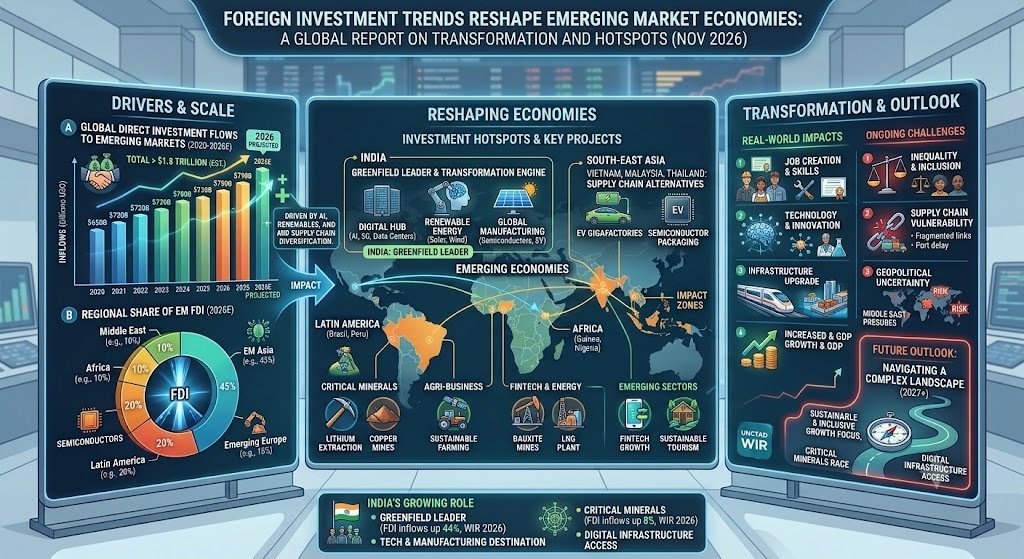
Foreign investment is playing an increasingly important role in shaping the economic development of emerging markets. As businesses and investors explore new opportunities across Asia, Africa, Latin America and other developing regions, international capital is influencing industrial growth, infrastructure development, employment and technological progress.
Emerging market economies offer attractive opportunities because of their expanding consumer markets, growing workforces, natural resources and improving industrial capabilities. However, changing global interest rates, geopolitical uncertainty, currency fluctuations and evolving trade policies are influencing where international investors choose to allocate their capital.
Foreign investment can provide countries with access to financial resources, advanced technologies and international business networks. Its long-term benefits, however, depend on the quality of investment, domestic economic policies and the ability of governments to create a stable business environment.
Foreign Direct Investment Supports Industrial Development
Foreign direct investment (FDI) is an important source of long-term capital for emerging economies. It generally involves investment by foreign companies in business operations, production facilities, subsidiaries or other lasting commercial interests in another country.
International manufacturers are increasingly evaluating emerging markets as potential locations for production and business expansion. Industries such as automobiles, electronics, pharmaceuticals, textiles, renewable energy and industrial machinery are attracting investment interest.
FDI can help local businesses access modern production techniques, improve operational efficiency and become part of international supply chains. It can also generate employment opportunities and encourage the development of supporting industries.
For host countries, attracting quality investment is therefore an important part of long-term industrial and economic planning.
Infrastructure Investment Creates New Opportunities
Infrastructure development is another major area attracting international investment. Roads, ports, railways, airports, power generation facilities and telecommunications networks are essential for improving economic productivity.
Emerging economies often require substantial investment to strengthen infrastructure and support expanding urban populations and industrial activity.
International investors, development finance institutions and multinational companies can contribute to financing large-scale projects. Improved infrastructure can reduce transportation costs, support trade and make domestic industries more competitive.
Investment in renewable energy, electricity transmission and digital connectivity is also becoming increasingly important as countries seek to modernise their economies.
However, infrastructure projects require transparent agreements, responsible financing and effective regulatory oversight to ensure long-term public and economic benefits.
India Strengthens Its Position as an Investment Destination
India remains an important destination for international businesses because of its large domestic market, skilled workforce, expanding digital economy and growing manufacturing capabilities.
Sectors such as electronics, automobiles, renewable energy, pharmaceuticals, information technology and financial services offer opportunities for both domestic and foreign investors.
Government initiatives aimed at improving infrastructure, encouraging manufacturing and simplifying business procedures are intended to strengthen India’s investment environment.
The country’s expanding consumer market also creates opportunities for international companies seeking long-term growth.
Nevertheless, maintaining investor confidence requires continued improvements in infrastructure, regulatory consistency, access to finance, workforce skills and ease of doing business.
Global Supply Chain Changes Influence Investment Decisions
International companies are reassessing their supply chain strategies in response to geopolitical developments, transportation disruptions and changing trade policies.
Some businesses are diversifying production locations to reduce dependence on a limited number of suppliers or manufacturing regions. This has created opportunities for emerging economies that can offer reliable infrastructure, competitive production costs and access to international markets.
Countries in Southeast Asia, Latin America and parts of Eastern Europe are seeking to strengthen their roles in global manufacturing networks.
This diversification can support industrial development, but countries must also compete on productivity, quality standards, logistics efficiency and policy stability rather than relying solely on lower labour costs.
Currency Movements and Global Interest Rates Affect Capital Flows
Foreign investment is closely connected to international financial conditions. Changes in interest rates in major economies can influence the movement of capital between developed and emerging markets.
When borrowing costs rise in major financial centres, some investors may reduce exposure to higher-risk markets and shift funds towards assets perceived as more stable.
Currency fluctuations also affect international investment returns. A weakening domestic currency may make certain assets less expensive for foreign investors, but it can increase the cost of imported machinery, raw materials and foreign-currency debt.
For emerging economies, maintaining macroeconomic stability, adequate foreign exchange reserves and credible monetary policies is important for managing these risks.
Challenges of Attracting Sustainable Investment
Although foreign investment can create significant opportunities, emerging economies face several challenges in attracting and retaining international capital.
Regulatory uncertainty, inadequate infrastructure, political instability, corruption risks and shortages of skilled workers can discourage investors. In addition, excessive dependence on foreign capital may expose economies to sudden changes in international financial conditions.
Governments must therefore focus on building strong domestic institutions, improving transparency and ensuring that investment policies support long-term national development.
Encouraging domestic entrepreneurship and strengthening local industries are equally important. Foreign investment should complement domestic economic capacity rather than replace it.
The Worldonomics Times View
At The Worldonomics Times, we believe that foreign investment can become a powerful driver of economic transformation when it is aligned with national development priorities and responsible business practices.
Emerging economies should focus not only on attracting larger volumes of international capital but also on securing investment that creates skilled employment, transfers technology, strengthens infrastructure and supports domestic industries.
Governments must provide predictable regulations, transparent investment procedures and strong legal protections while ensuring that public interests and environmental standards are respected.
We also believe that developing countries should strengthen their domestic financial systems and industrial capabilities so they can participate in global investment opportunities from a position of greater economic resilience.
The Worldonomics Times believes that the real value of foreign investment lies not simply in the capital it brings, but in the lasting productive capacity, knowledge and opportunities it creates for future generations.
Conclusion
Foreign investment is reshaping emerging market economies by supporting manufacturing, infrastructure, technology and international trade. As global businesses reconsider their investment strategies, developing countries have an opportunity to strengthen their positions in the international economic system.
However, sustainable progress requires more than attracting capital. Strong institutions, skilled workers, reliable infrastructure and consistent economic policies are essential for turning investment into lasting prosperity.
The future success of emerging markets will depend on their ability to attract responsible international investment while building competitive domestic industries and inclusive economic opportunities.