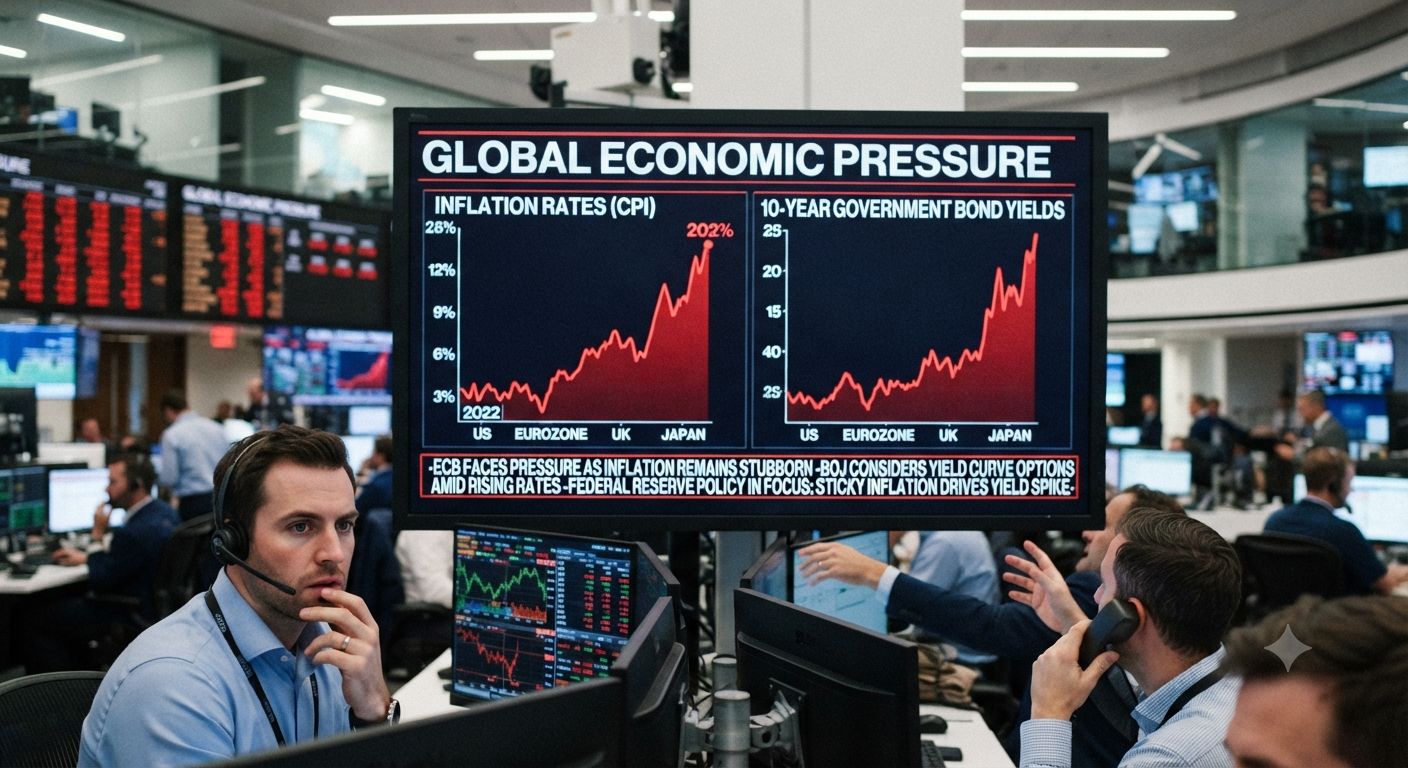
Global financial markets are facing renewed uncertainty as inflationary pressures, rising government bond yields and tighter financial conditions complicate the economic outlook for 2027. S&P Global Market Intelligence’s November 2026 economic outlook highlights growing challenges for major central banks, including the US Federal Reserve, European Central Bank (ECB) and Bank of Japan (BOJ), as policymakers prepare for further monetary tightening.
The report indicates that all three central banks are expected to increase interest rates in December, reflecting concerns that inflation may remain persistent despite recent movements in energy prices. At the same time, rising sovereign bond yields and widening credit spreads are increasing borrowing costs for governments and businesses.
These developments could place additional pressure on investment, consumer spending and economic activity in the coming year. Although lower crude oil prices may provide some relief to inflation, broader price pressures and fiscal vulnerabilities continue to create risks for the global economy.
Inflation Remains a Challenge Despite Lower Oil Prices
One of the key findings in S&P Global’s November outlook is the growing difference between energy-related inflation and underlying price pressures.
Crude oil prices declined sharply during November, offering the possibility of lower energy inflation in the coming months. S&P Global noted that Brent crude averaged approximately $96 per barrel during the first half of November, down from a peak above $116 per barrel in late October.
However, the decline in oil prices has not eliminated concerns about broader inflation.
In the United States, core consumer prices increased by 0.3% month-on-month for the third consecutive month in October. The annualised pace of core inflation over the latest three-month period was approaching 4%, indicating that underlying price pressures remain significant.
In the eurozone, core inflation remained at 2.5% in October, while headline inflation reached 4%, twice the European Central Bank’s target.
Food prices have also become a concern, particularly in Europe, where unusually hot and dry summer conditions have contributed to higher agricultural costs.
These developments suggest that central banks cannot rely entirely on lower energy prices to bring inflation under control. Persistent food, goods and services inflation may require policymakers to maintain restrictive monetary conditions.
Federal Reserve Faces Pressure for Further Tightening
The US Federal Reserve is confronting a challenging policy environment as inflation remains elevated and economic activity continues to show resilience.
According to S&P Global, the likelihood of additional monetary tightening in 2027 has increased following recent inflation data and stronger employment figures.
The organisation’s base-case forecast anticipates another 25-basis-point interest-rate increase in December, followed by a prolonged pause through much of 2027. However, the risks surrounding this outlook have shifted towards a more restrictive policy path.
Recent comments from Federal Reserve Governor Christopher Waller have also increased attention on the possibility of a larger December rate increase if core inflation remains strong.
Market expectations have consequently begun to reflect a higher probability of a 50-basis-point move, although this remains a relatively small possibility.
For businesses and consumers, further tightening could increase borrowing costs across mortgages, corporate loans and other forms of credit. Higher financing expenses may also influence investment decisions, particularly in sectors that depend on substantial external funding.
ECB and Bank of Japan Expected to Increase Rates
The European Central Bank and Bank of Japan are also expected to continue tightening monetary policy.
S&P Global forecasts that the ECB will increase its policy rate by 25 basis points in December, taking it to 2.75%. The Bank of Japan is also expected to raise its policy rate by 25 basis points to 1.50%.
Further limited increases are forecast for both central banks during 2027.
For the ECB, persistent food inflation and broader price pressures are important considerations. Although core inflation remained stable in October, higher headline inflation has strengthened the case for a cautious monetary policy approach.
Japan faces a different combination of challenges. Inflation concerns and the normalisation of monetary policy remain important, even as the country’s economy recorded a contraction during the July–September quarter, ending four consecutive quarters of growth.
The expected rate increases illustrate how major central banks are responding to inflation risks while managing different domestic economic conditions.
Rising Government Bond Yields Tighten Financial Conditions
Another major concern highlighted in the November outlook is the increase in sovereign bond yields and credit spreads.
Government bond yields influence borrowing costs across financial markets because they serve as important benchmarks for corporate lending, mortgages and other forms of financing.
When yields rise, governments face higher costs when issuing new debt, while companies may need to pay more to finance expansion and refinance existing obligations.
S&P Global noted that sovereign yields and spreads have tightened financial conditions across several major economies. France has emerged as a particular concern, with its 10-year government bond yield increasing by nearly 180 basis points since the beginning of the US-Iran conflict.
The country’s fiscal pressures and uncertain political outlook ahead of the spring 2027 elections have contributed to concerns about its borrowing costs.
Elevated yields in highly indebted economies could also create pressure across other European sovereign bond markets.
The European Central Bank has similarly warned that rising real rates, inflation concerns and government financing requirements are placing sovereign debt markets under renewed pressure. <Cite refs={[“turn443786search5″,”turn443786search6”]}/>
Higher Borrowing Costs Could Weigh on Business Investment
The impact of tighter financial conditions is expected to become increasingly visible in business investment and economic activity during 2027.
Higher interest rates can make new projects less attractive by increasing the cost of capital. Businesses may postpone expansion plans, reduce borrowing or adopt more cautious investment strategies.
Industries that require significant upfront funding, including construction, real estate, manufacturing and infrastructure, may be particularly sensitive to sustained increases in financing costs.
The housing market is already showing signs of pressure in the United States. S&P Global reported that existing home sales fell in October for the fourth time in five months, reaching their lowest pace since 2010.
Higher mortgage costs can reduce housing affordability, discourage property purchases and affect related industries such as building materials, home furnishings and construction services.
For governments, elevated bond yields can increase debt-servicing expenses and reduce the financial flexibility available for public investment and development programmes.
S&P Global’s Financial Conditions Growth Indexes, covering eight major economies that together account for approximately half of global GDP, indicate that financial conditions are becoming less supportive of economic growth.
Global Growth Outlook for 2027 Faces Increasing Risks
S&P Global expects tighter financial conditions to remain an important constraint on global economic growth during 2027.
The combination of higher interest rates, elevated sovereign yields and fiscal pressures could reduce investment momentum across major economies.
The outlook also identifies differences in economic performance across regions. Recent data from Japan and mainland China have been less encouraging, with Japan recording a quarterly GDP contraction and China’s domestic demand remaining weak.
In China, technology-related activity continues to provide some support, but broader consumption and investment indicators suggest that the economy remains reliant on export-driven growth.
Lower oil prices may provide some short-term support to global activity by reducing energy costs. However, the benefits could be offset if borrowing costs remain elevated and fiscal pressures continue to restrict economic flexibility.
The direction of monetary policy, government debt management and private-sector investment will therefore be important in determining the strength of the global recovery.
The Worldonomics Times View
S&P Global’s November outlook highlights an increasingly difficult environment for global policymakers. Inflation remains persistent in several major economies, while rising government bond yields are tightening financial conditions even before the full impact of additional policy rate increases is felt.
The expected December rate increases by the Federal Reserve, ECB and Bank of Japan demonstrate that inflation control remains a priority. However, policymakers must also consider the risks of excessive tightening, particularly when higher borrowing costs could discourage investment and weaken economic activity.
The distinction between falling oil prices and persistent underlying inflation is particularly important. Lower energy costs may provide temporary relief, but sustained inflation in food, goods and services could prevent central banks from shifting towards monetary easing.
For businesses and investors, 2027 may require greater attention to financing costs, debt exposure, refinancing requirements and investment returns. Companies with strong balance sheets and manageable borrowing requirements may be better positioned to withstand tighter financial conditions.
Conclusion: Global central banks are facing renewed pressure to raise interest rates as inflationary risks persist and government bond yields remain elevated. S&P Global expects further tightening by the Federal Reserve, ECB and Bank of Japan in December, with additional policy adjustments possible in 2027. Higher borrowing costs could weigh on business investment, government finances and global economic growth. The challenge for policymakers will be to contain inflation without creating an excessive slowdown in economic activity.