The International Monetary Fund warns that inflationary pressures will remain elevated across the global economy in 2026, driven by energy and food costs, geopolitical tensions and supply-chain disruptions. Although inflation is expected to ease in 2027, the outlook highlights the continuing challenges facing households, businesses and policymakers worldwide.
Global Inflation Outlook Remains Challenging
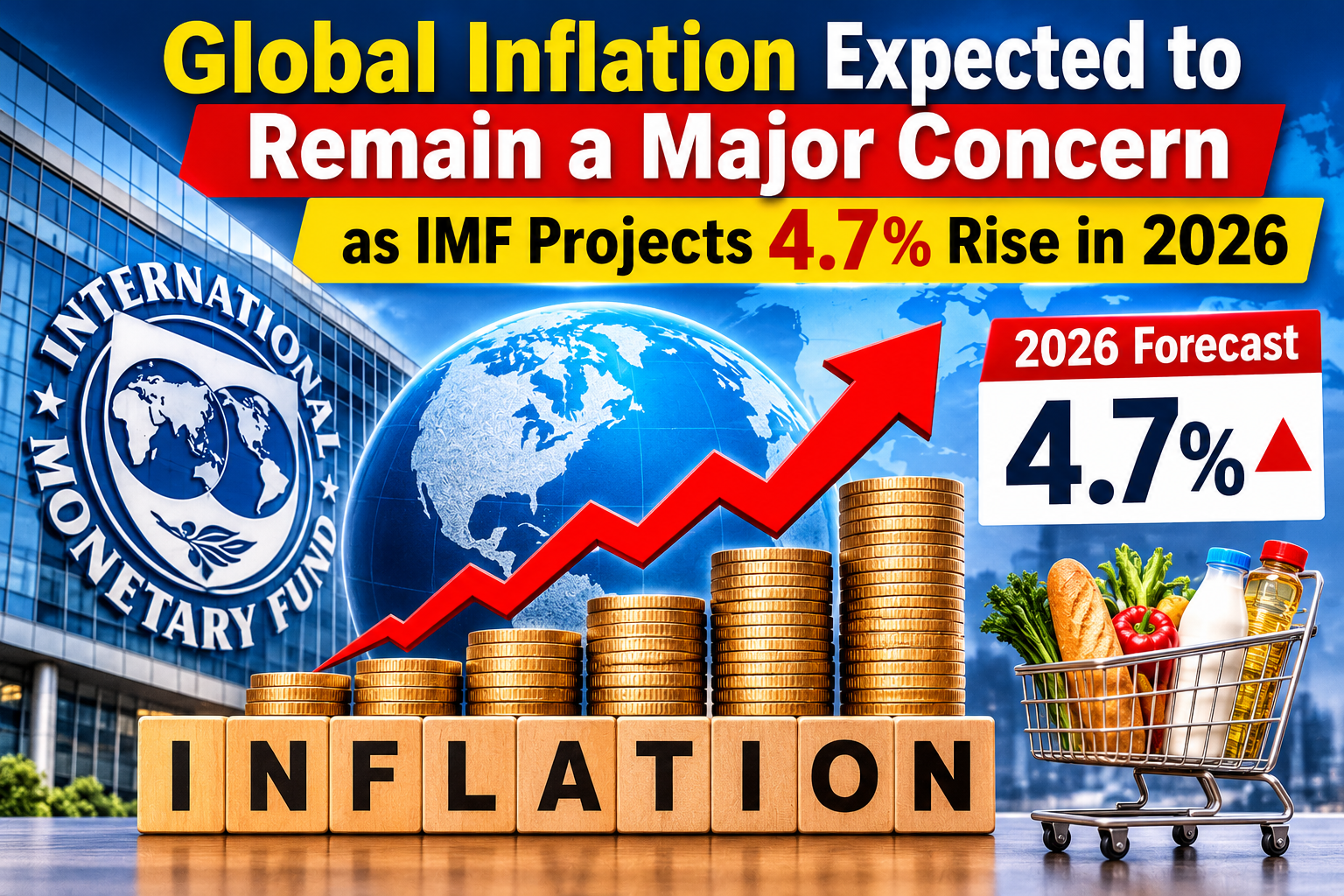
Global inflation is expected to remain a major concern for the international economy, even as several countries continue efforts to stabilise prices and restore economic confidence. According to the International Monetary Fund’s (IMF) October 2026 World Economic Outlook, global headline inflation is projected to rise to 4.7% in 2026, compared with an estimated 4.1% in 2025, before easing to 4.1% in 2027.
The forecast signals that the global disinflation process—the gradual reduction in the rate at which prices increase—has lost momentum. While the projected decline in 2027 offers some relief, inflation is likely to remain a significant economic and political challenge in the near term.
The IMF’s outlook comes at a time when the world economy is facing several overlapping pressures, including geopolitical instability, volatile commodity markets, changing trade relationships and uneven economic recovery. These developments are making it harder for governments and central banks to bring inflation under control without weakening economic growth.
Energy and Food Prices Remain Key Drivers
One of the major factors contributing to persistent inflation is the increase in energy and food prices. Disruptions to global energy supplies, geopolitical conflicts and uncertainty surrounding important shipping routes have increased the risk of higher transportation and production costs.
Energy prices influence almost every part of the economy. Higher oil, gas and electricity costs raise expenses for manufacturers, transport companies, agricultural producers and service providers. Businesses often pass at least part of these additional costs on to consumers, keeping inflation elevated.
Food prices are another important concern, particularly for lower-income households. Higher agricultural input costs, transportation expenses, weather-related disruptions and supply-chain difficulties can increase the price of essential commodities. Since food and energy account for a substantial share of household spending in many developing countries, price increases in these categories can have a particularly serious impact.
Geopolitical Tensions Add to Economic Uncertainty
International conflicts and trade tensions continue to create uncertainty for global markets. Disruptions to commodity supplies and shipping networks can increase the cost of importing essential goods, while restrictions on trade and changing tariffs may affect the availability and pricing of products.
The IMF has identified further escalation of conflicts and renewed trade tensions among the downside risks to the global economic outlook. Such developments could intensify inflationary pressures while simultaneously weakening economic activity.
The consequences are not limited to the countries directly involved in conflicts. Economies dependent on imported fuel, food and industrial materials may experience higher import bills, pressure on foreign exchange reserves and increased costs for domestic businesses.
Central Banks Face Difficult Policy Decisions
Persistent inflation places central banks in a difficult position. Their primary responsibility is to maintain price stability, generally through monetary policy measures such as adjusting interest rates and managing liquidity.
When inflation remains high, central banks may need to maintain restrictive interest rates for longer or consider further increases. Higher borrowing costs can help reduce excessive demand and limit price pressures, but they also make loans more expensive for households and businesses.
This creates a delicate balancing act. If monetary policy is tightened too aggressively, investment, consumption and employment may weaken. If policymakers ease restrictions too early, inflation could become more persistent and inflation expectations may rise.
The IMF has stressed the importance of clear monetary policy communication, central bank independence and strong financial oversight. Maintaining public confidence in the ability of institutions to control inflation will be essential.
Developing Economies Face Greater Pressure
The impact of global inflation is unlikely to be evenly distributed. Emerging and developing economies often face additional challenges because of their dependence on imported energy, exposure to currency fluctuations and limited fiscal resources.
A weaker domestic currency can make imported fuel, food and machinery more expensive. Governments may also face higher costs when servicing foreign-currency debt, leaving less money available for infrastructure, healthcare, education and social protection.
Small businesses can be particularly vulnerable. Higher raw-material prices, electricity bills, transport expenses and financing costs can reduce profit margins and discourage expansion. Consumers, meanwhile, may cut discretionary spending as essential goods absorb a larger share of household income.
For countries such as India, managing imported inflation, maintaining supply stability and supporting vulnerable households will remain important policy priorities. Domestic production, efficient logistics and diversified energy sources can help reduce exposure to external shocks.
IMF Calls for Targeted and Responsible Policy Measures
Addressing inflation requires more than short-term price controls. Governments must strengthen supply chains, improve energy security, support agricultural productivity and encourage competition in domestic markets.
The IMF’s October 2026 analysis of past cost-of-living crises highlights the importance of targeted and temporary support for vulnerable households. Rather than relying on broad subsidies that can become expensive and distort market signals, governments should focus assistance on those most affected by rising living costs.
Fiscal discipline is equally important. Excessive public spending, particularly when poorly targeted, can add to demand pressures and increase government debt. Policymakers must therefore protect vulnerable communities while preserving the financial capacity needed to respond to future shocks.
The Road Ahead
The IMF’s projection of 4.7% global inflation in 2026 followed by 4.1% in 2027 suggests that price pressures may gradually moderate, but a return to stable inflation will take time. The pace of improvement will depend on energy-market developments, geopolitical conditions, monetary policy decisions and the resilience of global supply chains.
Businesses will need to improve cost management and supply-chain flexibility, while households may continue to face pressure on purchasing power. Governments and international institutions must work together to reduce economic uncertainty and strengthen long-term resilience.
The Worldonomics Times View
The Worldonomics Times believes that persistent global inflation is not simply a monetary challenge; it is also a test of economic resilience, government preparedness and international cooperation. The IMF’s forecast makes it clear that the world cannot assume inflation will disappear automatically as economic conditions improve.
Central banks must remain committed to price stability, but monetary tightening alone cannot resolve supply shortages, energy disruptions or geopolitical uncertainty. Governments should complement responsible monetary policy with targeted household assistance, stronger domestic production, better infrastructure and investment in reliable energy systems.
Broad subsidies and temporary price controls may offer immediate relief, but they can create long-term fiscal pressures if used without careful planning. Support should be directed towards households and businesses most exposed to rising costs, while preserving incentives for efficient production and investment.
Ultimately, controlling inflation requires a balanced approach: protecting purchasing power without undermining growth, maintaining fiscal responsibility while supporting vulnerable communities, and strengthening cooperation across international markets. The decline projected for 2027 will be encouraging only if it is supported by durable improvements in supply, productivity and economic stability.
The central challenge for policymakers is clear: bringing inflation under control must go hand in hand with building an economy that is more resilient to the next global shock.