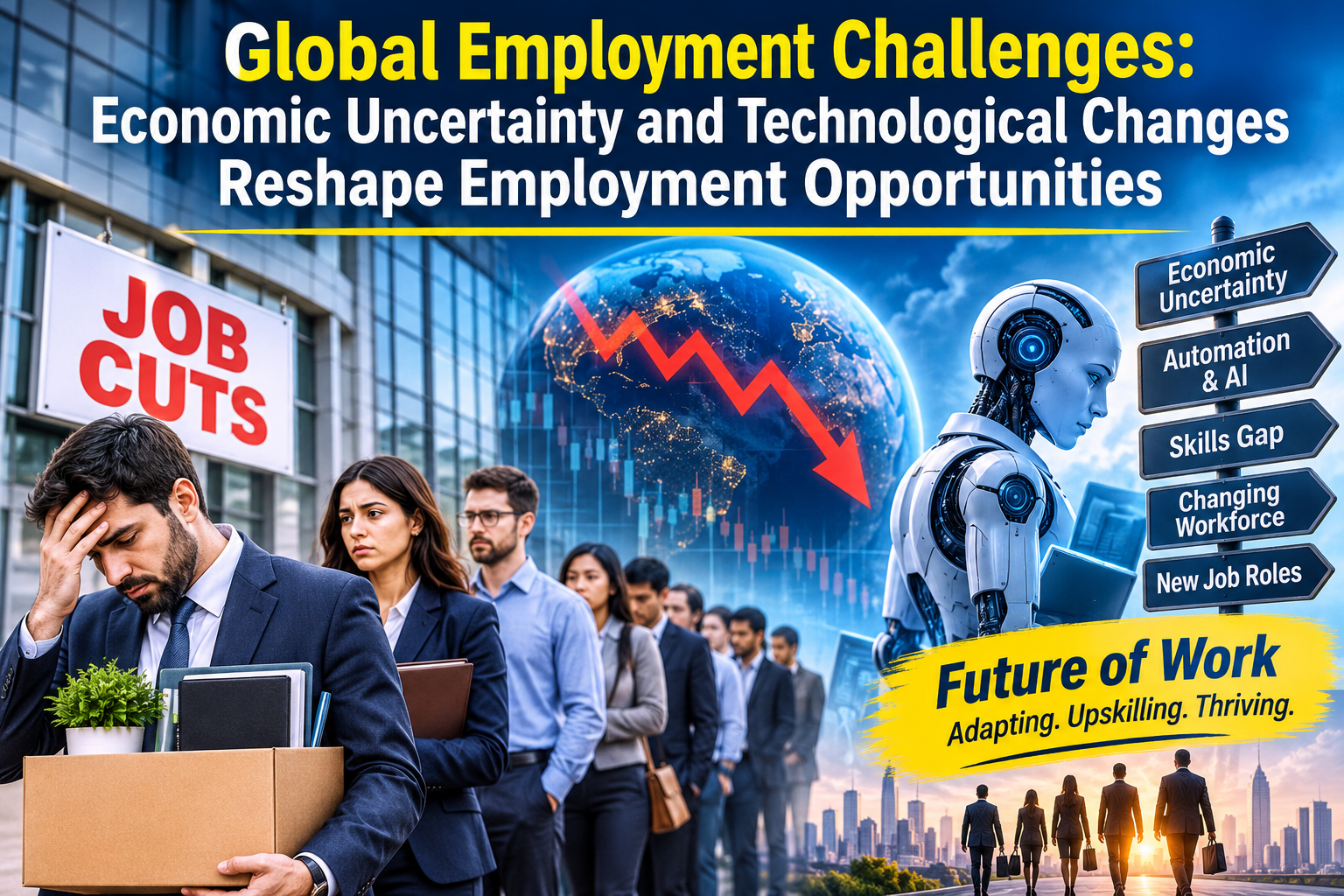
Economic uncertainty, changing business priorities and rapid technological advancements are transforming the global labour market. While automation and artificial intelligence are creating new career opportunities, traditional jobs are evolving or disappearing, making skill development and workforce adaptation essential for the future of employment.
Employment is one of the most important indicators of economic stability and social development. A strong labour market supports household incomes, consumer spending, business growth and national productivity. However, the global employment environment is undergoing significant changes as businesses respond to economic uncertainty, geopolitical tensions, rising operating costs and technological innovation.
Companies across industries are reconsidering their workforce requirements, while employees face increasing pressure to develop new skills and adapt to changing professional expectations. The challenge is no longer simply creating jobs, but ensuring that workers have access to stable, productive and meaningful employment.
Economic Uncertainty Affects Global Hiring
Slow economic growth, inflation, high borrowing costs and international trade uncertainty are influencing employment decisions across the world. Businesses facing unpredictable demand and rising expenses are becoming more cautious about recruitment, expansion and long-term workforce planning.
Manufacturing, construction, retail and export-oriented industries are particularly sensitive to changes in economic conditions. When consumer spending weakens or production costs increase, companies may postpone hiring, reduce working hours or restructure their operations.
According to the International Labour Organization’s Employment and Social Trends 2026 report, global unemployment is projected to remain at approximately 4.9% in 2026. However, this relatively stable figure hides deeper challenges. The global jobs gap, which includes people who want paid employment but cannot access it, is projected to reach 408 million.
This demonstrates that low headline unemployment does not necessarily mean that sufficient quality employment opportunities are available.
Artificial Intelligence and Automation Transform the Workplace
Artificial intelligence, robotics, automation and digital platforms are changing how businesses operate. Tasks that previously required significant manual effort can increasingly be performed through advanced software and automated systems.
Industries such as banking, manufacturing, customer service, logistics and information technology are adopting these technologies to improve efficiency, reduce operational costs and increase productivity.
While automation can eliminate or reduce demand for certain repetitive roles, it also creates opportunities in emerging fields such as data analysis, AI development, cybersecurity, cloud computing and digital infrastructure.
The World Economic Forum’s Future of Jobs Report 2025 estimates that global labour-market transformations could create 170 million jobs and displace 92 million by 2030, resulting in a net increase of 78 million jobs.
However, this transition will not benefit all workers equally. Employees whose existing skills become less relevant may struggle to move into newly created occupations without appropriate training and support.
The Growing Skills Gap Creates New Challenges
One of the biggest challenges facing employers is finding workers with the skills required by modern industries. Traditional qualifications alone may no longer be sufficient in workplaces where digital literacy, analytical thinking and technological understanding are increasingly important.
The World Economic Forum estimates that approximately 39% of workers’ existing skill sets could be transformed or become outdated between 2025 and 2030.
Demand is expected to grow for skills related to artificial intelligence, big data, cybersecurity and technological literacy. At the same time, human capabilities such as creativity, leadership, communication, critical thinking and adaptability will remain essential.
Businesses must therefore invest in continuous employee development. Governments and educational institutions also need to update training programmes to ensure that students and existing workers are prepared for changing labour-market requirements.
Young Workers Face Increasing Employment Pressure
Young people entering the workforce are experiencing particular difficulties in several economies. Limited professional experience, competition for entry-level positions and changing recruitment requirements can make it difficult to secure stable employment.
Automation may also affect traditional entry-level tasks that once provided opportunities for fresh graduates to gain experience.
The OECD’s Employment Outlook 2026 identifies signs of weakening labour-market conditions in several advanced economies and highlights growing employment difficulties among younger workers.
Internships, vocational education, apprenticeships and industry-linked training can help bridge the gap between academic qualifications and workplace requirements.
Employers should also recognise the importance of providing opportunities for young professionals to develop practical skills rather than expecting extensive experience from applicants seeking their first jobs.
New Opportunities in Green and Digital Industries
Despite these challenges, technological and economic transformation is creating opportunities in emerging sectors.
Renewable energy, electric mobility, healthcare, education, advanced manufacturing and digital services are generating demand for specialised professionals.
The expansion of solar and wind energy is increasing the need for engineers, technicians, project managers and energy specialists. Similarly, the growing use of artificial intelligence is creating opportunities for software developers, data professionals and cybersecurity experts.
Healthcare and education are also expected to remain important employment sectors because of demographic changes and growing demand for essential services.
These developments demonstrate that the future labour market will require a combination of technical expertise and human-centred skills.
Governments and Businesses Must Prepare for Workforce Transformation
Addressing global employment challenges requires cooperation between governments, employers and educational institutions.
Governments should strengthen vocational training, improve access to affordable education and develop policies that encourage job creation. Investment in infrastructure, manufacturing and emerging industries can also generate employment opportunities.
Businesses must adopt responsible technology strategies by supporting employees through retraining and professional development. Rather than viewing automation only as a way to reduce labour costs, companies should explore how technology can improve productivity while creating new roles.
Stronger social protection systems, fair employment practices and opportunities for lifelong learning will also be essential to ensure that workers are not left behind.
The Worldonomics Times View
The global employment market is entering a period of fundamental transformation. Economic uncertainty is affecting hiring decisions, while artificial intelligence and automation are changing the skills businesses require. These developments present both opportunities and risks for workers, employers and governments.
The Worldonomics Times believes that technological progress should be treated as an opportunity to improve productivity and create better employment opportunities, rather than simply a mechanism for reducing workforce costs.
However, the benefits of innovation will not be distributed automatically. Without effective education, retraining and social protection, technological transformation could increase inequality and widen the gap between workers who possess modern skills and those whose occupations are becoming less relevant.
Governments must make workforce development a central part of economic policy. Educational institutions should strengthen practical learning, digital literacy and industry-focused training, while businesses should invest in employees whose roles are changing because of automation.
Particular attention must be given to young people, low-skilled workers and employees in industries undergoing rapid restructuring. Access to apprenticeships, vocational programmes and affordable reskilling opportunities can help these groups participate in the emerging economy.
Ultimately, the future of employment will depend not only on how quickly technology advances, but also on how effectively societies prepare people to work alongside it. Economic progress should create opportunities for both businesses and workers.
A resilient global labour market will require innovation, continuous learning, fair employment policies and cooperation. The countries that invest in their people today will be better positioned to build productive, inclusive and competitive economies tomorrow.