By The Worldonomics Times
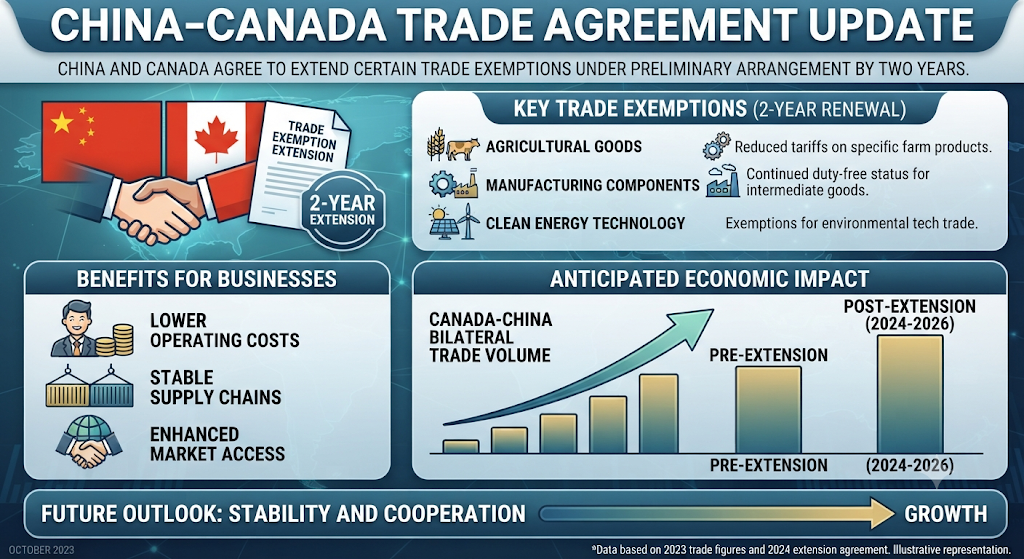
China and Canada have agreed to extend and expand several trade exemptions under their preliminary trade arrangement, taking another step towards improving bilateral economic relations. The agreement, announced following a meeting between Canadian Prime Minister Mark Carney and Chinese President Xi Jinping on November 17, 2026, aims to reduce trade barriers, improve market access and provide greater certainty for businesses in both countries.
Under the expanded arrangement, China will continue tariff relief for selected Canadian agricultural and seafood exports, while Canada will extend existing tariff-remission measures for certain Chinese steel and aluminium products by two years, until the end of 2028. The measures form part of a broader effort to strengthen commercial cooperation following a period of trade tensions. The development is significant for international trade because both countries are seeking to diversify their economic partnerships amid changing global trade conditions and uncertainty surrounding major trading relationships.
Two-Year Extension of Trade Exemptions
The latest agreement builds on the preliminary trade arrangement reached between China and Canada in January 2026.
Under the expanded terms, Canada will extend tariff-remission measures covering selected Chinese steel and aluminium products until December 2028. The coverage will also expand to include 23 steel and nine aluminium tariff categories for which Canadian domestic supply is insufficient or unavailable.
China, meanwhile, will extend tariff relief for Canadian canola meal, peas, lobster and crab for another two years. The agreement also restores or improves market access for several Canadian exports, including frozen pork, Greenland halibut, cold-water shrimp, molluscs and sea cucumber.
According to Canada’s Department of Foreign Affairs, the measures are intended to support exporters, strengthen commercial relationships and make trade between the two countries more predictable.
The agreement therefore represents more than a simple extension of existing exemptions. It expands the range of products receiving improved market access and provides businesses with a longer period to plan their export and import activities.
Agriculture and Seafood Exports Gain Market Access
Canadian agricultural producers and seafood exporters are among the major beneficiaries of the arrangement.
China is an important destination for Canadian agricultural products, particularly canola and pulses. Earlier trade restrictions had affected several Canadian exports, creating difficulties for farmers and businesses that depend on access to the Chinese market.
The January 2026 arrangement helped reduce some of these barriers. China lowered tariffs on Canadian canola seed to a combined rate of approximately 15% from March 1, 2026. It also suspended additional tariffs on selected Canadian agricultural and seafood products.
The Canadian government reported that canola seed exports to China reached approximately C$1.74 billion between March and August 2026, an increase of 43% compared with the same period in 2025. Canadian exports of canola meal, peas, lobster and crab also recorded significant improvements following the earlier measures.
The latest extension is expected to provide additional stability for exporters by reducing uncertainty about the future availability of preferential market access.
Chinese Steel and Aluminium Products Receive Continued Relief
Canada’s decision to extend tariff-remission measures for selected Chinese steel and aluminium products is another important part of the agreement.
These exemptions apply to products for which Canadian manufacturers and businesses have limited domestic supply options. Extending the measures could help importers maintain access to necessary industrial materials and avoid additional costs.
Steel and aluminium are essential inputs for construction, transportation, machinery, infrastructure and manufacturing. Businesses that depend on these materials require predictable import conditions to manage production costs and maintain supply continuity.
The expanded coverage of the remission measures also indicates that both countries are seeking practical ways to reduce trade barriers in sectors where imports can support domestic economic activity.
However, the exemptions are product-specific. They do not represent a general removal of Canada’s trade restrictions on Chinese steel and aluminium.
Electric Vehicles Remain an Important Part of the Trade Relationship
Electric vehicles (EVs) have also played a significant role in the recent improvement in China-Canada trade relations.
As part of the January 2026 arrangement, Canada agreed to allow an initial annual quota of 49,000 Chinese electric vehicles to enter its market at a 6.1% most-favoured-nation tariff rate. This represented a substantial reduction from the 100% tariff previously imposed on Chinese EV imports.
According to the Canadian government, 16,211 vehicles had entered Canada under the arrangement between March and the latest reporting period in 2026. The agreement also provides for a growing share of the import quota to be reserved for more affordable electric vehicles over time.
For Chinese manufacturers, the arrangement creates an opportunity to expand their presence in the Canadian market. For Canadian consumers, increased access to competitively priced electric vehicles could broaden purchasing choices.
Nevertheless, the development may raise questions among domestic automobile manufacturers about competition, employment and the future of Canada’s automotive supply chain.
Canada Seeks to Diversify Its International Trade
A major motivation behind Canada’s renewed engagement with China is the need to diversify its export markets.
The United States remains Canada’s largest trading partner, making the Canadian economy particularly exposed to changes in US trade policy. Tariffs and disagreements over market access have encouraged Ottawa to strengthen commercial relationships with other major economies.
Canada has set a target of increasing exports to China by 50% by 2030. According to the Canadian government, bilateral trade in goods and services totalled C$113.9 billion in 2025.
Expanding trade with China could create opportunities for Canadian agricultural producers, seafood exporters, manufacturers and service providers. It may also help Canada reduce its dependence on a single export market.
However, maintaining stronger economic relations with Beijing will require Canada to balance commercial opportunities with concerns involving national security, political differences and domestic industrial interests.
Implications for the Global Economy
The agreement comes at a time when international trade is being reshaped by tariffs, geopolitical tensions and efforts to diversify supply chains.
China and Canada are both significant participants in global trade. Greater cooperation between them could support agricultural exports, industrial imports and investment flows across the Asia-Pacific region.
The arrangement may also encourage other economies to pursue targeted trade agreements that reduce barriers in selected sectors without requiring comprehensive free-trade negotiations.
However, the long-term impact will depend on implementation. Businesses need clear customs procedures, consistent tariff treatment and reliable regulatory arrangements to benefit fully from the exemptions.
The agreement also does not eliminate wider disagreements between the two countries. Trade cooperation will continue to operate alongside differences over political and security issues.
Implications for India
The improving trade relationship between China and Canada may have indirect implications for India.
As both countries expand their commercial engagement, opportunities could emerge across agricultural trade, industrial materials, electric vehicles and manufacturing supply chains. Indian businesses competing in international markets may face changes in pricing, sourcing and market access.
India could also learn from the emphasis on targeted tariff exemptions and sector-specific trade cooperation. Strengthening trade relationships with multiple partners can help diversify export markets and reduce dependence on individual economies.
At the same time, India must continue improving its domestic manufacturing capacity, logistics infrastructure and export competitiveness. Sectors such as engineering, automobiles, electronics, pharmaceuticals and agricultural processing could benefit from stronger international market access.
For Indian companies, the changing trade environment reinforces the importance of monitoring bilateral agreements and identifying opportunities in markets where trade barriers are being reduced.
The Worldonomics Times View
The extension of selected trade exemptions between China and Canada represents a constructive step towards improving bilateral economic relations. By extending tariff relief and expanding product coverage, both countries are seeking to provide greater certainty for exporters, importers and manufacturers.
Canada’s agricultural and seafood industries could benefit from improved access to the Chinese market, while selected Chinese steel and aluminium products will continue to receive tariff-remission treatment in Canada. The arrangements also build on earlier cooperation involving electric vehicles and canola exports.
However, the agreement should not be interpreted as a complete resolution of trade tensions. Differences over industrial competition, security and market access remain important considerations.
For the global economy, targeted trade cooperation can help maintain commercial activity during periods of uncertainty. Yet its success depends on transparent implementation and consistent policies.
For India, the agreement highlights the importance of export diversification and stronger international trade partnerships. Countries that develop competitive industries and reliable supply chains will be better positioned to benefit from changing global trade relationships.
Ultimately, the China-Canada arrangement demonstrates that even amid wider geopolitical disagreements, countries can pursue practical economic cooperation when there are clear mutual commercial benefits.