New Delhi | November 25, 2026
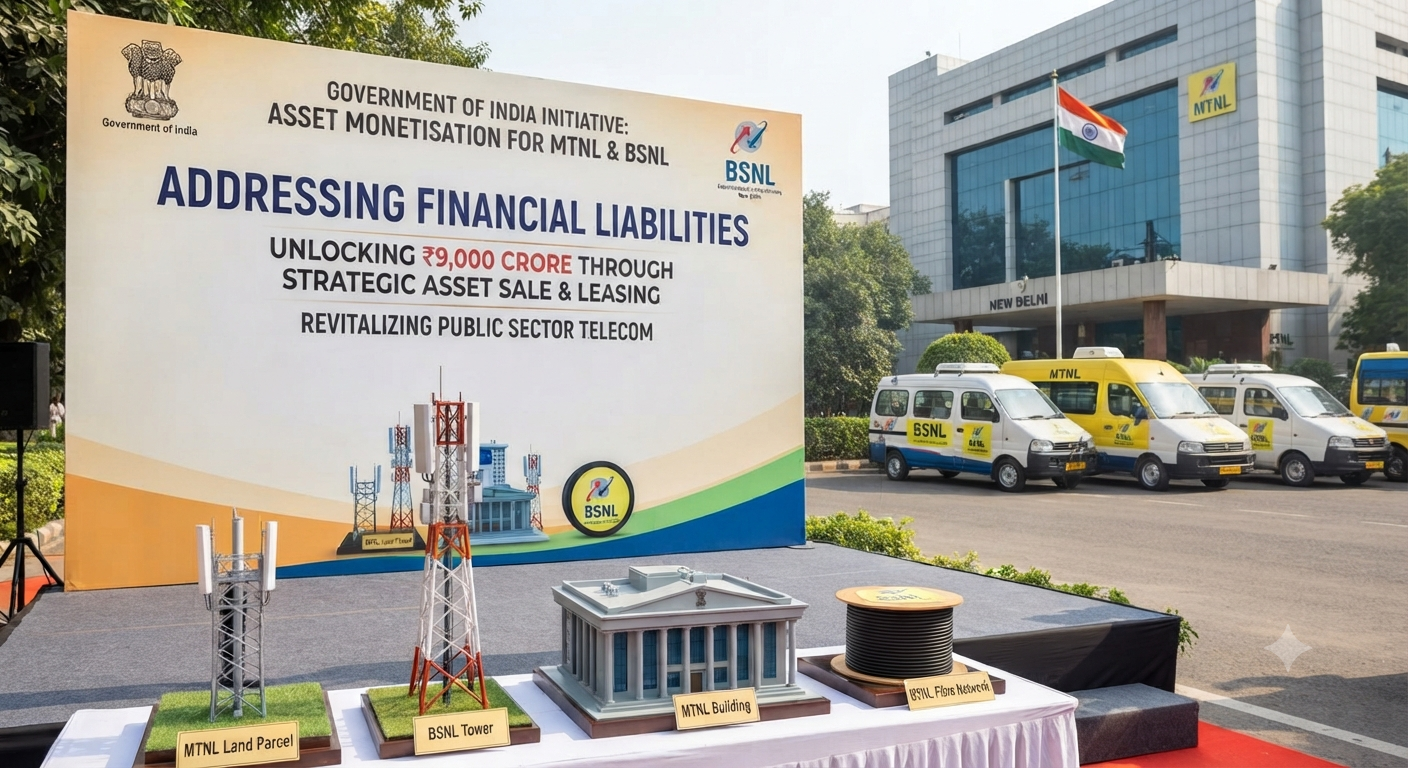
The Government of India is preparing a major asset monetisation initiative targeting ₹9,000 crore in FY2027–28 to address the financial liabilities of state-owned telecommunications companies Mahanagar Telephone Nigam Limited (MTNL) and Bharat Sanchar Nigam Limited (BSNL). The proposed initiative aims to unlock the value of surplus land and property assets, generate financial resources and strengthen the financial position of the country’s public-sector telecom companies.
According to reports citing government sources, the asset monetisation programme will form part of a broader strategy to manage the financial obligations of telecom and other public-sector enterprises. The combined liabilities of the concerned telecom and postal public-sector undertakings have been estimated at approximately ₹50,000 crore, including sovereign-guaranteed bonds worth around ₹30,000 crore.
The initiative comes as the government continues efforts to improve the financial sustainability of its telecom companies while strengthening their ability to compete in India’s rapidly evolving telecommunications market.
₹9,000 Crore Monetisation Target for FY2027–28
The proposed ₹9,000 crore target represents an important step in the government’s efforts to unlock value from underutilised public assets.
The monetisation programme is expected to focus primarily on surplus land, buildings and other non-core properties owned by government telecommunications entities.
For MTNL, the government has reportedly identified around 40 properties with clear ownership documentation that can be considered for monetisation. Resolving property ownership issues has been an important part of preparing these assets for sale.
According to reports, MTNL’s land assets worth approximately ₹9,000 crore are being targeted for monetisation during FY2027–28. The proceeds are expected to help reduce the company’s financial burden and meet its debt-related obligations. telecom.economictimes.indiatimes.com+1
The government is also developing an ongoing asset monetisation pipeline, with an estimated ₹4,000 crore to ₹5,000 crore targeted annually to support financial obligations across relevant public-sector entities.
MTNL and BSNL Face Financial Challenges
MTNL and BSNL have historically played an important role in India’s telecommunications development, providing mobile, broadband, fixed-line and enterprise connectivity services.
However, increasing competition from private telecom operators, substantial infrastructure requirements, employee-related expenses and legacy financial obligations have created significant challenges for the two companies.
MTNL, which primarily operates in Delhi and Mumbai, has faced particularly serious financial difficulties. Its debt and liabilities have placed pressure on its ability to meet financial commitments.
Reports indicate that MTNL has faced repayment difficulties with several public-sector banks. The company has also relied significantly on income generated through property rentals to support certain operational expenses.
BSNL, meanwhile, continues to focus on expanding its network capabilities, strengthening its 4G services and preparing for next-generation telecommunications requirements.
The proposed asset monetisation programme is intended to unlock financial value from surplus properties without requiring the companies to depend entirely on additional government financial assistance.
National Land Monetisation Corporation to Play a Key Role
The National Land Monetisation Corporation (NLMC), established under the Ministry of Finance, is expected to play an important role in implementing the asset monetisation programme.
The corporation is responsible for facilitating the identification, valuation, management and monetisation of surplus land and non-core assets belonging to central public-sector enterprises and government departments.
Under the proposed process, properties will undergo ownership verification, documentation checks, independent valuation and other necessary due diligence before being offered to potential buyers.
Properties with clear titles and completed documentation will be prioritised to improve transaction efficiency and attract prospective investors.
Depending on the nature of the transaction and applicable approvals, assets may be offered through competitive auctions or other permitted sale arrangements.
The government has also emphasised the importance of transparent procedures and proper valuation to ensure that public assets generate appropriate economic value.
Resolving Long-Standing Property Ownership Issues
One of the major challenges facing the government’s asset monetisation programme has been the complicated ownership of land and buildings across different public-sector departments.
In several cases, properties occupied by the Department of Telecommunications (DoT), BSNL, MTNL and the Department of Posts have involved overlapping occupation arrangements and incomplete ownership documentation.
To address these issues, government departments have undertaken extensive verification and reconciliation of property records. Reports indicate that ownership arrangements covering approximately 862 properties have been settled over the past two years.
The government is also working to complete pending land-record mutations and obtain the necessary No Objection Certificates (NOCs) between departments.
These measures are expected to reduce legal complications and make more properties eligible for monetisation.
Asset Monetisation to Support Debt Reduction
The primary objective of the initiative is to unlock the financial value of surplus public assets and use the proceeds to address existing liabilities.
For financially stressed telecom companies, reducing debt-related pressure could create greater flexibility to focus on infrastructure improvements, network modernisation and service expansion.
However, the government has clarified that it does not intend to sell capital assets simply to finance routine revenue expenditure such as salaries and operational costs. Instead, the focus is on using monetisation proceeds for appropriate financial and asset-management objectives.
This distinction is important because asset monetisation should strengthen the long-term financial position of public-sector enterprises rather than provide only temporary relief from recurring expenditure.
Opportunities for India’s Telecommunications Sector
The proposed programme comes at a critical time for India’s telecommunications industry.
The rapid expansion of 5G, growing demand for high-speed broadband, increasing data consumption and the development of digital infrastructure are transforming the sector.
BSNL is working to strengthen its market position through indigenous 4G technology deployment and network expansion. MTNL’s operations and financial restructuring remain important considerations in the broader government strategy for public-sector telecommunications.
Reducing financial pressure could help create a more stable environment for infrastructure planning and operational improvements.
At the same time, the government will need to ensure that the monetisation of surplus properties does not affect essential telecom infrastructure, network expansion or the delivery of public services.
The effective management of these assets could also attract private investment and encourage more productive utilisation of underused government land.
Outlook: Financial Restructuring and Telecom Modernisation
The ₹9,000 crore asset monetisation target reflects the government’s continued efforts to address the financial challenges of public-sector enterprises through structured asset management.
The success of the programme will depend on completing property documentation, securing necessary approvals, attracting buyers and achieving appropriate valuations.
For MTNL and BSNL, the larger objective extends beyond reducing financial liabilities. Both companies need to strengthen their operational efficiency, improve customer experience and remain relevant in an increasingly competitive telecommunications market.
As India advances towards a more digitally connected economy, the financial sustainability of its public telecom companies will remain an important policy consideration.
The coming financial years will therefore be significant in determining how effectively asset monetisation can support debt management while allowing these enterprises to focus on their long-term telecommunications responsibilities.
The Worldonomics Times View
The government’s proposed ₹9,000 crore asset monetisation programme represents an important development in the financial restructuring of India’s public-sector telecommunications industry.
The Worldonomics Times believes that unlocking value from surplus land and underutilised properties can provide MTNL and BSNL with additional financial resources while improving the utilisation of public assets.
However, asset monetisation should be viewed as one component of a broader restructuring strategy, not a complete solution to the financial challenges facing these companies.
The long-term sustainability of MTNL and BSNL will depend on their ability to improve operational efficiency, modernise infrastructure, strengthen customer services and compete in an increasingly technology-driven telecom market.
Equally important is the need for transparent property valuations, competitive sale procedures and responsible utilisation of the proceeds. Essential telecom infrastructure and strategically important assets must be protected to ensure that financial restructuring does not compromise future network development.
The Worldonomics Times believes that the real success of this initiative will be measured not simply by the ₹9,000 crore raised, but by how effectively the funds contribute to financial stability, better asset utilisation and the modernisation of India’s public telecommunications sector.
India’s digital economy requires reliable and competitive telecommunications infrastructure. Ensuring that MTNL and BSNL remain financially and operationally sustainable will therefore be important for the country’s broader digital development.