New Delhi | October 26, 2026
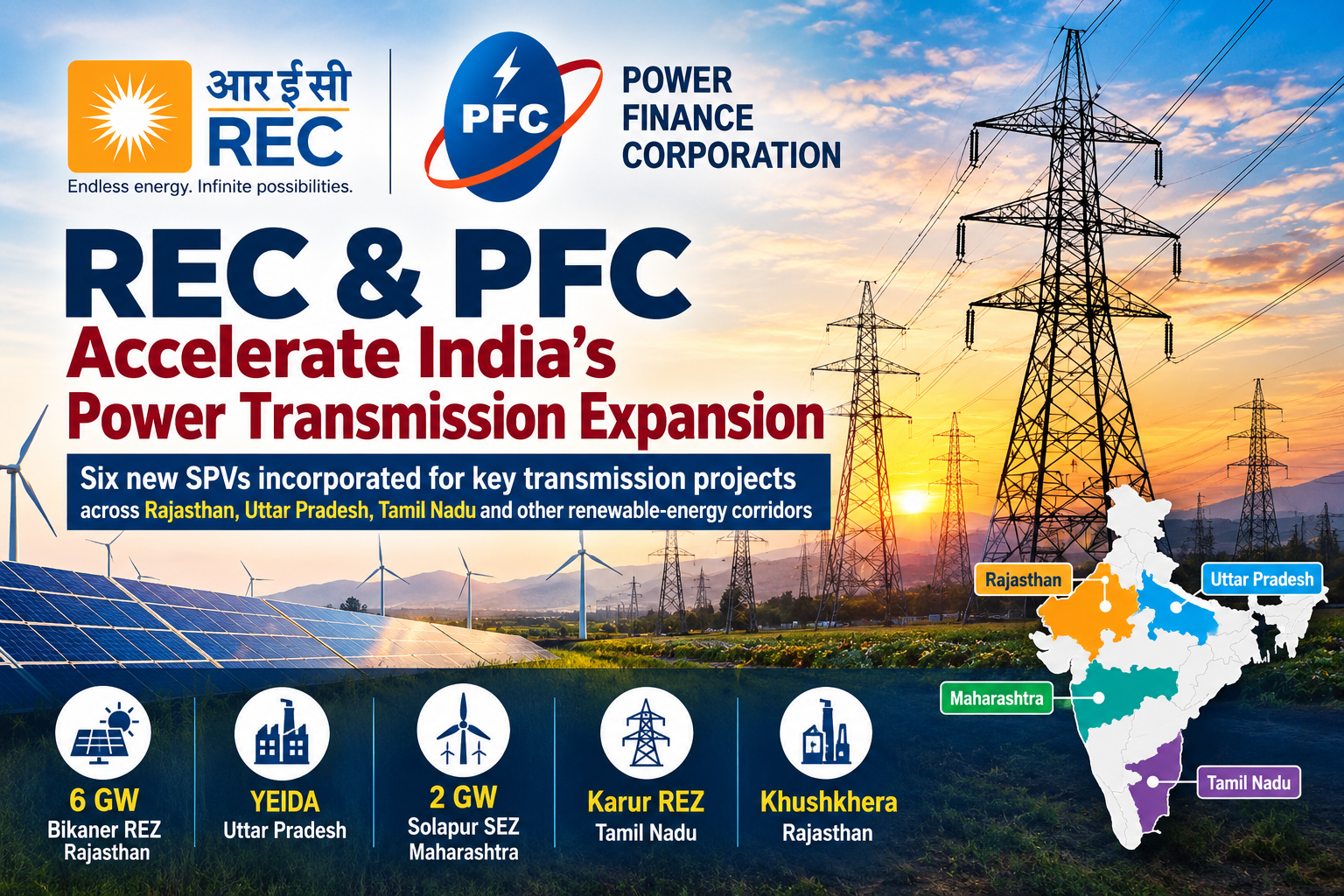
India’s power transmission infrastructure is receiving another major push as REC Limited and Power Finance Corporation (PFC) have incorporated six new project-specific Special Purpose Vehicles (SPVs) to facilitate the development of transmission systems across Rajasthan, Uttar Pradesh, Tamil Nadu and other renewable-energy corridors.
The latest move highlights the growing importance of transmission infrastructure in India’s energy transition. As the country adds large volumes of solar, wind and other renewable-energy capacity, the ability to evacuate electricity from generation-rich regions to major consumption centres is becoming as important as generation itself.
Six New SPVs to Drive Transmission Development
Three of the newly incorporated entities have been established through REC Power Development and Consultancy Limited (RECPDCL), a wholly owned subsidiary of REC Limited. These are:
- Bikaner V Part C Power Transmission Limited
- Bikaner V Part D Power Transmission Limited
- YEIDA Power Transmission Limited
The Bikaner V Part C and Part D SPVs are linked to the transmission scheme for evacuation of power from the Rajasthan Renewable Energy Zone (REZ) Phase-IV, Part-6, covering the Bikaner-V complex with a planned renewable-energy capacity of around 6 GW.
The development is strategically important because Rajasthan has emerged as one of India’s largest renewable-energy hubs. Large-scale solar and wind projects in the state require high-capacity transmission corridors to move electricity to demand centres across India.
The third REC-backed entity, YEIDA Power Transmission Limited, has been incorporated for a transmission project in Uttar Pradesh’s Yamuna Expressway Industrial Development Authority area. The project involves the establishment of a 400/220 kV, 3×500 MVA gas-insulated substation at Sector-28, YEIDA, together with associated transmission lines and bays.
PFC Expands Transmission Project Pipeline
On the PFC side, three SPVs have been incorporated through PFC Consulting Limited (PFCCL), a wholly owned subsidiary of Power Finance Corporation.
The entities are:
- Solapur SEZ Power Transmission Limited
- Karur REZ Power Transmission Limited
- Khushkhera Transmission Limited
Solapur SEZ Power Transmission Limited has been created for the evacuation of electricity from renewable-energy projects in Solapur SEZ, Phase-II, involving approximately 2 GW of renewable capacity. It will also support network expansion to facilitate power drawal from the Solapur pooling station.
Karur REZ Power Transmission Limited has been established for strengthening the transmission system at Karur pooling station and integrating renewable-energy generation capacity.
Meanwhile, Khushkhera Transmission Limited will facilitate development of an intra-state transmission system around the 400 kV GSS Bhojrajka (Khushkhera) in Rajasthan. The planned infrastructure includes a new 400/220 kV, 2×500 MVA substation and associated transmission-line works.
SPV Model: Preparing Projects Before Developer Selection
The incorporation of these companies represents an important feature of India’s transmission-development model.
REC’s RECPDCL and PFC’s PFCCL act as Bid Process Coordinators (BPCs) for transmission projects. The SPVs are established at the initial stage so that important preparatory activities can begin before the final project developer is selected.
These activities can include surveys, land-related work, statutory approvals and other preparatory requirements.
Once the competitive bidding process is completed, the project-specific SPV is transferred to the successful developer. This allows the winning transmission service provider to take over a project that has already progressed through key preparatory stages.
Recent activity demonstrates how actively this model is being used. In October 2026, RECPDCL handed over Lakadia II Power Transmission Limited to Power Grid Corporation of India Limited and Jam Khambhaliya Jamnagar Power Transmission Limited to Ceigall India Limited after tariff-based competitive bidding.
Why Transmission Has Become a Strategic Priority
India’s renewable-energy ambitions are creating a fundamental shift in the country’s electricity network.
Solar and wind resources are not distributed evenly across India. Rajasthan and Gujarat, for example, possess substantial renewable-energy potential, while major electricity demand is concentrated around industrial, commercial and urban centres.
This geographical mismatch makes transmission infrastructure essential.
A large solar park can generate thousands of megawatts of electricity, but without adequate transmission capacity, generation can face evacuation constraints. New substations, high-voltage lines, pooling stations and inter-state transmission systems therefore form the backbone of India’s renewable-energy expansion.
The Bikaner projects are particularly significant in this context. The Rajasthan REZ programme is designed to facilitate evacuation of large-scale renewable generation, making transmission investment a critical enabler of the country’s clean-energy targets.
REC and PFC: Financing Meets Infrastructure Development
The developments also underline the expanding role of REC and PFC beyond their traditional identity as power-sector financiers.
Both institutions have become important participants in the development and facilitation of India’s electricity infrastructure.
While their core businesses remain centred on financing power-sector projects, their subsidiaries are increasingly involved in project development, consultancy and transmission-bidding activities.
This creates an ecosystem in which financing institutions can also help create a pipeline of bankable infrastructure projects.
For investors and the wider power sector, this could mean greater visibility of upcoming transmission opportunities across renewable-energy zones, industrial corridors and rapidly developing urban regions.
Supporting India’s Renewable-Energy Transition
India’s energy transition is not simply a question of installing more renewable-generation capacity. It requires simultaneous investment in generation, transmission, storage, distribution and grid-management systems.
The six new SPVs created by REC and PFC represent the transmission component of this larger transition.
The projects will help connect renewable-energy resources with the national and regional grid while supporting industrial development and increasing the reliability and flexibility of electricity networks.
With renewable-energy capacity continuing to expand, India’s transmission requirements are expected to grow substantially in the coming years. The establishment of project-specific SPVs by REC and PFC indicates that preparations for this next phase of grid expansion are already underway.
The Road Ahead
The latest incorporations are more than routine corporate filings. They represent early-stage building blocks for India’s future power network.
From the renewable-energy corridors of Rajasthan and Solapur to the industrial growth area around YEIDA and the transmission strengthening planned around Karur, the projects cover different aspects of India’s evolving electricity requirements.
For REC, PFC, transmission developers, infrastructure companies and power-sector investors, the growing pipeline of transmission projects could create significant opportunities in engineering, procurement and construction, equipment supply, financing and long-term operation.
As India moves towards a more renewable-intensive electricity system, the transmission grid will increasingly determine how efficiently clean power can reach consumers.
The message is clear: India’s energy transition will require not only more power generation, but also a stronger grid capable of carrying that power across the country. REC and PFC’s six new SPVs are another step in building that grid.