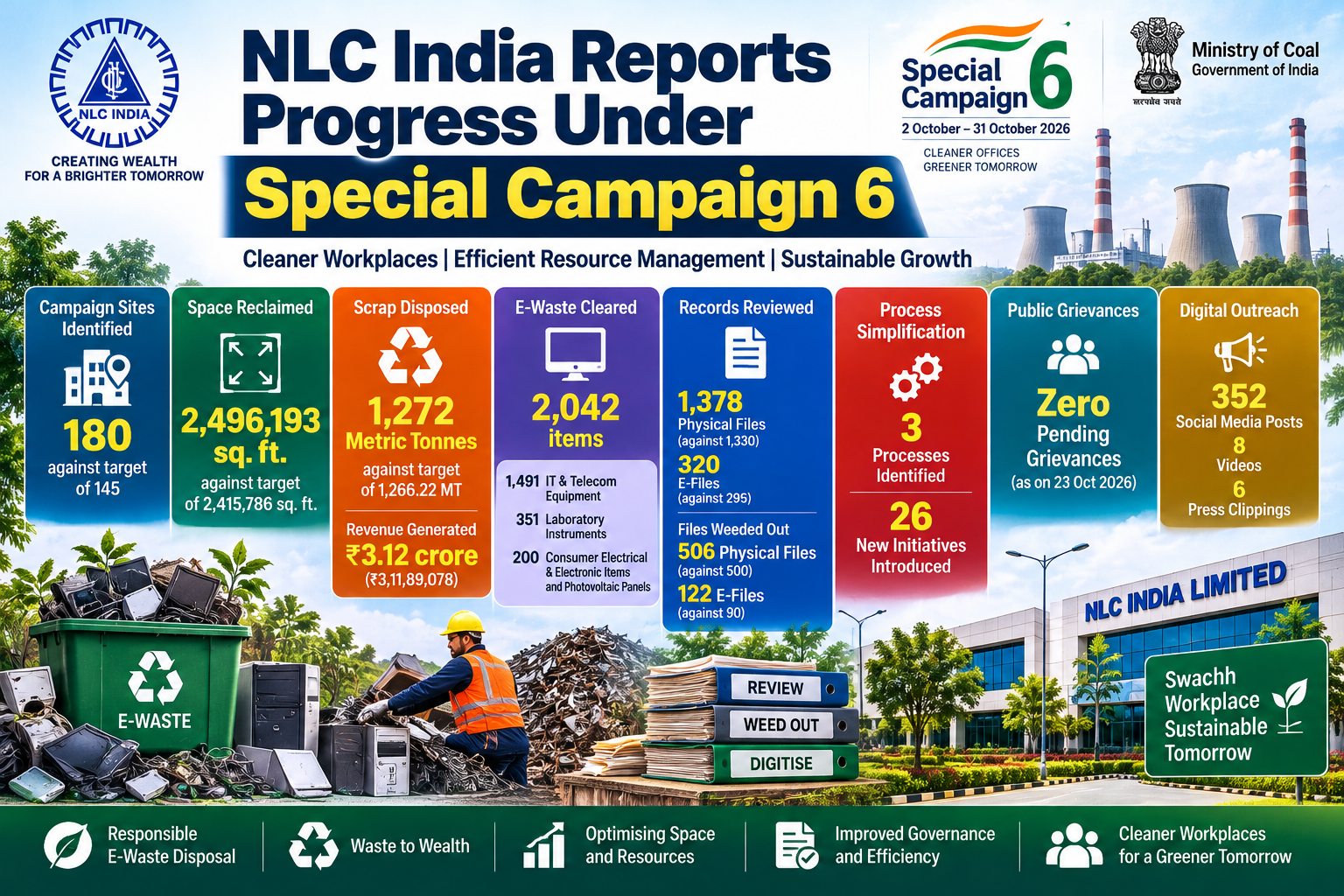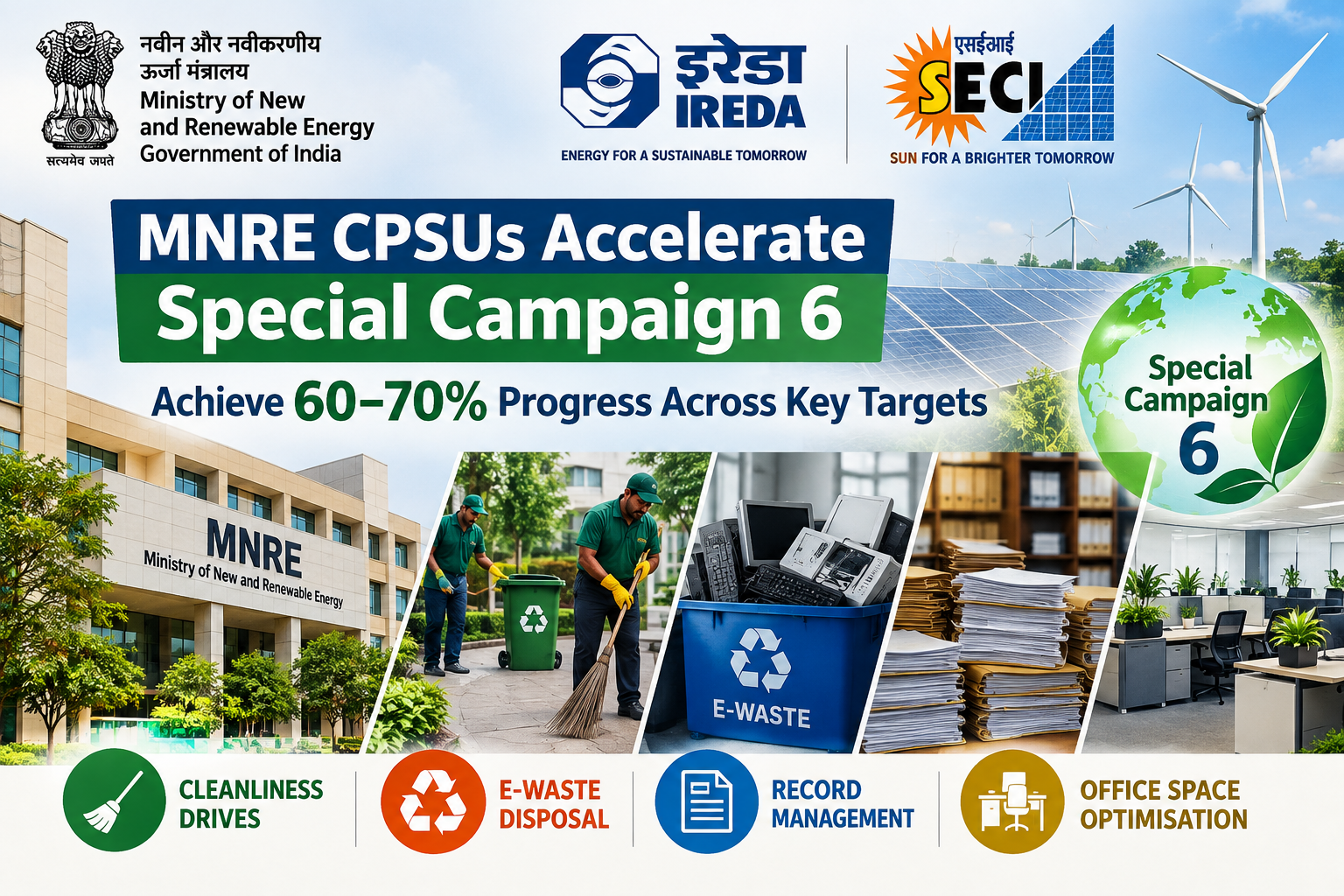
New Delhi, October 27, 2026: The Ministry of New and Renewable Energy (MNRE) and its Central Public Sector Enterprises (CPSEs) are stepping up efforts under Special Campaign 6, with several organisations reporting significant progress in cleanliness, disposal of obsolete materials, e-waste management, record management and optimisation of office space.
The campaign reflects the Government of India’s broader emphasis on improving workplace efficiency, institutional cleanliness and responsible management of public assets. MNRE and its associated public-sector organisations are working to complete identified activities within the campaign framework, with progress across several parameters reported in the 60–70% range.
Focus on Cleanliness and Better Workplace Management
Special Campaign 6 places considerable emphasis on cleanliness drives across government offices and establishments. MNRE and its CPSEs are undertaking systematic cleanliness activities covering office premises, common areas and other identified locations.
Beyond routine cleanliness, the campaign seeks to create a more efficient working environment by removing obsolete material and ensuring that available office infrastructure is used effectively.
The initiative also encourages organisations to identify areas where accumulated records, unused equipment and scrap are occupying valuable space. Their systematic disposal can help improve workplace productivity while reducing maintenance and storage requirements.
E-Waste Disposal Gains Importance
One of the important components of the campaign is the disposal of electronic waste. Government offices and public-sector organisations generate significant quantities of obsolete computers, electronic equipment, peripherals and other electrical and electronic material over time.
MNRE’s campaign activities therefore include identification and disposal of e-waste through appropriate channels. Proper e-waste management is particularly important for renewable-energy and technology-focused organisations, where digital infrastructure and electronic equipment form an important part of operations.
Responsible disposal also supports environmental objectives by reducing the risks associated with improper handling of electronic waste and encouraging recycling and resource recovery.
Record Management and Space Optimisation
Another major area under Special Campaign 6 is record management. Ministries and CPSEs are reviewing physical records and identifying files that can be weeded out in accordance with applicable rules.
This process can reduce the burden of maintaining large volumes of physical documentation and free up space for productive use.
Office-space optimisation is similarly receiving attention. By removing obsolete material and reorganising existing infrastructure, organisations can potentially make better use of available premises without requiring additional space.
Role of MNRE CPSEs
MNRE’s public-sector ecosystem includes organisations such as Indian Renewable Energy Development Agency (IREDA) and Solar Energy Corporation of India (SECI), which play important roles in India’s renewable-energy development.
The participation of these organisations in Special Campaign 6 adds an operational dimension to the Government’s broader sustainability agenda. While their core mandate focuses on renewable energy, their internal administrative practices are also being aligned with principles of resource efficiency, cleanliness and responsible disposal.
Towards More Efficient Public Institutions
The progress achieved so far indicates that Special Campaign 6 is not limited to a one-time cleanliness exercise. Its broader objective is to institutionalise better practices in government offices and public-sector organisations.
The campaign brings together cleanliness, asset management, e-waste disposal, record management and space optimisation as interconnected elements of administrative efficiency.
For MNRE and its CPSEs, successful implementation can also reinforce the message that the transition towards a cleaner and more sustainable economy needs to be reflected not only in their external programmes but also in their own organisational operations.
With approximately 60–70% progress reported against identified campaign targets, the coming phase will focus on completing the remaining activities and consolidating the improvements achieved.
The initiative demonstrates how public-sector organisations can combine operational efficiency with environmental responsibility, supporting the Government’s wider objective of building cleaner, more efficient and resource-conscious public institutions.
— The Worldonomics Times | PSU & Government Sector Desk