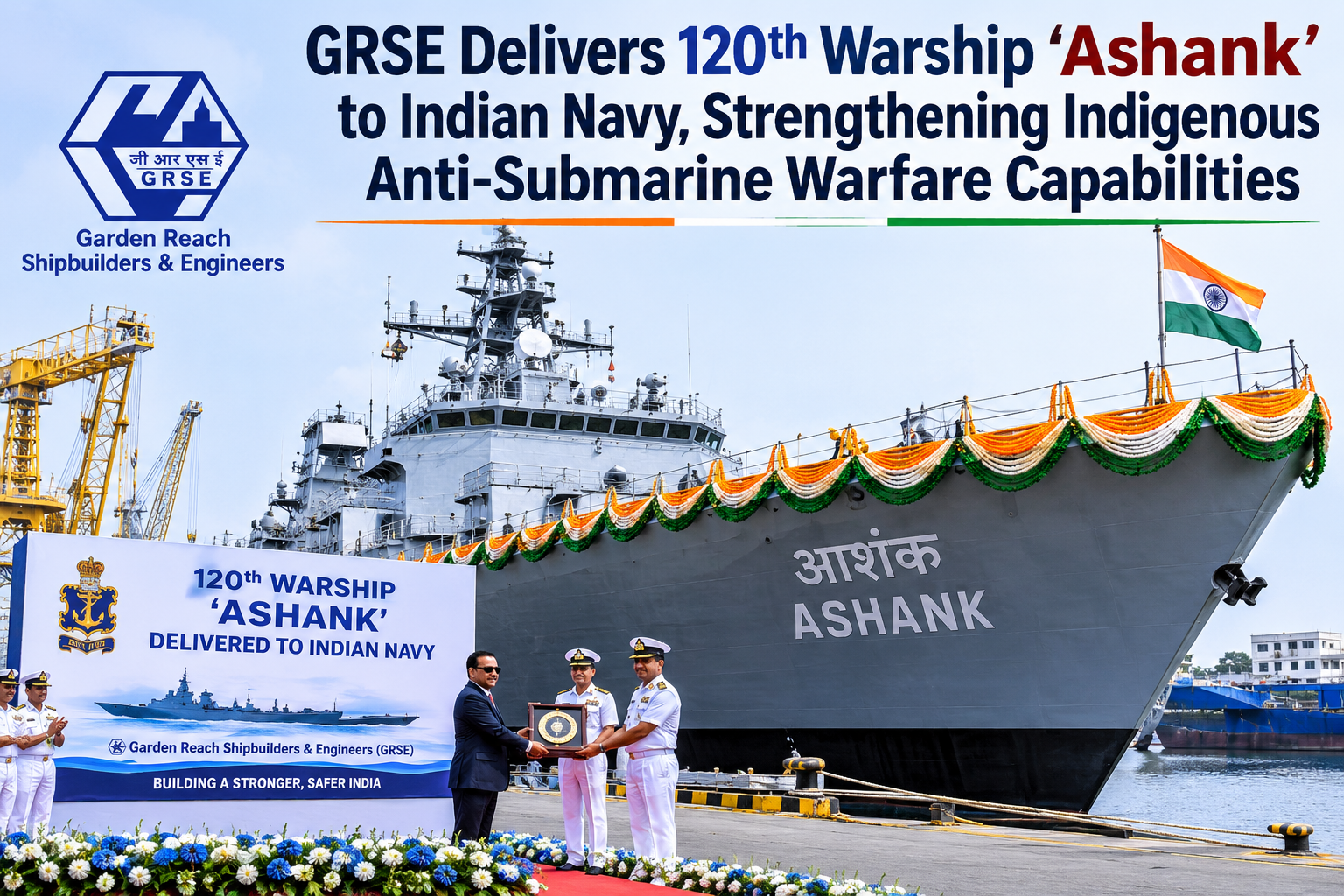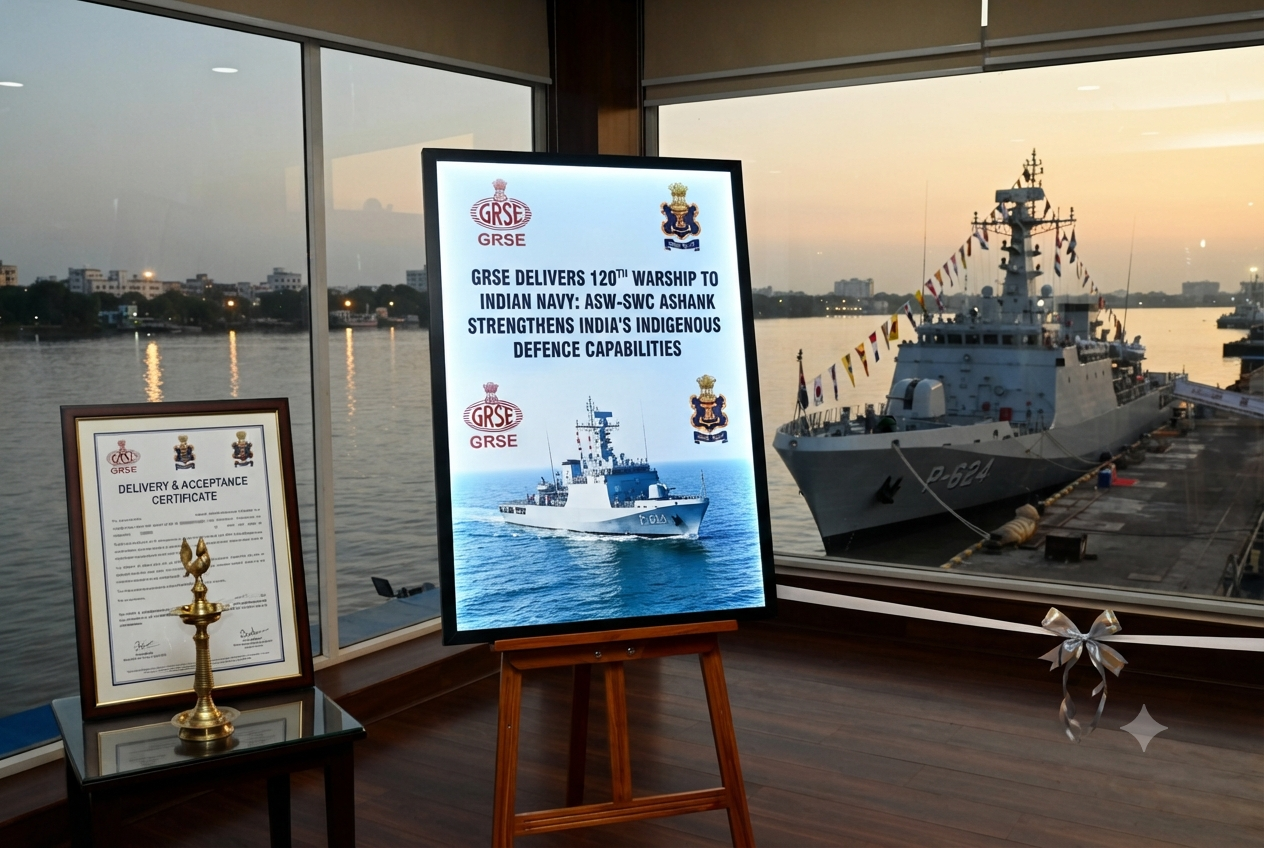
India has achieved another milestone in indigenous defence manufacturing as Garden Reach Shipbuilders & Engineers (GRSE) delivered its 120th warship, the Anti-Submarine Warfare Shallow Water Craft (ASW-SWC) Ashank, to the Indian Navy. The delivery, completed on 23 November 2026, highlights the growing capabilities of India’s domestic shipbuilding industry and its contribution to strengthening maritime security.
The latest achievement reinforces GRSE’s position as one of India’s leading defence shipbuilders and supports the Government’s broader vision of Aatmanirbhar Bharat, which aims to increase domestic manufacturing and reduce dependence on imported defence equipment.
GRSE Achieves Major Warship-Building Milestone
The delivery of Ashank marks an important moment in GRSE’s long-standing contribution to India’s naval development. With this achievement, the Kolkata-based defence public sector undertaking has built 120 warships, of which 82 have been delivered to the Indian Navy.
The vessel was formally accepted by Rear Admiral Gautam Marwaha, VSM, Chief Staff Officer (Technical), Headquarters Eastern Naval Command.
The delivery also demonstrates the shipyard’s ability to maintain momentum across its naval construction programme. Ashank was handed over just 18 days after GRSE delivered another ASW-SWC, Amini, on 5 November 2026. This marked the company’s second warship delivery within the same month.
GRSE’s achievement reflects decades of experience in naval shipbuilding, engineering and the integration of advanced maritime technologies. Its growing production capacity is becoming increasingly important as India works to modernise its naval fleet and strengthen its presence across strategically important maritime regions.
Ashank: Strengthening Anti-Submarine Warfare Capabilities
Ashank is an Anti-Submarine Warfare Shallow Water Craft designed specifically for operations in coastal waters and other shallow maritime environments.
Submarines operating close to coastlines can present complex security challenges because of varying water depths, underwater terrain and the difficulty of detecting submerged vessels. Specialised shallow-water platforms help naval forces monitor these areas and respond to potential underwater threats.
The vessel is equipped with advanced sonar systems, lightweight torpedoes and indigenous rocket launchers. These capabilities are designed to support underwater surveillance and anti-submarine warfare operations.
The platform also contributes to coastal surveillance and mine-warfare capabilities. Its waterjet propulsion system provides the speed and manoeuvrability required for operations in littoral waters.
The name Ashank signifies fearlessness and an undaunted spirit, reflecting the vessel’s intended role in protecting India’s maritime frontiers.
With its specialised equipment and operational design, the craft will strengthen the Indian Navy’s ability to monitor underwater activity and safeguard important coastal areas.
Indigenous Technology at the Centre of Development
One of the most significant aspects of the ASW-SWC programme is its high level of indigenous content. According to GRSE’s announcement, the vessels incorporate approximately 88% indigenous content, highlighting the contribution of Indian manufacturers and technology suppliers.
The platform also features a 30mm Naval Surface Gun manufactured by GRSE.
The programme demonstrates the growing ability of India’s domestic defence industry to design, manufacture and integrate sophisticated systems into frontline naval platforms. This involves coordination among shipbuilders, equipment manufacturers, engineering companies and technology providers.
Indigenous production offers several strategic advantages. It can reduce dependence on foreign suppliers, improve the availability of maintenance support and create opportunities for domestic research and development.
It can also strengthen the participation of small and medium-sized enterprises in the defence supply chain, generating employment and supporting industrial growth.
For India, developing these capabilities is particularly important in a global environment where access to advanced military technology can be affected by geopolitical tensions, export restrictions and supply-chain disruptions.
GRSE’s Expanding Shipbuilding Order Book
The delivery of Ashank comes as GRSE continues to work on a substantial portfolio of naval and commercial vessel projects.
The shipyard is currently constructing 12 frontline naval platforms. These include one Project 17A Advanced Stealth Frigate, two ASW-SWCs, four Next Generation Offshore Patrol Vessels and five Next Generation Corvettes.
In addition, GRSE is building 36 other vessels, including 13 export platforms.
This diversified project portfolio demonstrates the company’s role beyond domestic naval procurement. Its activities also contribute to India’s broader shipbuilding industry and international maritime manufacturing presence.
The ability to execute multiple complex projects simultaneously will be important for meeting delivery schedules, maintaining quality standards and strengthening the company’s competitiveness.
Boost to India’s Defence Manufacturing Ecosystem
India has increasingly prioritised domestic defence production as part of its long-term national security and industrial development strategy.
Warship construction is particularly important because it involves a wide range of specialised industries, including steel production, electronics, propulsion systems, sensors, communication equipment and advanced engineering.
Every major shipbuilding project creates demand across several layers of the industrial ecosystem. Domestic suppliers gain opportunities to improve their technical capabilities, while research institutions and manufacturers can develop expertise in specialised technologies.
The successful delivery of Ashank therefore represents more than an addition to the Indian Navy’s fleet. It also reflects progress in building a stronger domestic defence manufacturing base.
As India’s maritime responsibilities expand, reliable local shipbuilding capacity will remain essential for maintaining naval readiness and supporting long-term fleet modernisation.
The Worldonomics Times View
The Worldonomics Times believes that GRSE’s delivery of its 120th warship is an important indicator of India’s growing industrial and technological capabilities in the defence sector.
The achievement demonstrates that domestic shipyards are increasingly capable of delivering specialised naval platforms equipped with advanced systems. The high indigenous content of the ASW-SWC programme is particularly encouraging because it supports domestic suppliers and strengthens India’s control over critical defence capabilities.
However, the long-term success of India’s defence manufacturing ambitions will depend on more than delivery milestones. Consistent product quality, timely project execution, technological innovation and investment in research and development will be equally important.
India must also continue strengthening its supply chain for advanced sensors, propulsion systems, electronics and other critical components. Greater collaboration between public-sector shipyards, private manufacturers and technology companies can help accelerate this progress.
GRSE’s expanding order book provides an opportunity to strengthen domestic production while improving India’s position in the international shipbuilding market.
Conclusion
The delivery of Ashank marks a significant milestone for GRSE and India’s indigenous naval shipbuilding programme. With 120 warships built and 82 delivered to the Indian Navy, the company continues to play an important role in strengthening the country’s maritime capabilities.
Equipped for anti-submarine warfare and incorporating a substantial level of indigenous technology, Ashank adds to the Indian Navy’s operational strength in coastal waters.
As GRSE advances its ongoing projects, the company’s contribution will remain important to India’s defence modernisation, industrial development and Aatmanirbhar Bharat objectives. The latest delivery sends a strong message about the growing potential of India’s domestic defence manufacturing ecosystem.